

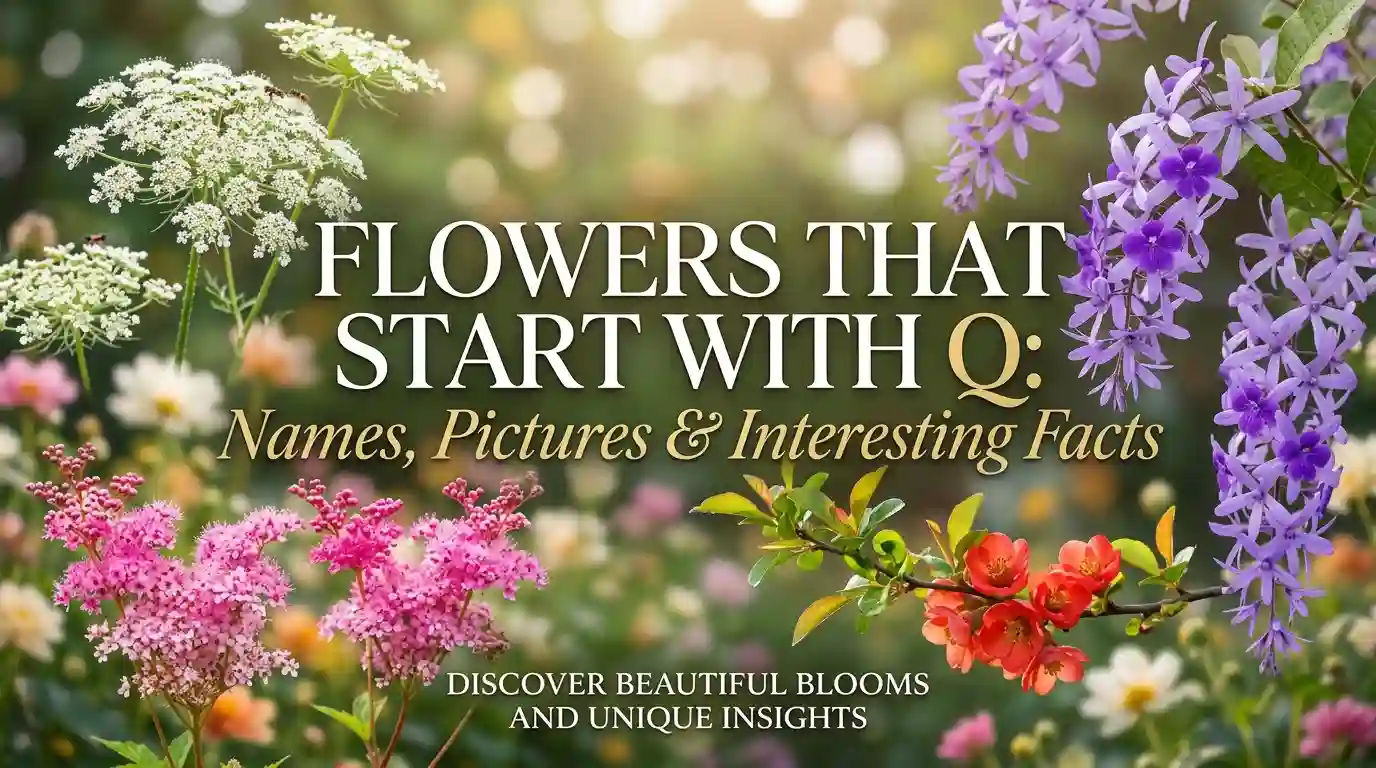
Flowers that start with Q are genuinely rare compared to almost any other letter. That scarcity actually makes this guide more useful, not less, since a shorter list means every entry deserves real detail instead of a rushed one-liner buried in a long scroll.
This guide sorts flowers that start with Q by growing context first, not alphabet order. Sun needs, shade tolerance, bloom speed, and skill level all come before any A-Z list. That structure gets you to a usable answer faster than scanning a name index from top to bottom.
The tone stays practical throughout. Easy plants get called easy. A couple of entries here also carry a safety note worth knowing before planting, including one flower that’s frequently mistaken for a genuinely poisonous look-alike. Nothing gets inflated just to pad out a short letter.
A full alphabetical index, a botanical name crosswalk, and a toxicity table sit near the end for quick reference. But the growing-context sections that follow are where the real planning value lives, especially given how few dedicated resources exist for this particular letter.
Quick Take: Where to Start
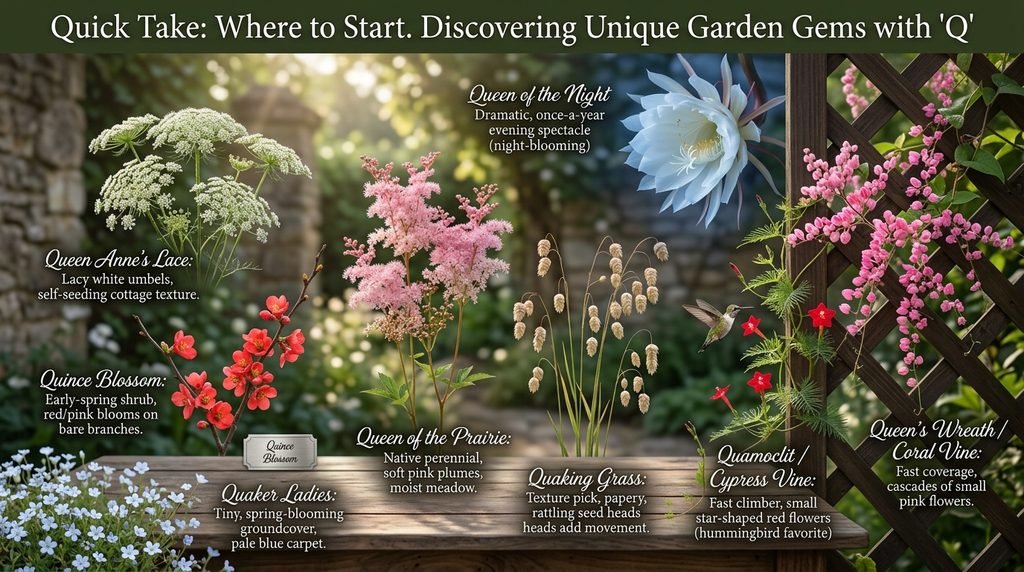
Queen Anne’s Lace solves the wild, cottage-garden texture problem better than almost any cultivated flower. Its lacy white umbels self-seed readily and pair well with almost any color scheme. Quince Blossom works differently. It’s an early-spring flowering shrub that produces red, pink, or coral blooms on bare branches before most other shrubs have even budded.
Queen’s Wreath, more commonly sold as Coral Vine, brings fast, vigorous coverage to a fence or trellis in warm climates, producing cascades of small pink flowers through summer and fall. Quamoclit, better known as Cypress Vine, climbs quickly and produces small, star-shaped red flowers that hummingbirds find almost immediately.
Queen of the Night, a night-blooming cactus, offers the same dramatic, once-a-year evening spectacle that draws crowds of gardeners who plan their evening around it. Queen of the Prairie earns its spot as a native perennial choice, sending up plumes of soft pink flowers in moist meadow-style plantings.
Quaker Ladies round out the group as the tiny, spring-blooming groundcover pick, carpeting woodland edges in pale blue before most other perennials have started growing. Quaking Grass closes the list as the texture pick — its papery, rattling seed heads add movement to a border that flowers alone can’t provide.
Full-Sun Picks That Hold Their Own
A handful of flowers that start with Q were built for strong, direct light. These work well on a hot fence line, an open meadow-style bed, or any spot that gets sun most of the day.
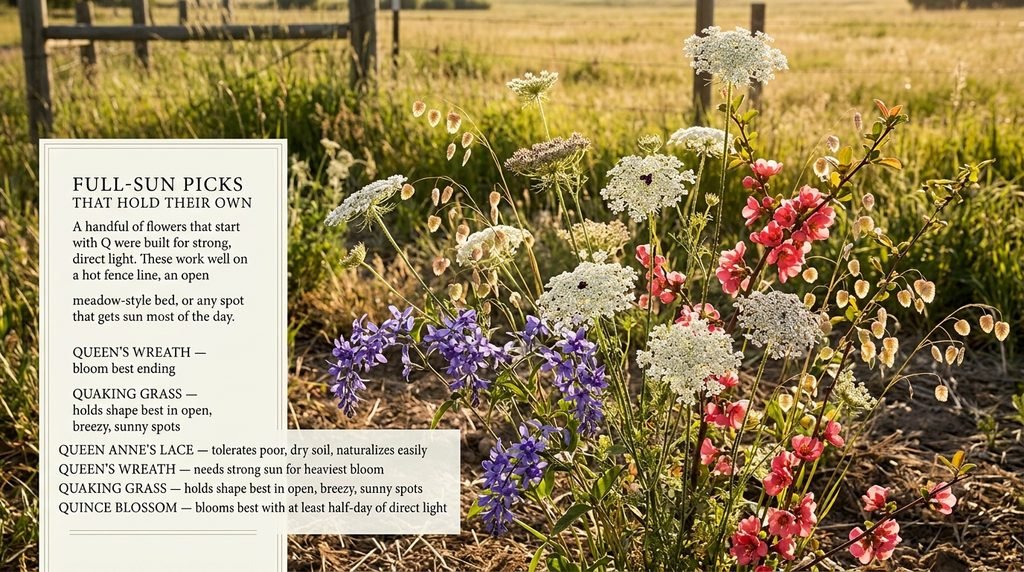
Queen Anne’s Lace tolerates poor, dry soil in full sun better than almost any cultivated flower, which explains why it naturalizes so easily along roadsides and neglected field edges. Queen’s Wreath needs strong sun to produce its heaviest bloom, and it slows down noticeably in anything less than a half day of direct light. Quaking Grass also prefers full sun, holding its shape and rattling seed heads best in an open, breezy spot rather than a sheltered corner.
- Queen Anne’s Lace — tolerates poor, dry soil, naturalizes easily
- Queen’s Wreath — needs strong sun for its heaviest bloom
- Quaking Grass — holds shape best in open, breezy, sunny spots
- Quince Blossom — blooms best with at least a half day of direct light
Quince Blossom rounds out this group. It tolerates a bit more shade than the others listed here, but its flower production drops off noticeably once light falls much below a half day of direct sun.
Shade and Partial-Shade Options
Shade narrows this list down to just a few reliable choices, but the ones that do prefer it are genuinely useful for woodland-style plantings.
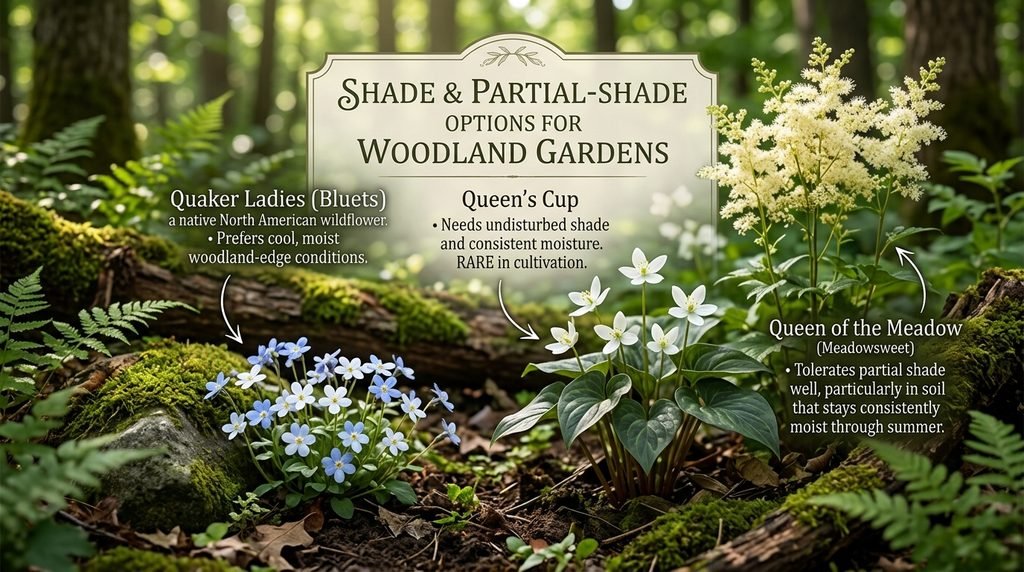
Quaker Ladies, a native North American wildflower also called Bluets, prefers the cooler, more even moisture found at a woodland edge over an open, sun-baked bed. Queen’s Cup, a small native lily relative, needs consistent shade and moist, undisturbed soil to establish, making it a poor fit for a bed that gets tilled or replanted often. Queen of the Meadow, a common name for Meadowsweet, tolerates partial shade well, particularly in soil that stays consistently moist through summer.
- Quaker Ladies — prefers cool, moist woodland-edge conditions
- Queen’s Cup — needs undisturbed shade and consistent moisture
- Queen of the Meadow — tolerates partial shade in moist soil
Queen’s Cup deserves a specific note here. It’s genuinely uncommon in cultivation and closer to a native wildflower find than a typical nursery purchase, so patience and the right site matter more than active care once it’s planted.
Fast Bloomers Versus Slow Payoff
Bloom speed shifts which flowers that start with Q make sense for a short-timeline project. A few reward you within weeks; others ask for years.
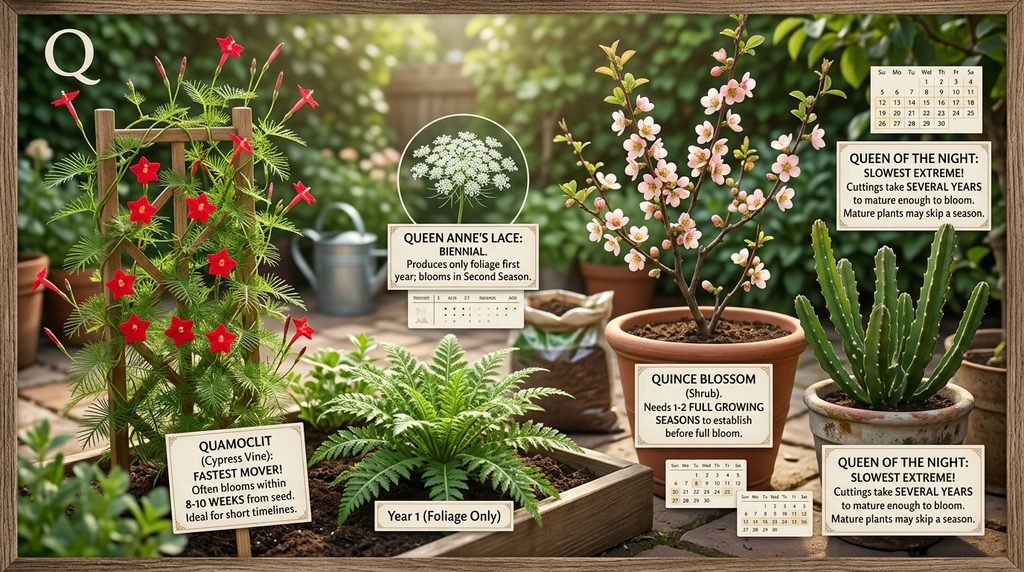
Quamoclit is the fastest mover in this group by a wide margin, often producing its first blooms within eight to ten weeks of direct sowing, which makes it a strong choice for gardeners starting later in the season. Queen Anne’s Lace, grown as a biennial in most climates, produces only foliage in its first year and doesn’t flower until its second season, which surprises gardeners expecting quick results from a seed packet.
Queen of the Night sits at the opposite extreme entirely. A cutting-grown plant can take several years to mature enough for its first bloom, and even mature plants may skip a season depending on conditions. Quince Blossom, grown as a shrub, typically needs one to two full growing seasons to establish before flowering reaches its full potential. Anyone working against a tight deadline should lean toward Quamoclit rather than these slower picks.
What Actually Holds Up With Minimal Care
A couple of flowers that start with Q tolerate real neglect, which matters most for a first-time grower who wants results without a strict schedule.
Queen Anne’s Lace is the standout here. It naturalizes readily, tolerates poor soil, and often shows up on its own in a neglected corner without any deliberate planting at all. Quaking Grass is nearly as forgiving, since its ornamental seed heads persist through dry spells that would wilt a typical flowering annual.
- Queen Anne’s Lace — naturalizes easily, tolerates poor soil and neglect
- Quaking Grass — persists through dry spells better than typical annuals
The tradeoff with both is a lack of showiness. Neither delivers the bold, saturated color of a typical bedding plant, but both ask for almost nothing in return.
The One Worth a Careful Look
This letter doesn’t carry a large group of genuinely dangerous flowers, but one entry deserves a specific caution that goes beyond typical toxicity.
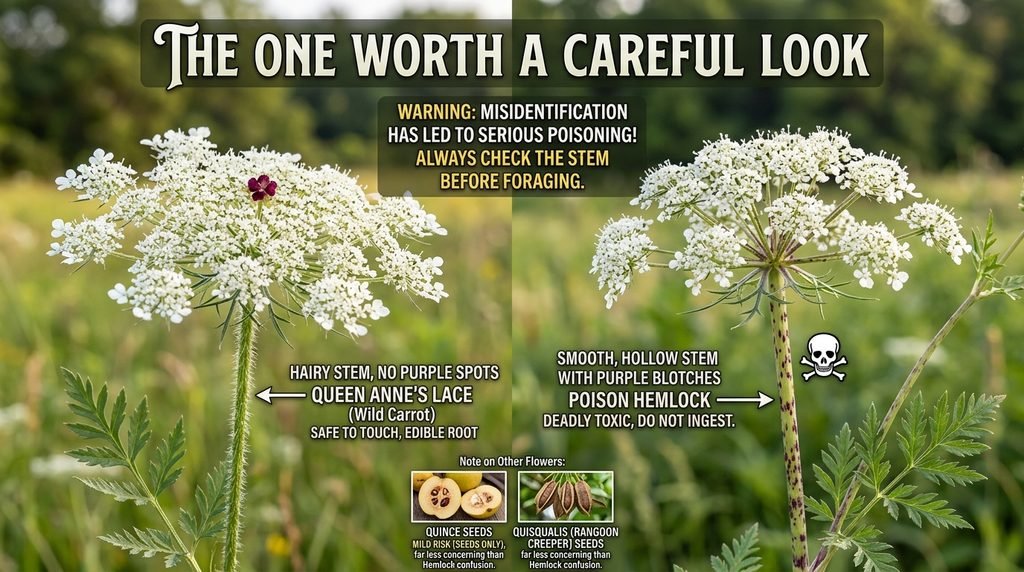
Queen Anne’s Lace looks almost identical to poison hemlock, a genuinely deadly plant, during certain growth stages. The two share similar lacy white flower clusters and fern-like foliage, and misidentification has led to serious poisoning cases when people mistake hemlock for the edible wild carrot that Queen Anne’s Lace actually is. The safest way to tell them apart involves checking the stem — Queen Anne’s Lace has fine hairs and no purple blotching, while poison hemlock has smooth, hollow stems marked with purple spots. Anyone foraging rather than simply growing this flower ornamentally should treat that identification step as non-negotiable.
- Queen Anne’s Lace — safe itself, but easily confused with deadly poison hemlock
- Quince seeds — mildly toxic if crushed and eaten in quantity, similar to apple seeds
- Quisqualis (Rangoon Creeper) seeds — can cause hiccups or nausea if eaten in excess
Quince and Quisqualis both carry a mild risk limited mainly to their seeds rather than their flowers, which makes them far less concerning than the identification issue tied to Queen Anne’s Lace.
A Companion Planting Guide
Companion planting works for a few of these pairings, mostly around pollinator traffic and shared growing needs rather than pest deterrence specifically. A few flowers that start with Q have partners worth knowing before laying out a bed.
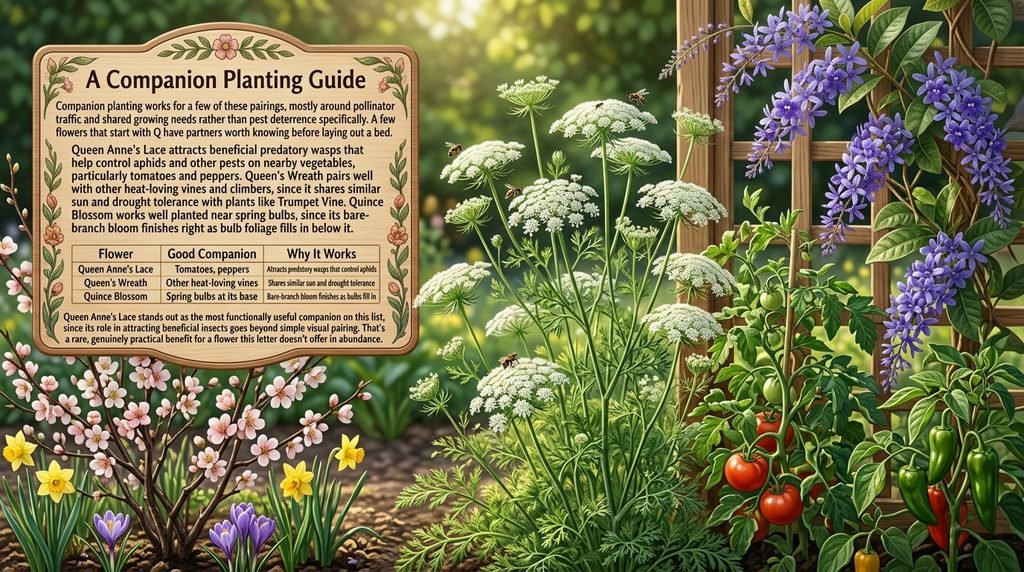
Queen Anne’s Lace attracts beneficial predatory wasps that help control aphids and other pests on nearby vegetables, particularly tomatoes and peppers. Queen’s Wreath pairs well with other heat-loving vines and climbers, since it shares similar sun and drought tolerance with plants like Trumpet Vine. Quince Blossom works well planted near spring bulbs, since its bare-branch bloom finishes right as bulb foliage fills in below it.
| Flower | Good Companion | Why It Works |
| Queen Anne’s Lace | Tomatoes, peppers | Attracts predatory wasps that control aphids |
| Queen’s Wreath | Other heat-loving vines | Shares similar sun and drought tolerance |
| Quince Blossom | Spring bulbs at its base | Bare-branch bloom finishes as bulbs fill in |
Queen Anne’s Lace stands out as the most functionally useful companion on this list, since its role in attracting beneficial insects goes beyond simple visual pairing. That’s a rare, genuinely practical benefit for a flower this letter doesn’t offer in abundance.
A Season-by-Season Care Calendar
Timing matters for the handful of flowers that start with Q worth planning around closely. The calendar below covers the top picks from the Quick Take section.
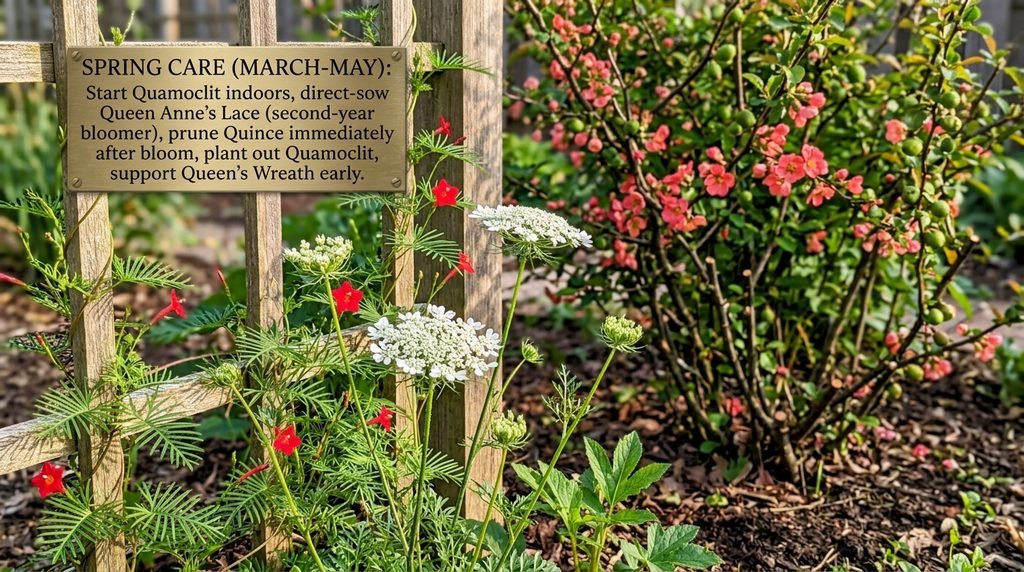
March: Start Quamoclit seeds indoors in cooler climates, since this vine needs warm soil to germinate reliably outdoors.
April: Direct-sow Queen Anne’s Lace once frost risk has passed, remembering it won’t flower until its second year. Prune Quince Blossom immediately after its spring bloom finishes, not before.
May: Plant out Quamoclit seedlings once nights stay reliably warm. Provide climbing support for Queen’s Wreath early, before the vine gets tangled on its own.
June: Watch Quamoclit for rapid growth and redirect it onto its support structure as needed. Deadhead spent Queen Anne’s Lace blooms if self-seeding beyond the intended area is a concern.
September: This is a reasonable window to divide or transplant established Queen of the Prairie clumps before cooler weather sets in.
October: Bring potted Queen of the Night cactus indoors before the first frost if it spent the growing season outside.
The most useful timing note for this letter involves patience rather than a specific date. Queen Anne’s Lace won’t flower in its first year no matter when it’s planted, and gardeners expecting first-season blooms are often disappointed by a plant that’s actually performing exactly as it should.
Mistakes Beginners Make With This Letter
A few errors show up repeatedly with flowers that start with Q, and most trace back to unfamiliarity rather than any real difficulty growing them.
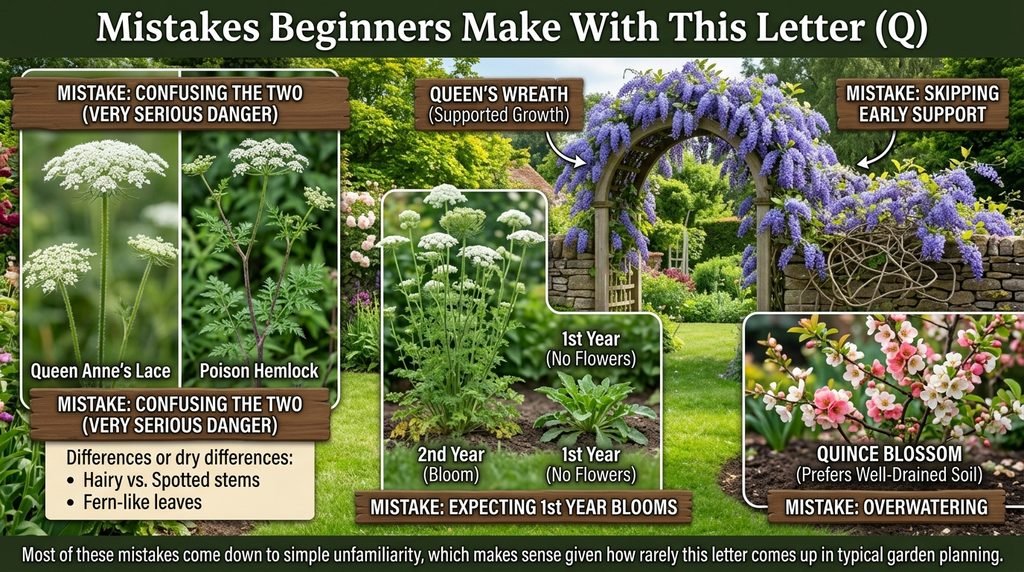
Misidentifying poison hemlock as Queen Anne’s Lace is the most serious mistake possible with this letter, given the real danger the look-alike poses if foraged or handled carelessly. Expecting Queen Anne’s Lace to bloom in its first year is a much more common, lower-stakes mistake, since the plant simply needs a second season to flower. Letting Queen’s Wreath grow unsupported is another frequent issue, since the vine’s fast growth quickly becomes tangled without an early trellis or fence to guide it.
- Confusing Queen Anne’s Lace with poison hemlock during foraging or identification
- Expecting first-year blooms from a biennial Queen Anne’s Lace planting
- Skipping early support structures for fast-growing Queen’s Wreath
- Overwatering Quince Blossom, which prefers well-drained soil over consistently wet conditions
Most of these mistakes come down to simple unfamiliarity, which makes sense given how rarely this letter comes up in typical garden planning.
Where to Actually Buy These
Availability is limited across this entire letter compared to almost any other. Queen Anne’s Lace is the most widely available, often sold as a wildflower seed mix component or found growing naturally along roadsides and field edges rather than purchased as a potted plant. Quince Blossom is reasonably available at nurseries that carry flowering shrubs, particularly in early spring.
Queen of the Night, Queen’s Wreath, and Quamoclit typically require a specialty nursery, a cactus and succulent supplier, or a mail-order seed source rather than a general garden center. Queen’s Cup and Quaker Ladies are harder still, usually found only through native-plant specialty growers given how uncommon they are outside their native range. This entire letter sits closer to the specialty-order end of the spectrum than almost any other in this series.
If You Only Have Room for a Couple
Given how short this letter runs, a curated shortlist matters even more than usual. Queen Anne’s Lace takes the first spot without much competition, since it delivers wild, cottage-garden texture with almost no ongoing effort once established. Quince Blossom earns the second spot as the most reliable, widely available flowering shrub on this list, rewarding patience with genuine early-spring color.
A third pick depends entirely on climate and space. Gardeners in warm regions with a fence or trellis to fill should choose Queen’s Wreath for fast, vigorous coverage. Anyone with room for a container and the patience for a rare evening event should choose Queen of the Night instead.
Handling These Safely
This letter carries less overall toxicity risk than most others, but two specific notes deserve attention. Queen Anne’s Lace itself is safe and even edible in its root form, resembling a thin, fibrous wild carrot, but its resemblance to deadly poison hemlock makes correct identification essential before any foraging. Quince seeds contain small amounts of cyanogenic compounds, similar to apple seeds, and are only a concern if crushed and eaten in unusually large quantities.
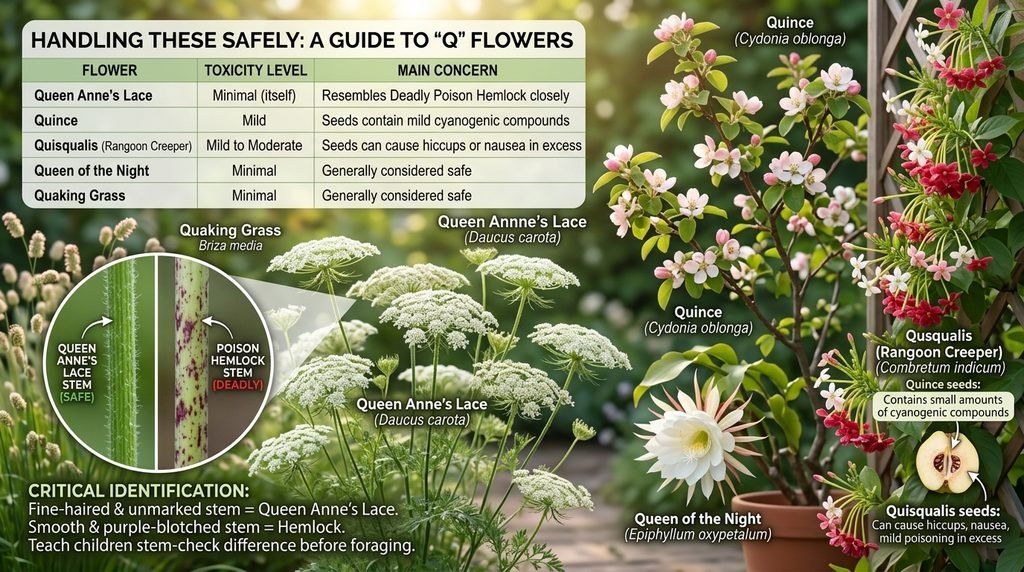
Quisqualis, or Rangoon Creeper, has a more specific caution tied to its seeds, which have been used historically in some traditional remedies but can cause hiccups, nausea, or mild poisoning symptoms if eaten in excess. None of the flowers covered in this guide approach the severity seen in some other letters, but the hemlock look-alike issue with Queen Anne’s Lace deserves to be treated seriously regardless.
| Flower | Toxicity Level | Main Concern |
| Queen Anne’s Lace | Minimal (itself) | Resembles deadly poison hemlock closely |
| Quince | Mild | Seeds contain mild cyanogenic compounds |
| Quisqualis (Rangoon Creeper) | Mild to moderate | Seeds can cause hiccups or nausea in excess |
| Queen of the Night | Minimal | Generally considered safe |
| Quaking Grass | Minimal | Generally considered safe |
The identification risk tied to Queen Anne’s Lace matters more than any true toxicity concern on this list. Anyone gardening with children should teach the stem-check difference — smooth and purple-blotched means hemlock, fine-haired and unmarked means Queen Anne’s Lace — well before either plant is anywhere near a curious hand.
Sorting These Flowers by Color
Color options run thinner across this letter than most others, but a few genuine standouts exist in each category.
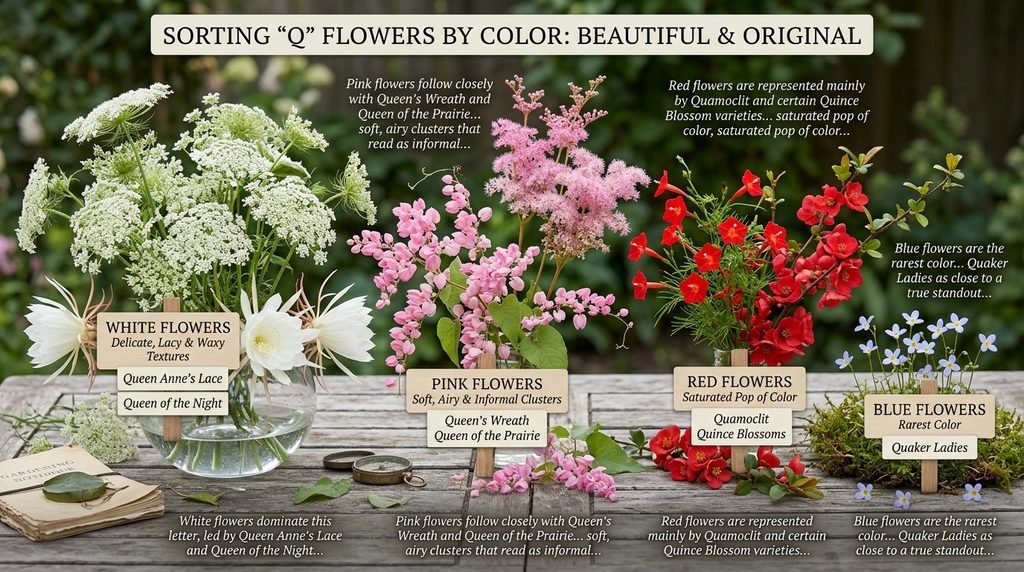
White flowers dominate this letter, led by Queen Anne’s Lace and Queen of the Night, both offering delicate, lacy or waxy textures rather than bold solid petals. Pink flowers follow closely with Queen’s Wreath and Queen of the Prairie, both producing soft, airy clusters that read as informal rather than structured. Red flowers are represented mainly by Quamoclit and certain Quince Blossom varieties, both bringing a saturated pop of color that stands out against this letter’s otherwise pale-dominant palette. Blue flowers are the rarest color in this group, with Quaker Ladies as close to a true standout as this letter offers.
Full Name Index
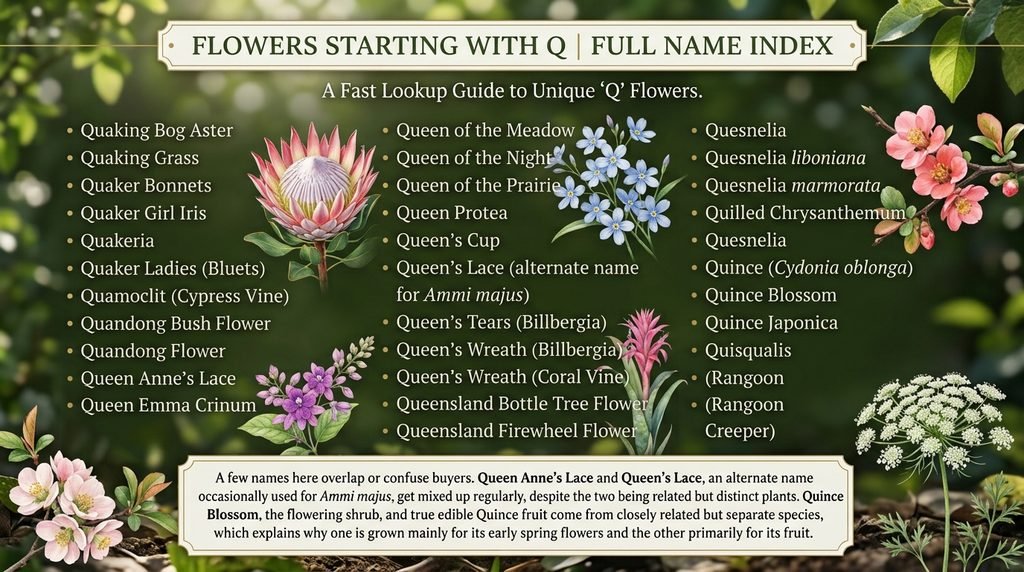
The list below rounds up the flowers that start with Q worth knowing, mixing common names with botanical genus names. Detailed growing notes for the most relevant entries appear in the sections above; this index exists purely as a fast lookup.
- Queen Anne’s Lace
- Queen of the Night
- Queen of the Prairie
- Queen of the Meadow
- Quince Blossom
- Quaking Grass
- Quamoclit (Cypress Vine)
- Quaker Ladies (Bluets)
- Queen’s Wreath (Coral Vine)
- Queen’s Cup
- Quesnelia
- Queen Protea
- Quandong Flower
- Quaker Bonnets
- Quince (Cydonia oblonga)
- Queensland Firewheel Flower
- Queen’s Tears (Billbergia)
- Quilled Chrysanthemum
- Quaker Girl Iris
- Quisqualis (Rangoon Creeper)
- Queen Emma Crinum
- Quandong Bush Flower
- Quesnelia marmorata
- Quaking Bog Aster
- Queen’s Lace (alternate name for Ammi majus)
- Quesnelia liboniana
- Queensland Bottle Tree Flower
- Quince Japonica
A few names here overlap or confuse buyers. Queen Anne’s Lace and Queen’s Lace, an alternate name occasionally used for Ammi majus, get mixed up regularly, despite the two being related but distinct plants. Quince Blossom, the flowering shrub, and true edible Quince fruit come from closely related but separate species, which explains why one is grown mainly for its early spring flowers and the other primarily for its fruit.
Common Name to Botanical Name Crosswalk
Botanical names matter most when ordering online or confirming a nursery tag, since common names shift by region in ways botanical names don’t. The crosswalk below covers the flowers referenced most throughout this guide.
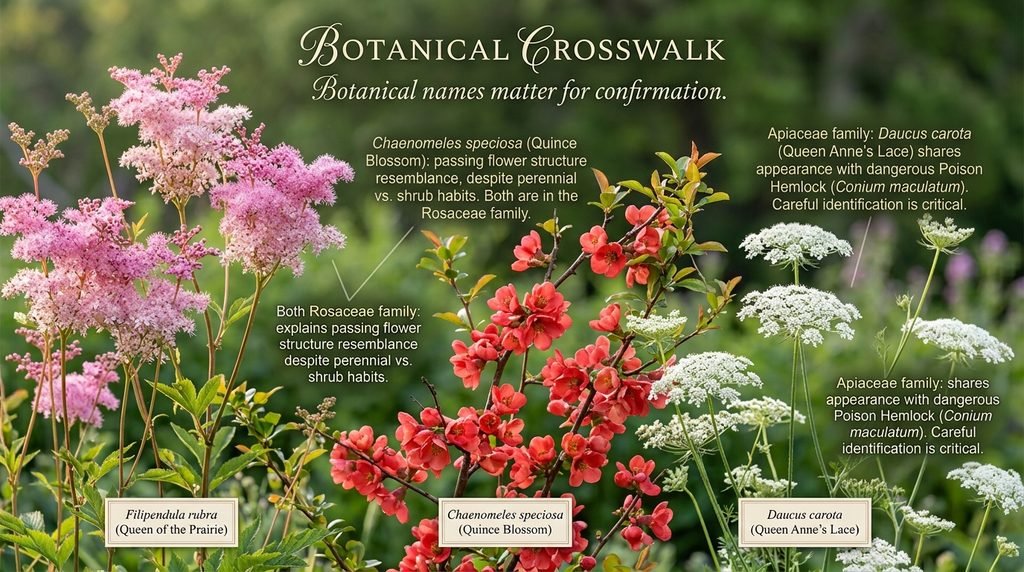
| Common Name | Botanical Name | Family |
| Queen Anne’s Lace | Daucus carota | Apiaceae |
| Queen of the Night | Epiphyllum oxypetalum | Cactaceae |
| Queen of the Prairie | Filipendula rubra | Rosaceae |
| Quince Blossom | Chaenomeles speciosa | Rosaceae |
| Quamoclit | Ipomoea quamoclit | Convolvulaceae |
| Quaker Ladies | Houstonia caerulea | Rubiaceae |
| Queen’s Wreath | Antigonon leptopus | Polygonaceae |
| Quisqualis | Quisqualis indica | Combretaceae |
Queen of the Prairie and Quince Blossom sharing the Rosaceae family explains a passing resemblance in flower structure, despite one being a soft-stemmed perennial and the other a woody shrub. Queen Anne’s Lace belonging to Apiaceae, the same family as poison hemlock, explains exactly why the two plants look so similar and why careful identification matters so much.
What These Flowers Have Meant Through History
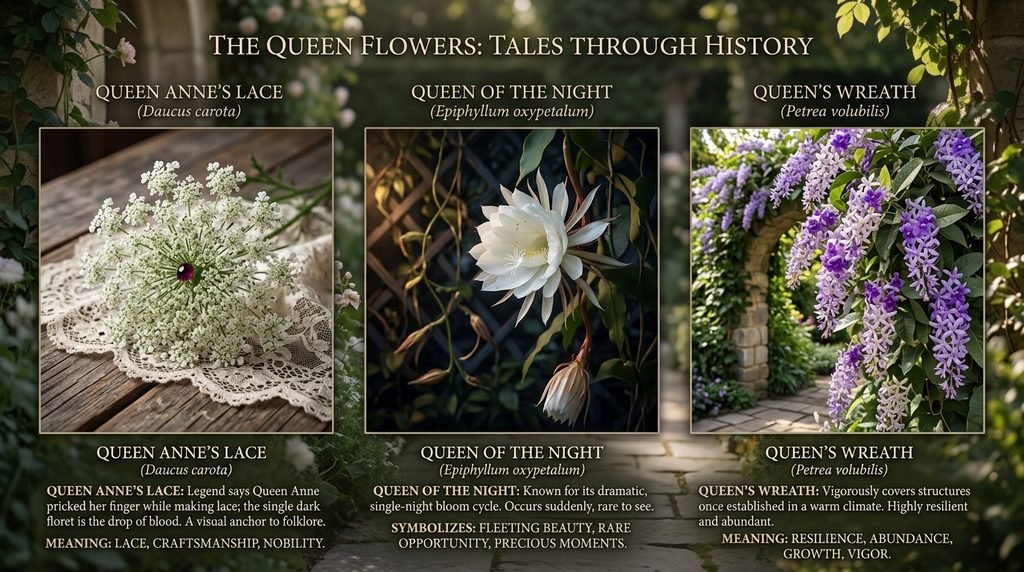
A couple of flowers that start with Q carry stories worth knowing beyond their growing needs. Queen Anne’s Lace takes its name from a legend involving Queen Anne of England, who is said to have pricked her finger while making lace, with a single drop of blood forming the small dark floret often found at the center of the flower’s white cluster. That detail is real and visible on many blooms, giving the legend an unusually literal visual anchor.
Queen of the Night carries meaning tied directly to its behavior rather than folklore. Its single-night bloom cycle has made it a symbol of fleeting beauty and rare opportunity in several cultures, often associated with events too brief to plan around precisely. Queen’s Wreath, less steeped in formal symbolism, has become associated more recently with resilience and abundance, largely because of how vigorously it covers a structure once established in the right climate.
Final Thoughts
Flowers that start with Q may be few in number, but the ones that exist cover real range, from the wild texture of Queen Anne’s Lace to the rare, single-night drama of Queen of the Night. Starting with sun, shade, and skill level makes it far easier to land on the right flowers that start with Q for your specific space, rather than settling for the first name you happen to recognize. Given how short this letter runs, even a single well-chosen pick can genuinely round out a garden that’s missing something the rest of the alphabet doesn’t quite offer.
Frequently Asked Questions
What are the easiest flowers that start with Q for beginners?
Queen Anne’s Lace and Quaking Grass are the most forgiving picks. Both tolerate poor soil and inconsistent care once established.
Is Queen Anne’s Lace dangerous to grow?
The flower itself is safe, but it closely resembles deadly poison hemlock. Careful identification matters if you plan to forage rather than simply grow it ornamentally.
How can I tell Queen Anne’s Lace apart from poison hemlock?
Check the stem. Queen Anne’s Lace has fine hairs and no purple marks, while poison hemlock has smooth, hollow stems with purple blotching.
Why hasn’t my Queen Anne’s Lace bloomed yet?
It’s likely still in its first year. This plant is a biennial and typically doesn’t flower until its second growing season.
What’s the fastest-blooming flower that starts with Q?
Quamoclit, or Cypress Vine, often produces its first blooms within eight to ten weeks of direct sowing.
Can Queen of the Night grow indoors?
Yes, in a bright spot with well-draining soil, though it may take several years to reach flowering maturity as a container plant.
Is Quince fruit related to the flowering Quince shrub?
They’re closely related but distinct species within the same plant family, which is why one is grown mainly for fruit and the other for early spring flowers.
Which flowers that start with Q work well on a trellis or fence?
Queen’s Wreath and Quamoclit both perform well as climbing vines, given consistent sun and a sturdy support structure.
Are Quince seeds safe to handle?
They’re only a concern if crushed and eaten in large quantities, since they contain small amounts of mildly toxic compounds similar to apple seeds.