

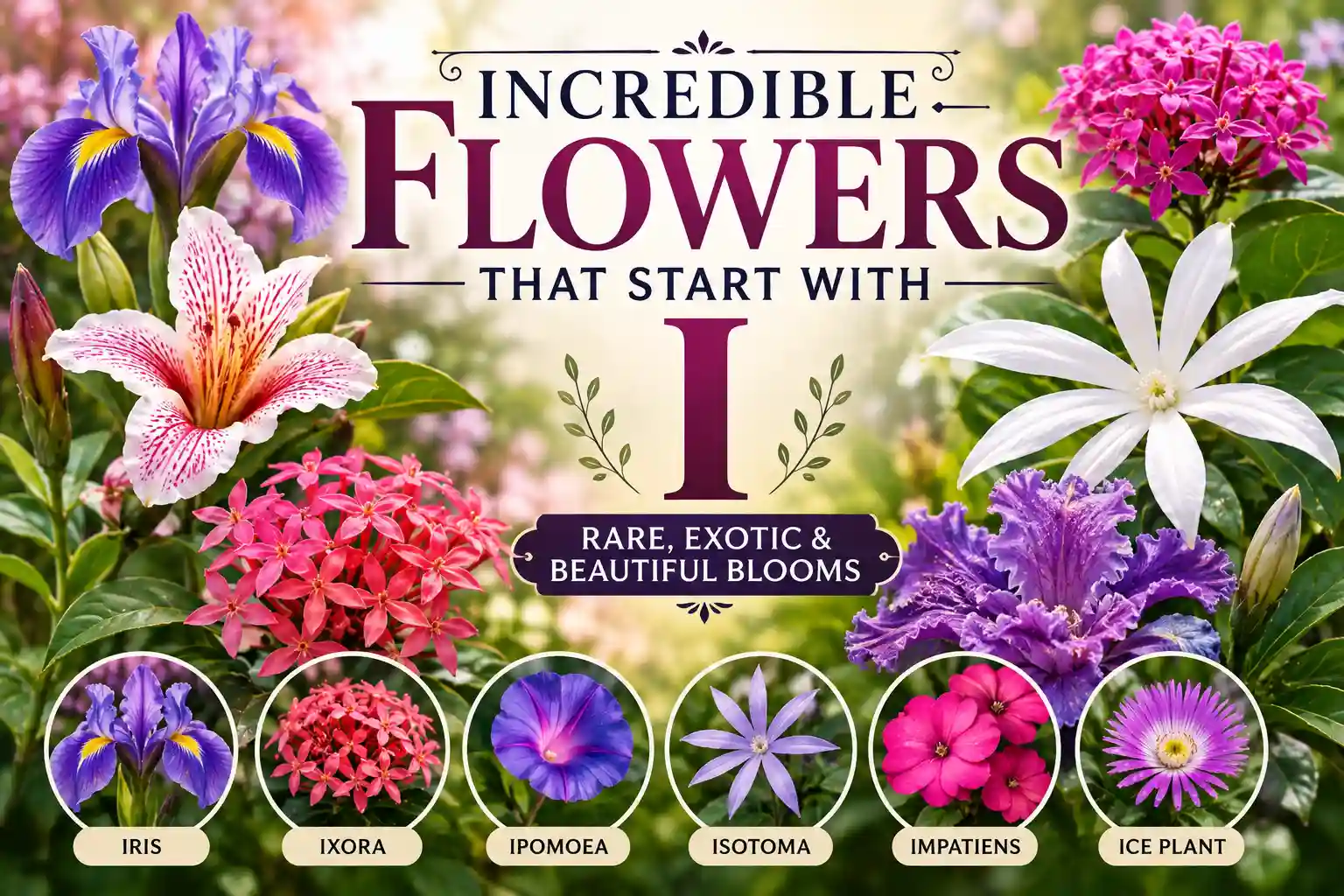
Flowers that start with I cover unusually varied ground — everyday garden staples like Iris and Impatiens sit alongside genuinely exotic picks like Ixora and Impala Lily. Lumping all of them into one flat A-to-Z list flattens that variety and makes the guide harder to actually use when standing in front of an empty flower bed.
This article sorts I-flowers by the practical questions that determine whether a plant thrives: how much sun a spot gets, how quickly color is needed, and whether a beginner can manage the plant without much troubleshooting. That structure lets a reader jump straight to the section that matches their actual yard instead of scanning past two dozen names looking for the right three or four.
The complete alphabetical list of I-flower names still appears in this guide — it’s simply placed near the end, functioning as a quick-reference appendix rather than the article’s main organizing structure. Anyone who already knows what they’re after can skip straight there.
What follows draws on commonly available I-flowers found at nurseries and specialty growers, along with a handful of striking but less mainstream picks for gardeners looking to branch out beyond Iris and Impatiens.
Quick Take: Standout I-Flowers Worth Knowing
These ten make the list for concrete, practical reasons rather than just visual appeal.
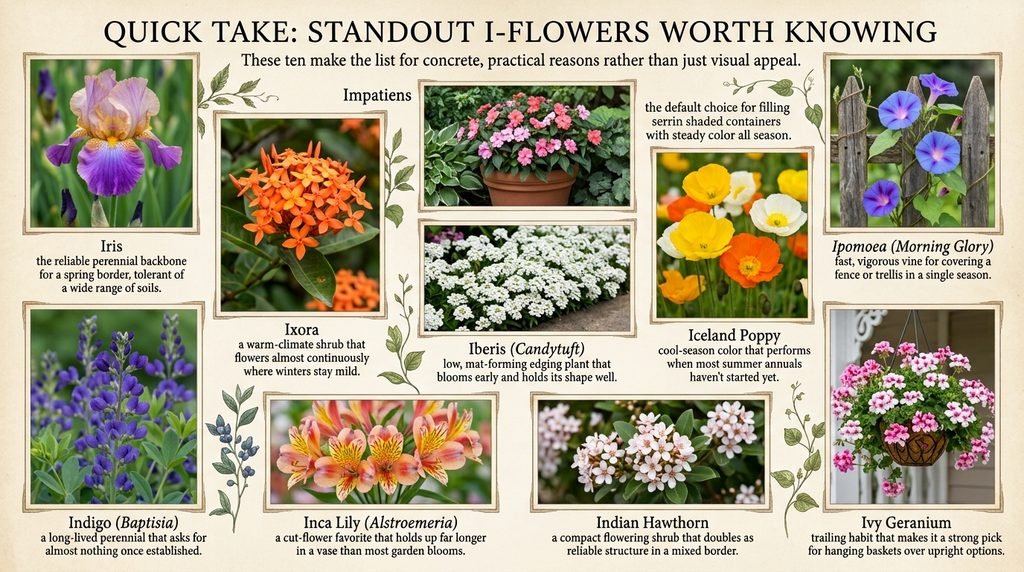
- Iris — the reliable perennial backbone for a spring border, tolerant of a wide range of soils.
- Impatiens — the default choice for filling shaded containers with steady color all season.
- Ipomoea (Morning Glory) — fast, vigorous vine for covering a fence or trellis in a single season.
- Ixora — a warm-climate shrub that flowers almost continuously where winters stay mild.
- Iberis (Candytuft) — low, mat-forming edging plant that blooms early and holds its shape well.
- Iceland Poppy — cool-season color that performs when most summer annuals haven’t started yet.
- Indigo (Baptisia) — a long-lived perennial that asks for almost nothing once established.
- Inca Lily (Alstroemeria) — a cut-flower favorite that holds up far longer in a vase than most garden blooms.
- Ivy Geranium — trailing habit that makes it a strong pick for hanging baskets over upright options.
- Indian Hawthorn — a compact flowering shrub that doubles as reliable structure in a mixed border.
Sun-Loving Picks That Handle Real Heat
Several I-flowers are built for exposed, high-heat locations and genuinely perform better with more sun rather than merely tolerating it. Ixora is the standout here for warm climates, while Ice Plant and Indian Blanket both handle poor, dry soil in ways that make them useful for the difficult spots other flowers avoid.
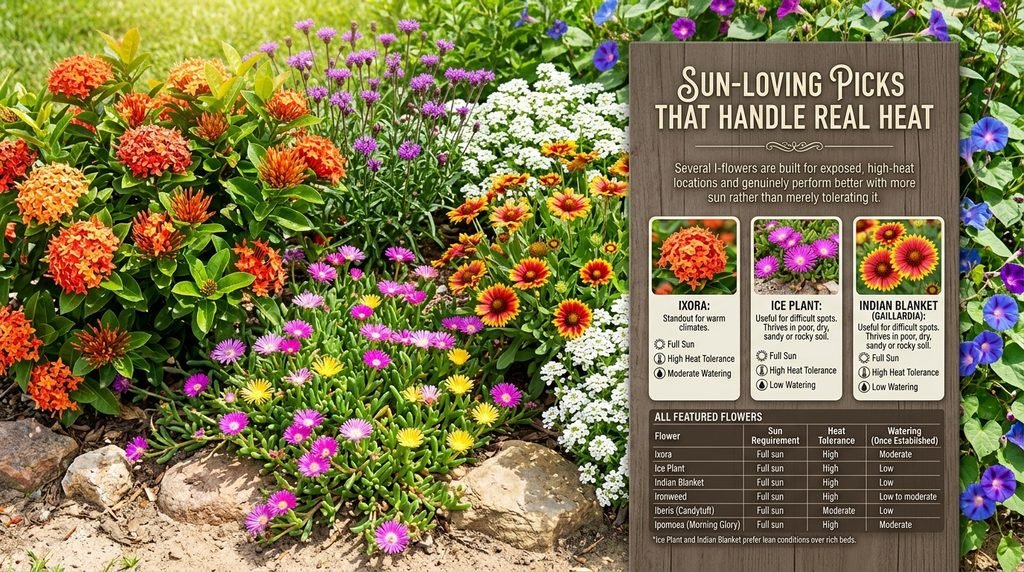
| Flower | Sun Requirement | Heat Tolerance | Watering Once Established |
| Ixora | Full sun | High | Moderate |
| Ice Plant | Full sun | High | Low |
| Indian Blanket (Gaillardia) | Full sun | High | Low |
| Ironweed | Full sun | High | Low to moderate |
| Iberis (Candytuft) | Full sun | Moderate | Low |
| Ipomoea (Morning Glory) | Full sun | High | Moderate |
Ice Plant and Indian Blanket are the two to reach for in genuinely poor, sandy, or rocky soil, since both actually prefer lean conditions over rich, regularly amended beds. Ixora needs more consistent watering than the others in this group despite its heat tolerance, so it rewards a bit more attention than a true “plant and forget” choice.
Shaded Beds and Low-Light Corners
Not every I-flower wants full sun, and a few genuinely prefer some protection from direct afternoon light. Impatiens remains the most dependable shade performer in this category, while Inside-Out Flower and Iris (specifically woodland types) round out a solid shade-tolerant trio.
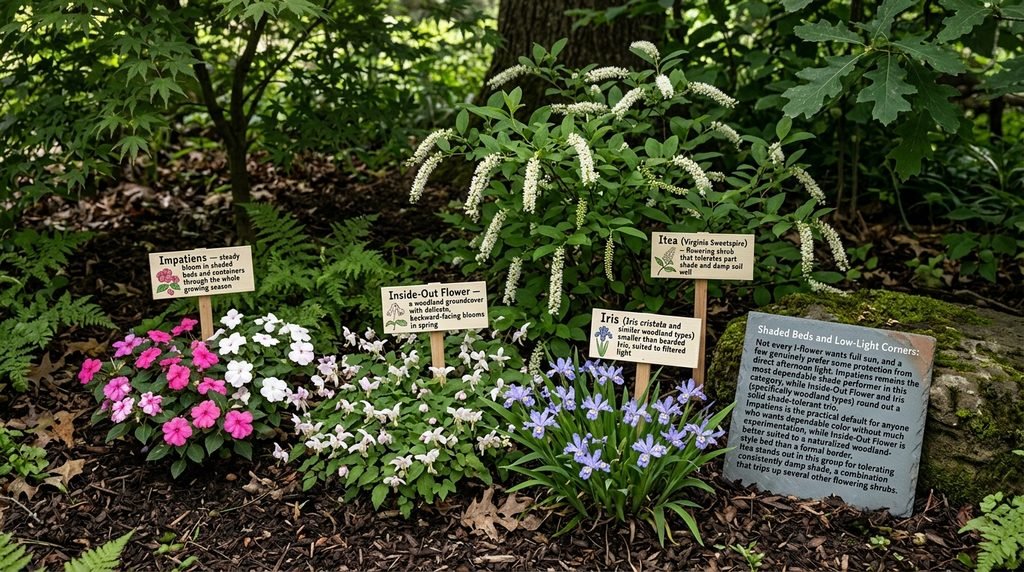
- Impatiens — steady bloom in shaded beds and containers through the whole growing season
- Inside-Out Flower — a woodland groundcover with delicate, backward-facing blooms in spring
- Iris (Iris cristata and similar woodland types) — smaller than bearded Iris, suited to filtered light
- Itea (Virginia Sweetspire) — flowering shrub that tolerates part shade and damp soil well
Impatiens is the practical default for anyone who wants dependable color without much experimentation, while Inside-Out Flower is better suited to a naturalized woodland-style bed than a formal border. Itea stands out in this group for tolerating consistently damp shade, a combination that trips up several other flowering shrubs.
Which I-Flowers Bloom the Fastest
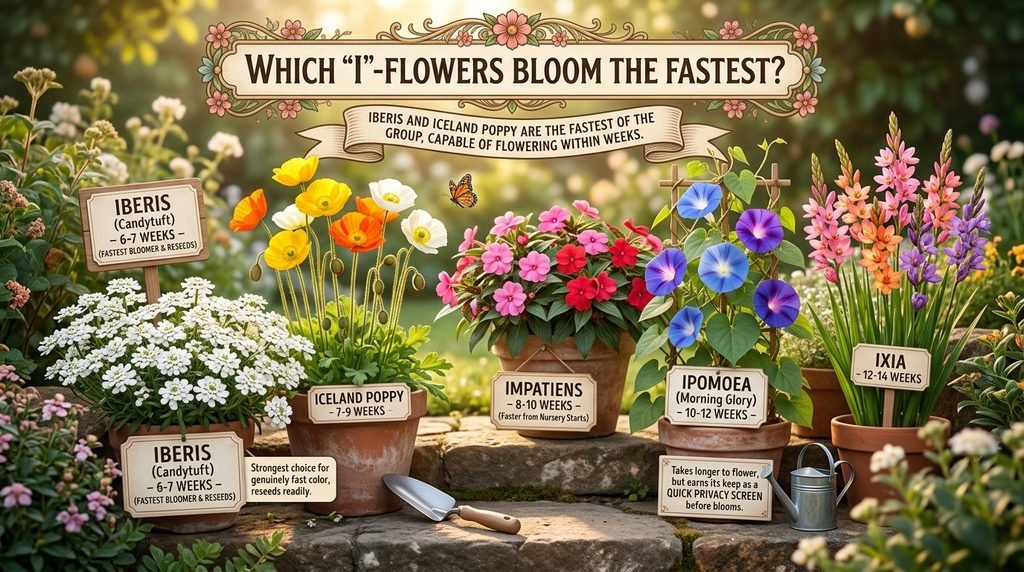
For gardeners working against a deadline — an event, a quick seasonal refresh, or simple impatience — bloom speed becomes the deciding factor. Iberis and Iceland Poppy are the fastest of the group, both capable of flowering within a matter of weeks under the right conditions.
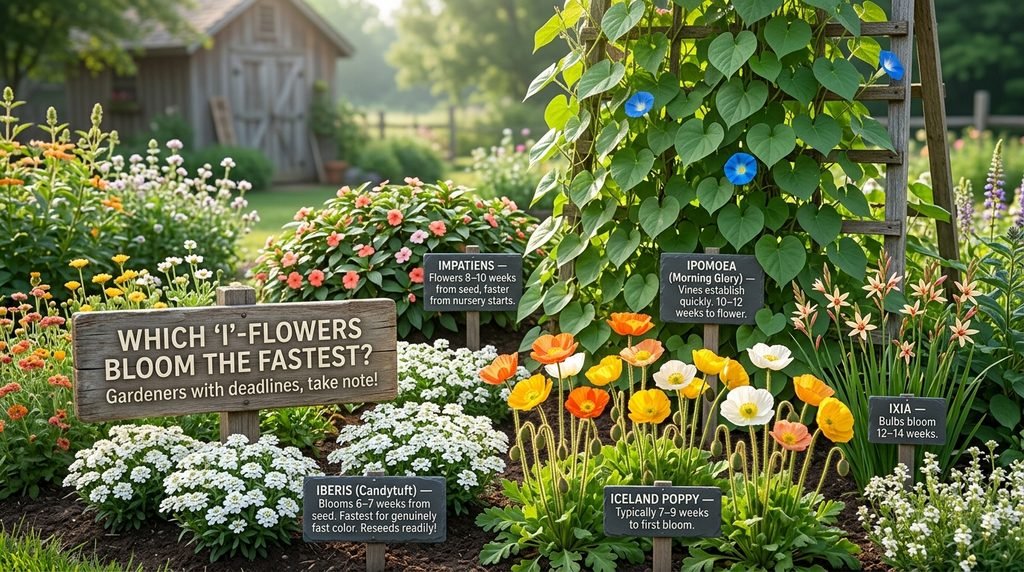
- Iberis (Candytuft) — often blooms within 6–7 weeks from seed
- Iceland Poppy — typically 7–9 weeks from seed to first bloom
- Impatiens — usually flowers within 8–10 weeks from seed, faster from nursery starts
- Ipomoea (Morning Glory) — vines establish quickly but generally take 10–12 weeks to flower
- Ixia — bulbs typically bloom within 12–14 weeks of planting
Iberis is the strongest choice for genuinely fast color, and it has the added benefit of reseeding readily in many climates, which extends its usefulness well past a single season. Ipomoea takes longer to flower, but its rapid vine growth means it earns its keep as a quick privacy screen even before the first blooms appear.
Matching the Plant to the Gardener’s Experience
Some I-flowers are close to foolproof, and others punish inexperience in ways that discourage beginners unnecessarily. Impatiens and Iberis are about as forgiving as flowering plants get, tolerating average soil and inconsistent watering without much visible stress. Impala Lily (Adenium) sits at the difficult end of the spectrum — it needs excellent drainage, warm temperatures year-round, and a very specific watering rhythm that punishes both overwatering and neglect, which makes it a poor first project for anyone still learning basic plant care.
- Solid starting points: Impatiens, Iberis, Iris (bearded types), Iceland Poppy
- Manageable with a bit of attention: Indigo (Baptisia) — slow to establish but low-effort afterward
- Better suited to experienced growers: Impala Lily (Adenium) — precise watering and drainage needs; Ixora — sensitive to soil pH and cold snaps
If Space Is Limited, Start With Three
For a small garden or a few containers, three I-flowers can cover most practical needs without redundancy. Iris supplies reliable perennial structure and spring color that returns without replanting, Impatiens fills in shaded gaps with dependable season-long bloom, and Iberis adds a low, tidy edging effect that ties a small bed together. Between the three, a gardener gets height, shade coverage, and border definition without any of them competing for the same visual role.
Companion Planting for I-Flowers
Companion planting works best when neighboring plants share similar sun and water needs, or when one plant offers a practical benefit to the other, such as pest deterrence or ground shading for a shallow-rooted neighbor. A mismatch usually shows up gradually, with one plant thriving while the other quietly falls behind.
| Flower | Good Companion | Why It Works | Avoid Planting Near |
| Iris | Peony | Similar bloom timing and soil preferences | Mint (aggressive roots crowd rhizomes) |
| Impatiens | Hosta | Shared shade and moisture requirements | Full-sun annuals (light mismatch) |
| Ipomoea (Morning Glory) | Sunflowers | Vine can climb sturdy stalks without harming them | Delicate annuals (can get overtaken by the vine) |
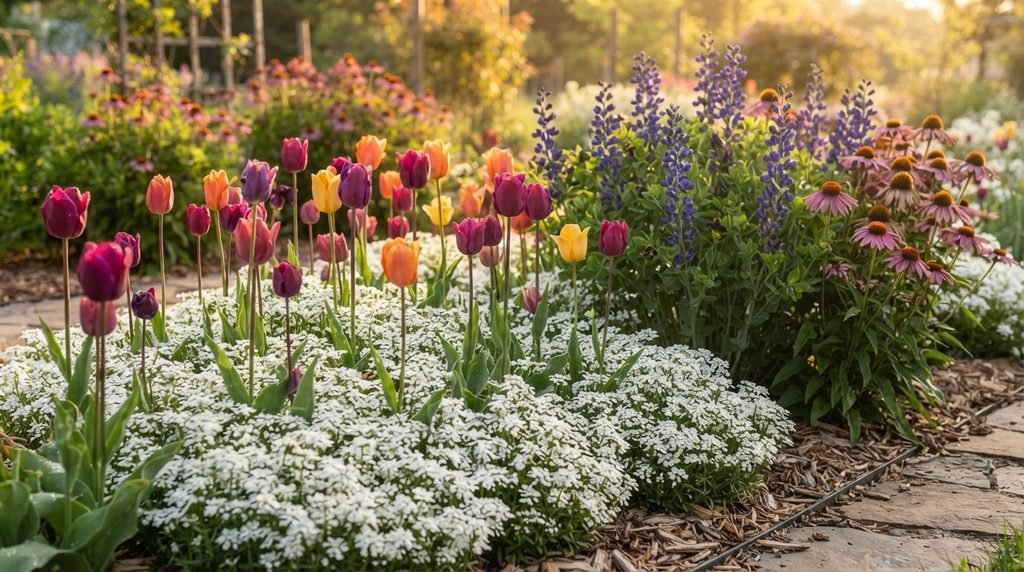
| Iberis (Candytuft) | Tulips | Candytuft’s low mat hides fading tulip foliage | Taller aggressive spreaders (light competition) |
| Indigo (Baptisia) | Coneflower | Both drought-tolerant, similar bloom season | Moisture-loving plants (watering mismatch) |
The Iberis-and-tulip pairing is a practical trick more than a pest-related one — Candytuft’s low, spreading habit conveniently covers tulip foliage as it yellows and dies back after bloom. The broader pattern worth noting is that most I-flowers pair poorly with plants that need significantly more or less water, which matters more for long-term success than any pest-deterrent benefit.
A Month-by-Month Calendar for the Top Picks
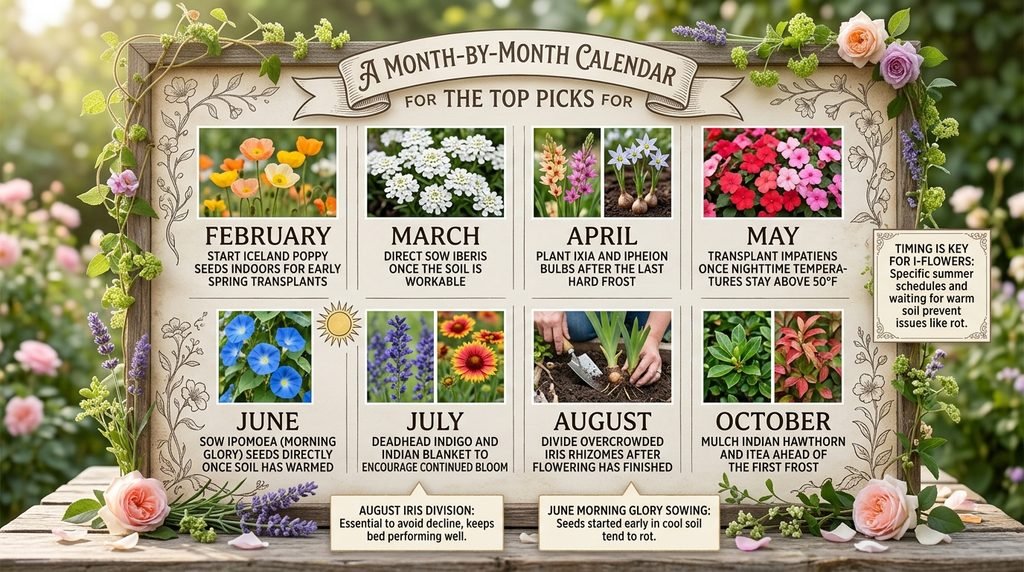
Timing has an outsized effect on how well I-flowers perform, particularly for bulbs and vines with narrow planting windows. Iris rhizomes need a specific summer division schedule, while Morning Glory seeds benefit from being started only once the soil has properly warmed.
| Month | Task |
| February | Start Iceland Poppy seeds indoors for early spring transplants |
| March | Direct sow Iberis once the soil is workable |
| April | Plant Ixia and Ipheion bulbs after the last hard frost |
| May | Transplant Impatiens once nighttime temperatures stay above 50°F |
| June | Sow Ipomoea (Morning Glory) seeds directly once soil has warmed |
| July | Deadhead Indigo and Indian Blanket to encourage continued bloom |
| August | Divide overcrowded Iris rhizomes after flowering has finished |
| October | Mulch Indian Hawthorn and Itea ahead of the first frost |
The August Iris division is easy to overlook but matters — crowded rhizomes bloom less reliably over time, so periodic division keeps a bed performing well for years rather than gradually declining. The June Morning Glory sowing window is worth respecting too, since seeds started too early in cool soil tend to rot rather than germinate.
Flowers That Deserve Extra Caution
A few I-flowers carry real risk to pets, children, or livestock, and that information matters more than aesthetics for anyone gardening around a household with either. Iris rhizomes contain compounds that cause vomiting and drooling if chewed or ingested, with the concentrated rhizome itself posing more risk than the flower or leaves. Impala Lily (Adenium) is significantly more dangerous — it contains cardiac glycosides similar to those found in oleander, and ingestion by pets or livestock can cause serious heart-related symptoms. English Ivy, sometimes grouped loosely with I-flowers for its flowering vine habit, contains compounds in its leaves and berries that can cause skin irritation and digestive upset.
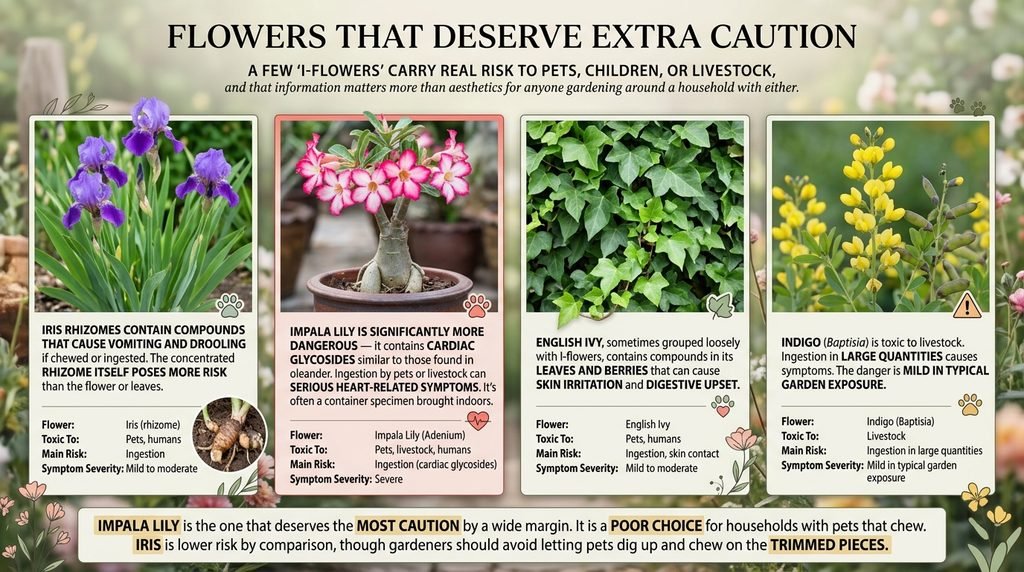
| Flower | Toxic To | Main Risk | Symptom Severity |
| Iris (rhizome) | Pets, humans | Ingestion | Mild to moderate |
| Impala Lily (Adenium) | Pets, livestock, humans | Ingestion (cardiac glycosides) | Severe |
| English Ivy | Pets, humans | Ingestion, skin contact | Mild to moderate |
| Indigo (Baptisia) | Livestock | Ingestion in large quantities | Mild in typical garden exposure |
Impala Lily is the one that deserves the most caution by a wide margin, and it’s generally a poor choice for any household with pets that chew on houseplants, since it’s most often grown as a container specimen brought indoors during colder months. Iris is lower risk by comparison, though gardeners who divide rhizomes by hand should still avoid letting pets dig up and chew on the trimmed pieces.
Color Groupings Across the I-Flowers
Purple and blue dominate this letter more than most, showing up strongly in Iris, Ironweed, and Indigo (Baptisia), which makes this the range to reach for when a true cool-toned color is the goal in a border.
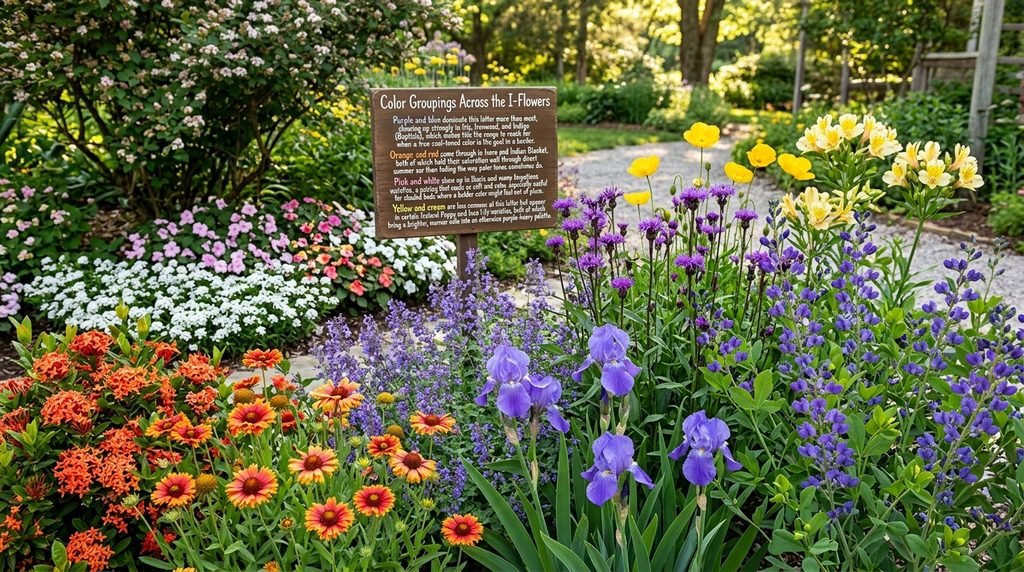
Orange and red come through in Ixora and Indian Blanket, both of which hold their saturation well through direct summer sun rather than fading the way paler tones sometimes do.
Pink and white show up in Iberis and many Impatiens varieties, a pairing that reads as soft and calm, especially useful for shaded beds where a bolder color might feel out of place.
Yellow and cream are less common at this letter but appear in certain Iceland Poppy and Inca Lily varieties, both of which bring a brighter, warmer note into an otherwise purple-heavy palette.
The Full List of Flowers That Start With I
Anyone who came here specifically for the name list can find the complete set below, gathering every flower mentioned above along with a few additional I-names worth knowing.
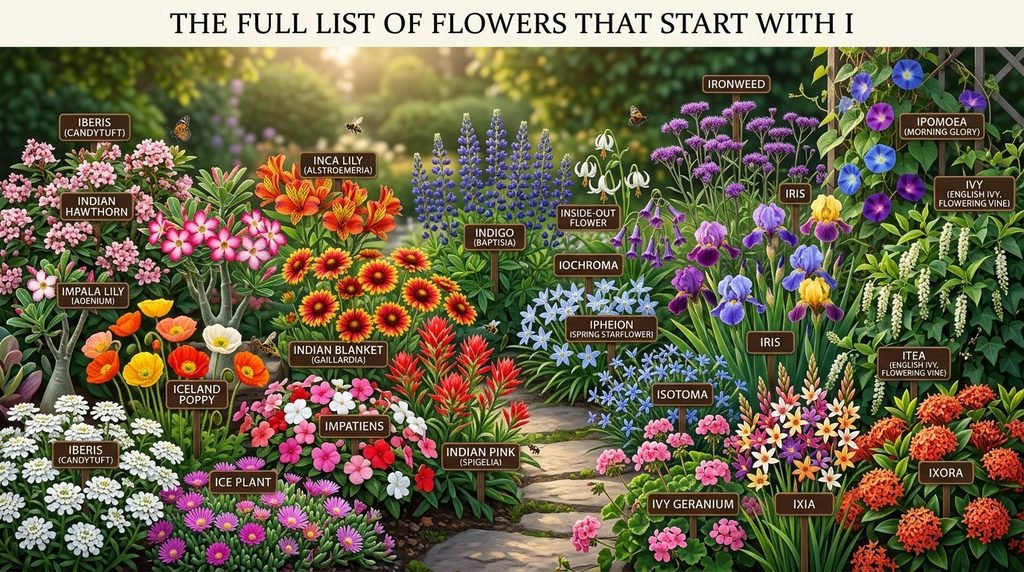
- Iberis (Candytuft)
- Ice Plant
- Iceland Poppy
- Impala Lily (Adenium)
- Impatiens
- Inca Lily (Alstroemeria)
- Indian Blanket (Gaillardia)
- Indian Hawthorn
- Indian Paintbrush
- Indian Pink (Spigelia)
- Indigo (Baptisia)
- Inside-Out Flower
- Iochroma
- Ipheion (Spring Starflower)
- Ipomoea (Morning Glory)
- Iris
- Ironweed
- Isotoma
- Itea (Virginia Sweetspire)
- Ivy (English Ivy, flowering vine)
- Ivy Geranium
- Ixia
- Ixora
This list favors flowers that are realistically available through nurseries or specialty bulb and seed suppliers, rather than obscure botanical entries with little practical growing information available.
Common Names vs. Botanical Names
Botanical names help avoid confusion when ordering online, especially for I-flowers where common names sometimes overlap with unrelated plants. This table covers the botanical names for the most frequently grown picks on this list.
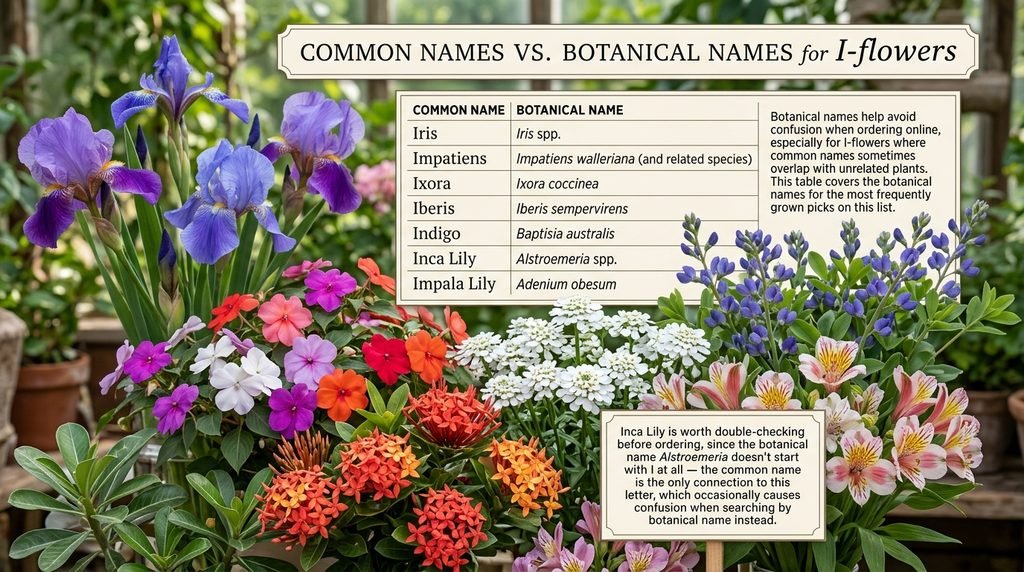
| Common Name | Botanical Name |
| Iris | Iris spp. |
| Impatiens | Impatiens walleriana (and related species) |
| Ixora | Ixora coccinea |
| Iberis | Iberis sempervirens |
| Indigo | Baptisia australis |
| Inca Lily | Alstroemeria spp. |
| Impala Lily | Adenium obesum |
Inca Lily is worth double-checking before ordering, since the botanical name Alstroemeria doesn’t start with I at all — the common name is the only connection to this letter, which occasionally causes confusion when searching by botanical name instead.
What These Flowers Have Meant to People Over Time
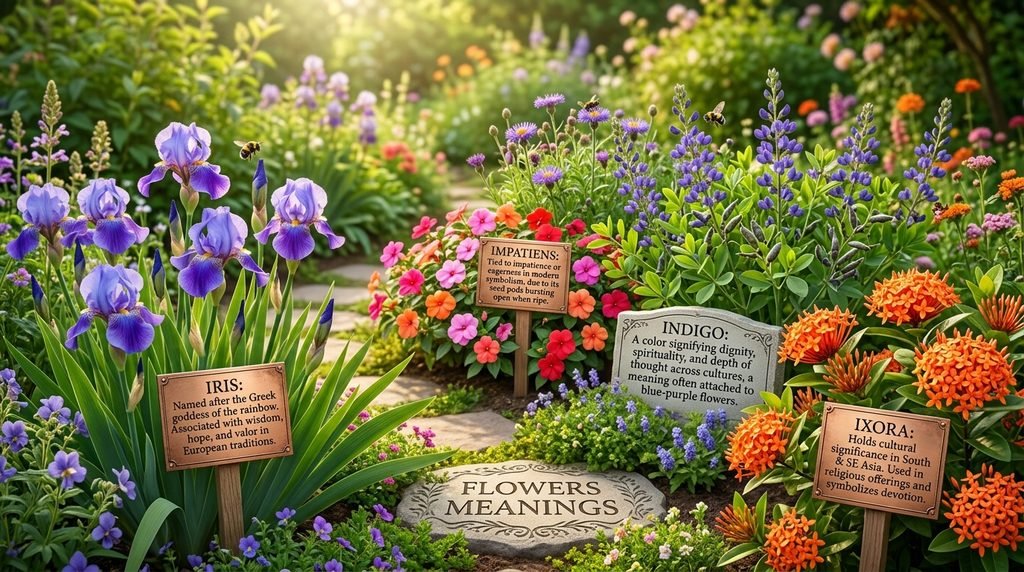
Flower symbolism still shapes gift-giving and garden design choices today, even for people who don’t consciously think about it, which makes it worth covering rather than skipping. Iris takes its name directly from the Greek goddess of the rainbow, and it has long carried associations with wisdom, hope, and valor across several European traditions. Impatiens, somewhat fittingly given its name, has been loosely tied to impatience or eagerness in more casual, modern flower symbolism, largely because the seed pods burst open at the slightest touch once ripe.
Indigo, as a color rather than strictly the flower Baptisia, carries a long history tied to dignity, spirituality, and depth of thought across multiple cultures, and that broader color symbolism tends to attach itself to purple-blue flowers like Iris and Ironweed as well. Ixora holds particular cultural significance in parts of South and Southeast Asia, where it’s sometimes used in religious offerings and associated with devotion.
Bringing the I-Flowers Together
Flowers that start with I range from dependable perennial staples like Iris to genuinely demanding specialty plants like Impala Lily, and that range is exactly why sorting by growing conditions works better than a flat alphabetical list. Anyone using this guide should be able to match a specific spot in their yard — sunny, shaded, fast-blooming, or beginner-friendly — to a realistic shortlist of I-flowers rather than working through two dozen names one at a time.
Frequently Asked Questions
What are the easiest flowers that start with I for a beginner to grow?
Impatiens, Iberis, and bearded Iris are the most forgiving choices, tolerating average soil and inconsistent watering without much trouble.
Which I-flowers are toxic to pets?
Impala Lily (Adenium) carries the most serious risk, while Iris rhizomes and English Ivy pose milder but still notable toxicity concerns.
How fast does Iberis bloom from seed?
Typically within six to seven weeks, making it one of the fastest-blooming options among flowers that start with I.
Can Impala Lily be grown outdoors year-round?
Only in consistently warm, frost-free climates — in most regions it’s grown as a container plant that comes indoors before cold weather arrives.
What’s the difference between Iris and woodland Iris varieties?
Bearded Iris prefers full sun and average soil, while woodland types like Iris cristata are smaller and better suited to filtered light and part shade.
Do Morning Glory vines need support to grow well?
Yes, a trellis, fence, or sturdy neighboring plant gives Ipomoea something to climb, since it doesn’t hold itself upright without one.
Which I-flowers tolerate shade best?
Impatiens, Inside-Out Flower, and woodland Iris varieties handle shaded conditions better than most other flowers on this list.
Is Ixora difficult to grow outside tropical climates?
It can be challenging outside warm regions, since it’s sensitive to cold snaps and prefers consistently warm, humid conditions to bloom well.
What are good companion plants for Iris? Peony works well due to similar bloom timing and soil needs, while aggressive spreaders like mint should be kept well away from Iris rhizomes.
When should Iris rhizomes be divided?
Typically in late summer, a few weeks after flowering has finished, to prevent overcrowding that reduces bloom quality over time.
Do Indian Blanket flowers attract pollinators?
Yes, Indian Blanket is a strong pollinator draw, particularly for bees and butterflies, and it tends to bloom over a long stretch of summer.
What color varieties are available for Iris?
Purple and blue are the most iconic, but Iris also comes in yellow, white, pink, and bicolor varieties depending on the type.