

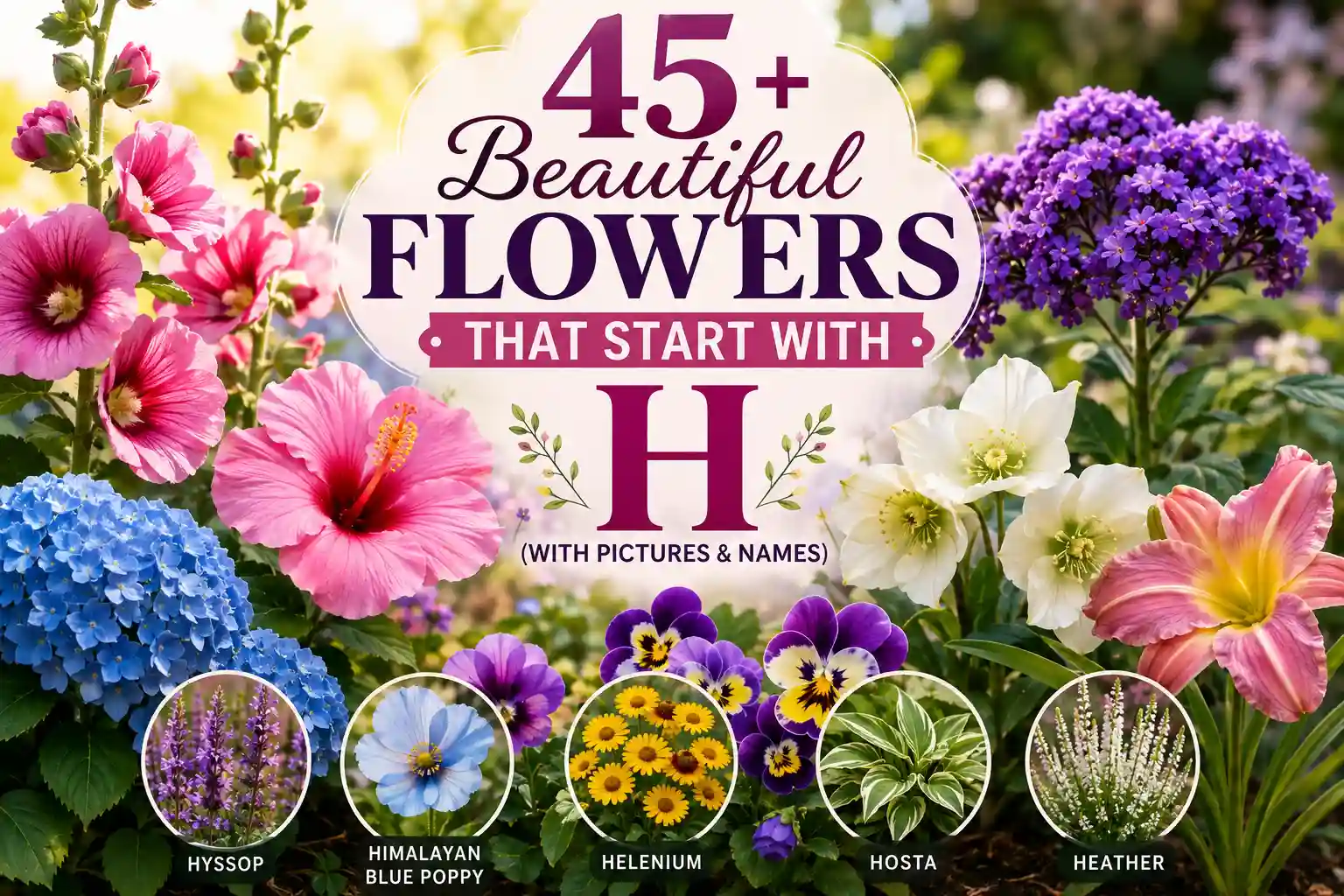
A straight A-to-Z list is easy to skim but hard to actually use when you’re standing in a garden bed trying to decide what goes where. This guide takes a different approach: it groups H-flowers by the growing conditions that actually determine whether a plant survives, before it ever gets to a plain alphabetical rundown.
That means the sections below are built around real decisions — how much sun a spot gets, how fast a bloom needs to show up, and whether a plant forgives a missed watering or two. Anyone shopping for a specific look (full sun, part shade, fast color) can jump straight to the relevant section instead of scrolling past forty-plus names hunting for the three that fit their yard.
The full alphabetical index, with all 45+ names in one place, is included near the end as a quick-reference appendix. It’s there for anyone who already knows what they want and just needs the full list for a final scan.
Every entry below reflects commonly available H-flowers found at nurseries, seed catalogs, and garden centers, with a few well-regarded but less common picks mixed in for gardeners who want something beyond the usual suspects.
Quick Take: Where to Start With H-Flowers
These ten stand out for practical reasons — not just because they’re pretty, but because each one solves a specific gardening problem well.
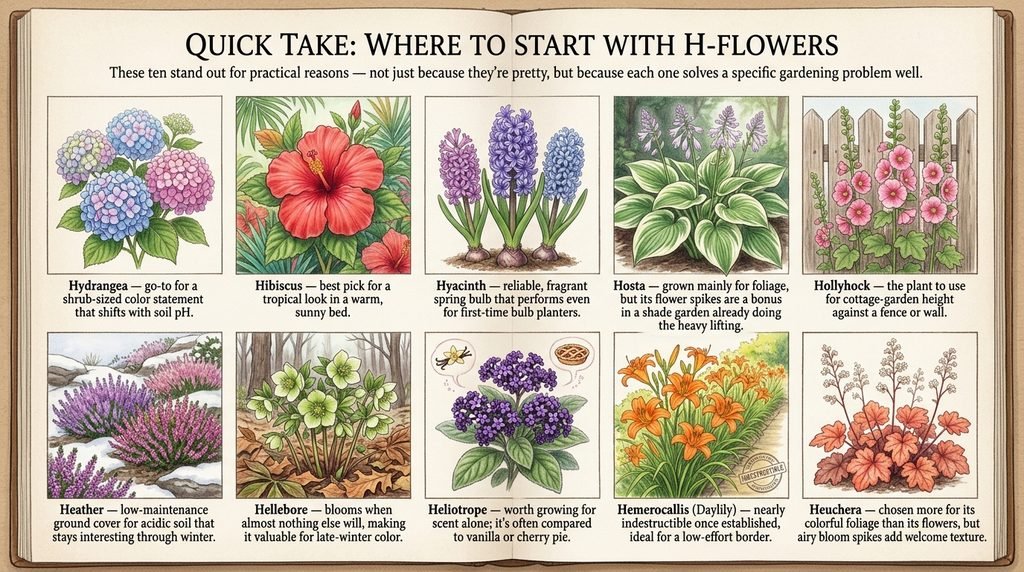
- Hydrangea — go-to for a shrub-sized color statement that shifts with soil pH.
- Hibiscus — best pick for a tropical look in a warm, sunny bed.
- Hyacinth — reliable, fragrant spring bulb that performs even for first-time bulb planters.
- Hosta — grown mainly for foliage, but its flower spikes are a bonus in a shade garden already doing the heavy lifting.
- Hollyhock — the plant to use for cottage-garden height against a fence or wall.
- Heather — low-maintenance ground cover for acidic soil that stays interesting through winter.
- Hellebore — blooms when almost nothing else will, making it valuable for late-winter color.
- Heliotrope — worth growing for scent alone; it’s often compared to vanilla or cherry pie.
- Hemerocallis (Daylily) — nearly indestructible once established, ideal for a low-effort border.
- Heuchera — chosen more for its colorful foliage than its flowers, but its airy bloom spikes add welcome texture.
Full-Sun Performers That Don’t Sulk in Heat
Sun-loving H-flowers vary a lot in how much punishment they’ll actually take once temperatures climb. Some, like Hibiscus, are built for it and barely slow down; others technically tolerate full sun but perform noticeably better with a break from afternoon intensity. Matching the right plant to the harshest part of a yard avoids a lot of wasted watering later in the season.
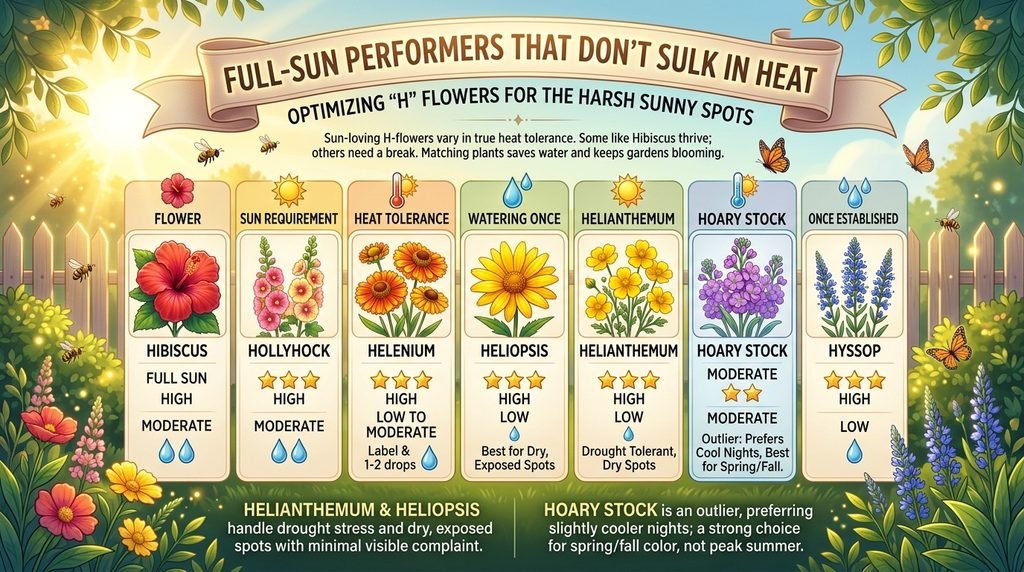
| Flower | Sun Requirement | Heat Tolerance | Watering Once Established |
| Hibiscus | Full sun | High | Moderate |
| Hollyhock | Full sun | High | Moderate |
| Helenium | Full sun | High | Low to moderate |
| Heliopsis | Full sun | High | Low |
| Helianthemum | Full sun | High | Low |
| Hoary Stock | Full sun | Moderate | Moderate |
| Hyssop | Full sun | High | Low |
Helianthemum and Heliopsis are the two to lean on for genuinely dry, exposed spots, since both handle drought stress without much visible complaint. Hoary Stock is the outlier in this group — it appreciates full sun but performs noticeably better with slightly cooler nights, so it’s a stronger choice for spring and fall color than peak summer heat.
Shade and Part-Shade Options Worth Planting
A shaded bed doesn’t have to default to plain green foliage. Several H-flowers are built for filtered or indirect light, and a few — Hosta and Hellebore in particular — are practically the backbone of a well-planned shade garden. Pairing a spring bloomer with a later one keeps a shaded spot from going flat for months at a stretch.
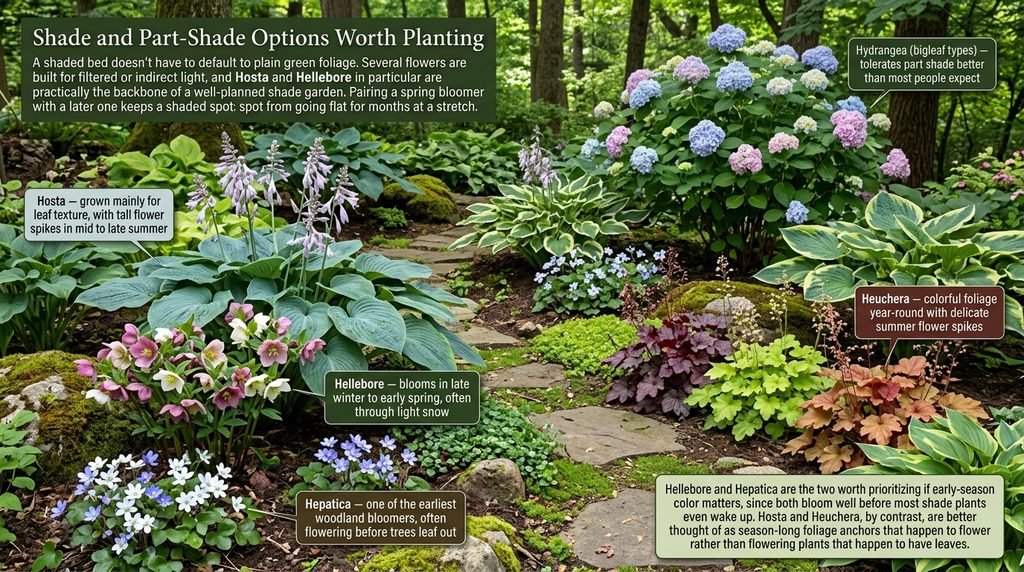
- Hosta — grown mainly for leaf texture, with tall flower spikes in mid to late summer
- Hellebore — blooms in late winter to early spring, often through light snow
- Heuchera — colorful foliage year-round with delicate summer flower spikes
- Hepatica — one of the earliest woodland bloomers, often flowering before trees leaf out
- Hydrangea (bigleaf types) — tolerates part shade better than most people expect
Hellebore and Hepatica are the two worth prioritizing if early-season color matters, since both bloom well before most shade plants even wake up. Hosta and Heuchera, by contrast, are better thought of as season-long foliage anchors that happen to flower rather than flowering plants that happen to have leaves.
Fastest Bloomers for Gardeners Who Don’t Want to Wait
Some H-flowers reward patience over a full season; others put on a show within weeks of planting. For anyone filling a bed quickly — before an event, or just out of impatience — speed matters as much as looks.
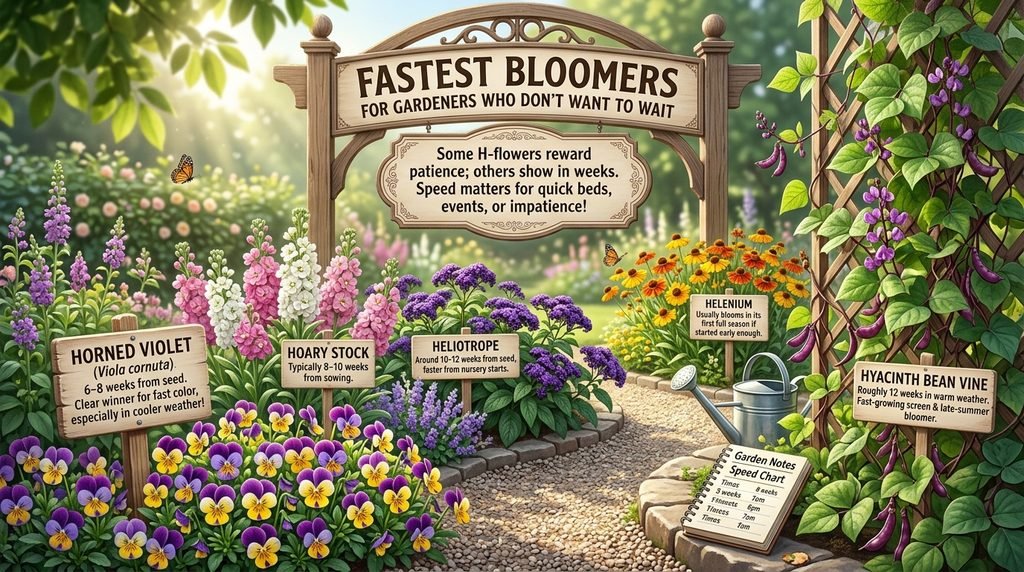
- Horned Violet — often blooms within 6–8 weeks from seed
- Hoary Stock — typically 8–10 weeks from sowing to bloom
- Heliotrope — around 10–12 weeks from seed, faster from nursery starts
- Hyacinth Bean Vine — climbs and flowers within roughly 12 weeks in warm weather
- Helenium — usually blooms in its first full season if started early enough
Horned Violet is the clear winner for fast color, especially in cooler weather when it holds up better than many summer annuals. Hyacinth Bean Vine takes longer to flower but earns its place on this list because it does double duty as a fast-growing screen and a late-summer bloomer at the same time.
Skill Level: What to Start With and What to Hold Off On
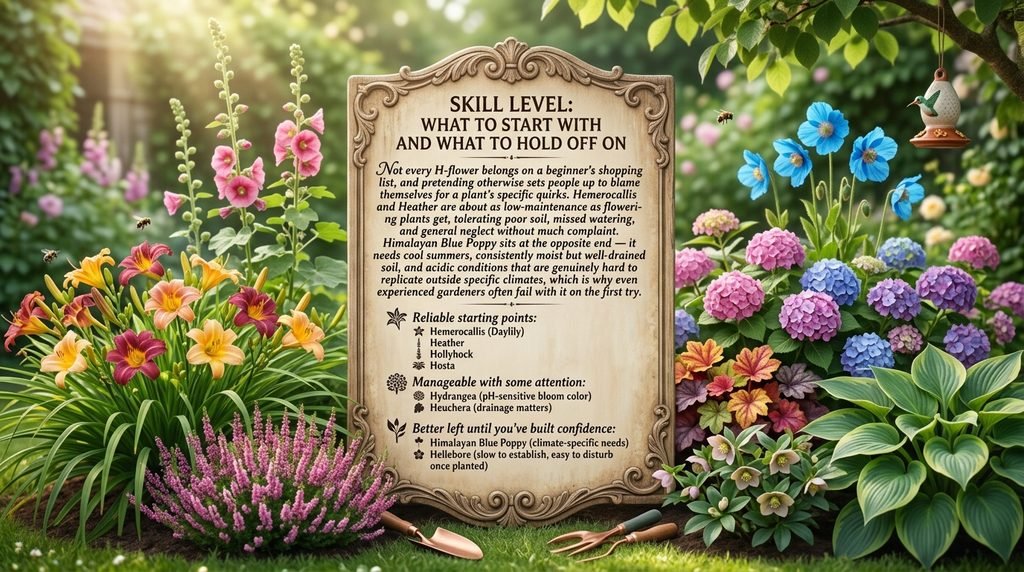
Not every H-flower belongs on a beginner’s shopping list, and pretending otherwise sets people up to blame themselves for a plant’s specific quirks. Hemerocallis and Heather are about as low-maintenance as flowering plants get, tolerating poor soil, missed watering, and general neglect without much complaint. Himalayan Blue Poppy sits at the opposite end — it needs cool summers, consistently moist but well-drained soil, and acidic conditions that are genuinely hard to replicate outside specific climates, which is why even experienced gardeners often fail with it on the first try.
- Reliable starting points: Hemerocallis, Heather, Hollyhock, Hosta
- Manageable with some attention: Hydrangea (pH-sensitive bloom color), Heuchera (drainage matters)
- Better left until you’ve built confidence: Himalayan Blue Poppy (climate-specific needs), Hellebore (slow to establish, easy to disturb once planted)
A Shortlist If Space Is Tight
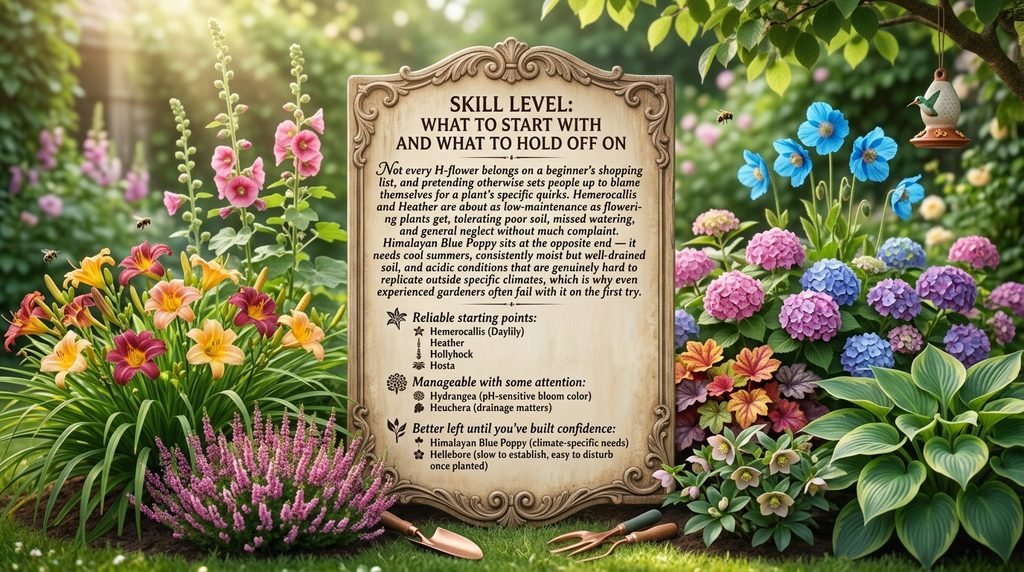
For a small bed or a handful of containers, three H-flowers can cover most of what a gardener actually wants: reliable color, low maintenance, and a bit of visual variety. Hemerocallis handles the “won’t die on me” requirement, Hydrangea supplies the shrub-sized visual anchor most small gardens are missing, and Heather fills in as a low, textural ground cover that still looks intentional through the off-season. That combination avoids redundancy — height, structure, and ground-level coverage are all represented without any of the three competing for the same visual job.
Pairing H-Flowers With the Right Neighbors
Companion planting works best when nearby plants share similar water and light needs, or when one plant’s scent or growth habit offers the other some practical benefit, like pest deterrence or shade. Getting this wrong usually shows up as one plant thriving while its neighbor quietly struggles for resources.
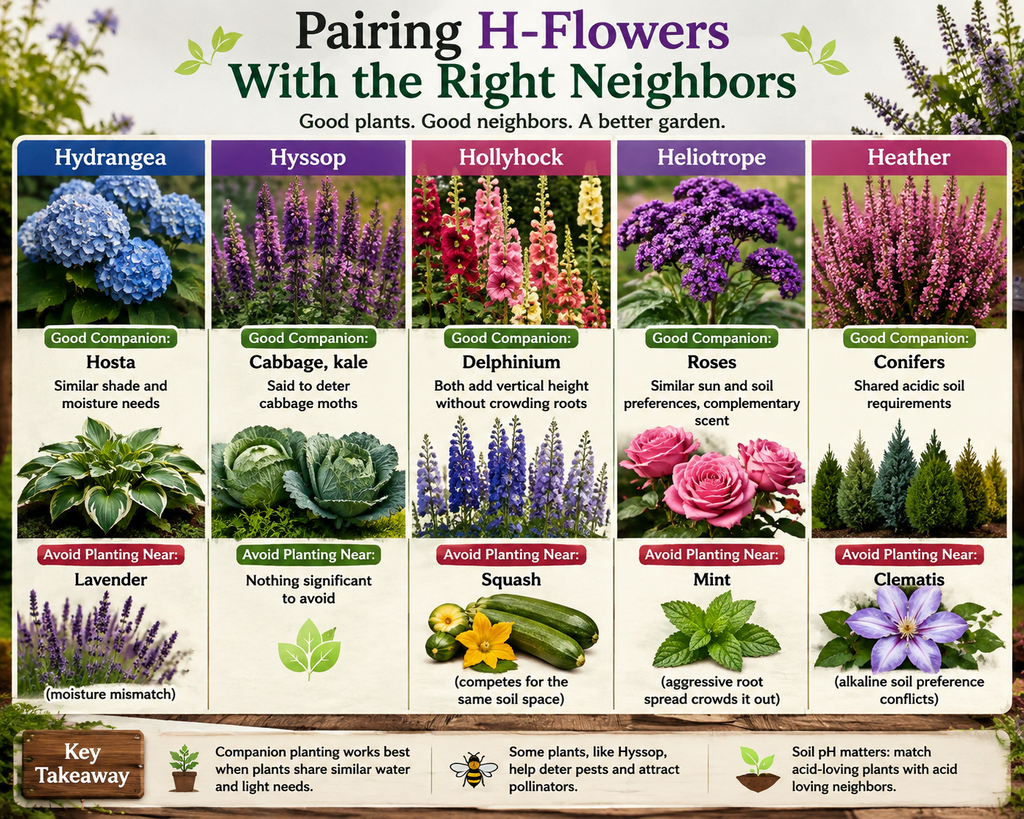
| Flower | Good Companion | Why It Works | Avoid Planting Near |
| Hydrangea | Hosta | Similar shade and moisture needs | Lavender (moisture mismatch) |
| Hyssop | Cabbage, kale | Said to deter cabbage moths | Nothing significant to avoid |
| Hollyhock | Delphinium | Both add vertical height without crowding roots | Squash (competes for the same soil space) |
| Heliotrope | Roses | Similar sun and soil preferences, complementary scent | Mint (aggressive root spread crowds it out) |
| Heather | Conifers | Shared acidic soil requirements | Clematis (alkaline soil preference conflicts) |
The Hyssop-and-cabbage pairing is a classic companion combination worth trying in a vegetable bed, since it doubles as a pollinator draw while it’s doing pest-deterrent work. The bigger pattern in this table is soil pH: Heather and conifers share the same acidic preference, while pairing Heather with alkaline-loving plants like Clematis tends to leave one of the two underperforming no matter how well it’s watered.
A Month-by-Month Plan for the Top Picks
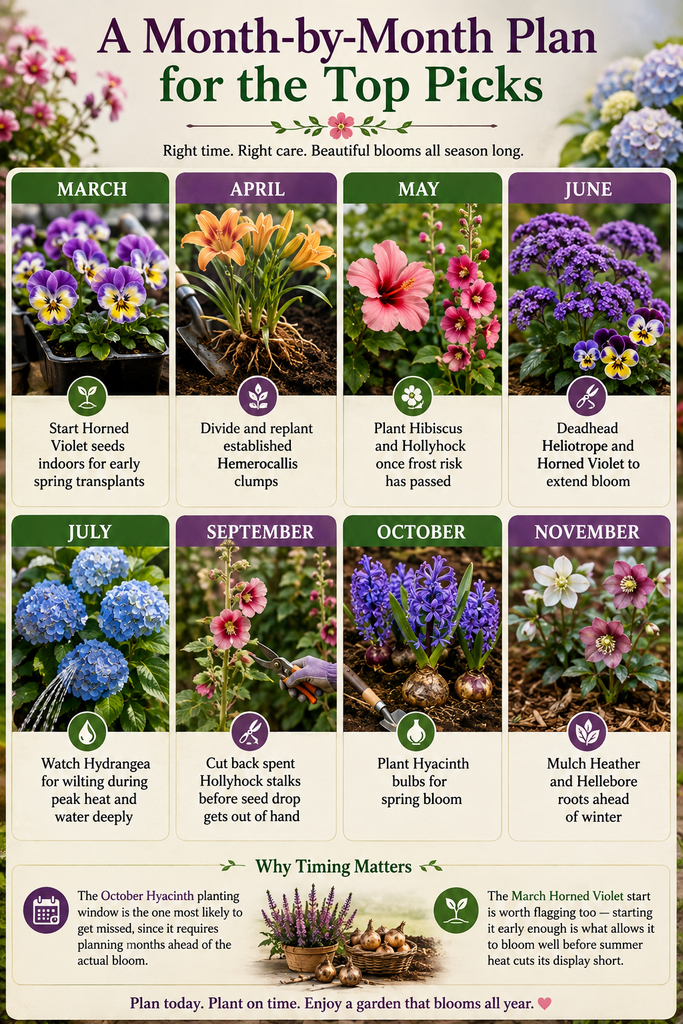
Timing determines a lot of the difference between a flower that thrives and one that limps through its first season. Spring bulbs like Hyacinth need a fall planting window to bloom on schedule, while heat-loving annuals like Hibiscus should go in only once the soil has properly warmed.
| Month | Task |
| March | Start Horned Violet seeds indoors for early spring transplants |
| April | Divide and replant established Hemerocallis clumps |
| May | Plant Hibiscus and Hollyhock once frost risk has passed |
| June | Deadhead Heliotrope and Horned Violet to extend bloom |
| July | Watch Hydrangea for wilting during peak heat and water deeply |
| September | Cut back spent Hollyhock stalks before seed drop gets out of hand |
| October | Plant Hyacinth bulbs for spring bloom |
| November | Mulch Heather and Hellebore roots ahead of winter |
The October Hyacinth planting window is the one most likely to get missed, since it requires planning months ahead of the actual bloom. The March Horned Violet start is worth flagging too — starting it early enough is what allows it to bloom well before summer heat cuts its display short.
Where Real Caution Is Needed
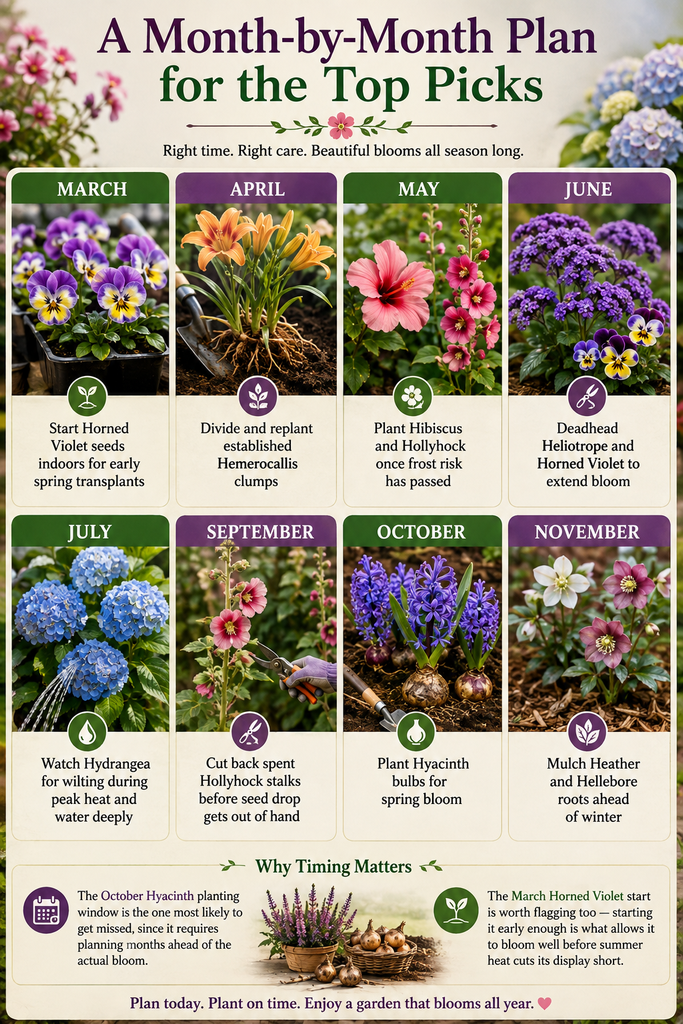
A few H-flowers carry genuine risk to pets, children, or anyone prone to skin sensitivity, and that information shouldn’t get buried under aesthetic details. Hellebore contains compounds that affect the heart and digestive system if ingested, and even brief skin contact with the sap can cause irritation in sensitive individuals. Hydrangea contains cyanogenic glycosides in its leaves and flower buds, which can cause vomiting and lethargy in pets that chew on the plant, though severe poisoning is uncommon. Hyacinth bulbs are a lesser-known risk — the bulbs specifically, more than the flowers, can cause skin and digestive irritation, which matters most for dogs that dig.
| Flower | Toxic To | Main Risk | Symptom Severity |
| Hellebore | Humans, pets | Ingestion, skin contact with sap | Moderate to severe |
| Hydrangea | Pets | Ingestion (leaves, buds) | Mild to moderate |
| Hyacinth (bulb) | Pets, humans | Ingestion, skin irritation | Mild to moderate |
| Hound’s Tongue | Livestock, pets | Ingestion (liver-affecting compounds) | Severe with prolonged exposure |
Hellebore deserves the most caution of the group, since its toxicity profile is more serious than the others and it’s a genuinely common garden plant. Hound’s Tongue is less likely to show up in a typical home garden but is worth knowing if a property borders pasture or open land where it can spread on its own.
Color Groupings Worth Knowing
Blue and purple show up strongly in Hydrangea (with the right soil acidity), Heliotrope, and Himalayan Blue Poppy, making this the range to reach for when a true, cool blue is the goal — a color that’s genuinely rare across most flower families.
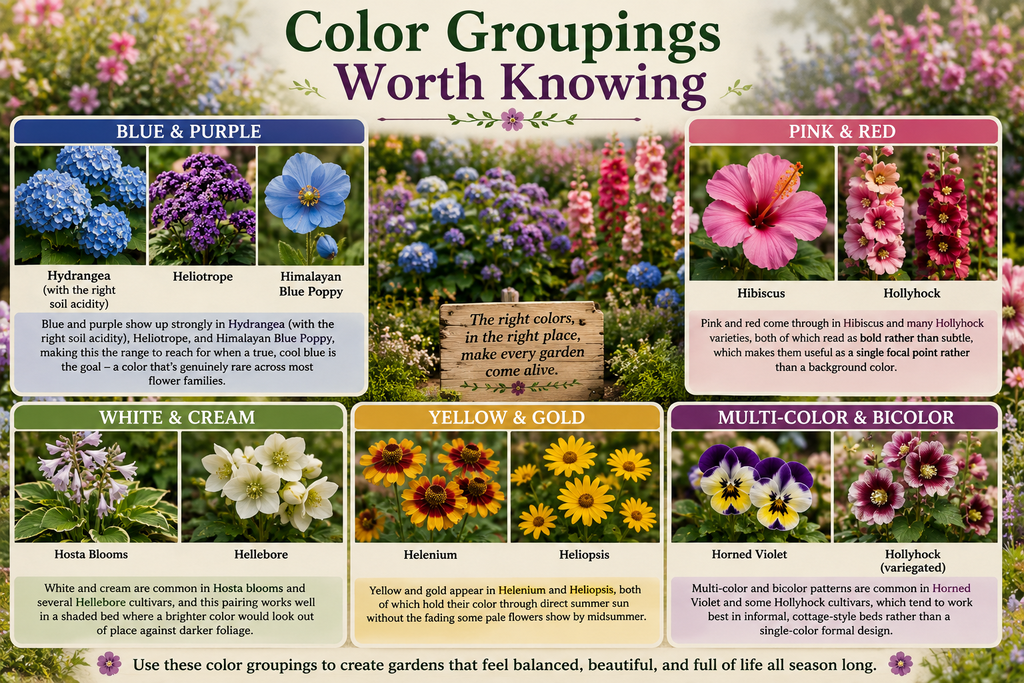
Pink and red come through in Hibiscus and many Hollyhock varieties, both of which read as bold rather than subtle, which makes them useful as a single focal point rather than a background color.
White and cream are common in Hosta blooms and several Hellebore cultivars, and this pairing works well in a shaded bed where a brighter color would look out of place against darker foliage.
Yellow and gold appear in Helenium and Heliopsis, both of which hold their color through direct summer sun without the fading some pale flowers show by midsummer.
Multi-color and bicolor patterns are common in Horned Violet and some Hollyhock cultivars, which tend to work best in informal, cottage-style beds rather than a single-color formal design.
The Full List of 45+ Flowers That Start With H
Anyone who came here specifically for the complete list can find it below — every flower referenced above, along with additional H-names worth knowing, all in one place.
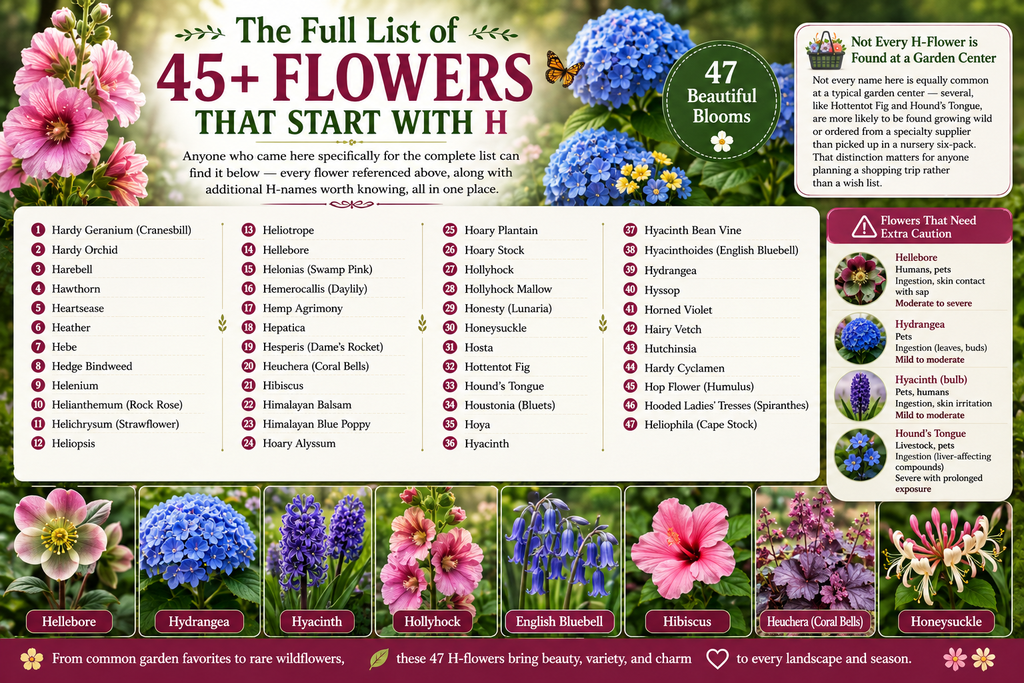
- Hardy Geranium (Cranesbill)
- Hardy Orchid
- Harebell
- Hawthorn
- Heartsease
- Heather
- Hebe
- Hedge Bindweed
- Helenium
- Helianthemum (Rock Rose)
- Helichrysum (Strawflower)
- Heliopsis
- Heliotrope
- Hellebore
- Helonias (Swamp Pink)
- Hemerocallis (Daylily)
- Hemp Agrimony
- Hepatica
- Hesperis (Dame’s Rocket)
- Heuchera (Coral Bells)
- Hibiscus
- Himalayan Balsam
- Himalayan Blue Poppy
- Hoary Alyssum
- Hoary Plantain
- Hoary Stock
- Hollyhock
- Hollyhock Mallow
- Honesty (Lunaria)
- Honeysuckle
- Hosta
- Hottentot Fig
- Hound’s Tongue
- Houstonia (Bluets)
- Hoya
- Hyacinth
- Hyacinth Bean Vine
- Hyacinthoides (English Bluebell)
- Hydrangea
- Hyssop
- Horned Violet
- Hairy Vetch
- Hutchinsia
- Hardy Cyclamen
- Hop Flower (Humulus)
- Hooded Ladies’ Tresses (Spiranthes)
- Heliophila (Cape Stock)
Not every name here is equally common at a typical garden center — several, like Hottentot Fig and Hound’s Tongue, are more likely to be found growing wild or ordered from a specialty supplier than picked up in a nursery six-pack. That distinction matters for anyone planning a shopping trip rather than a wish list.
Common Names vs. Botanical Names
Nursery tags and seed packets don’t always agree on naming, which makes a quick crosswalk useful before ordering anything online. This table covers the botanical names for the most commonly grown H-flowers on this list.
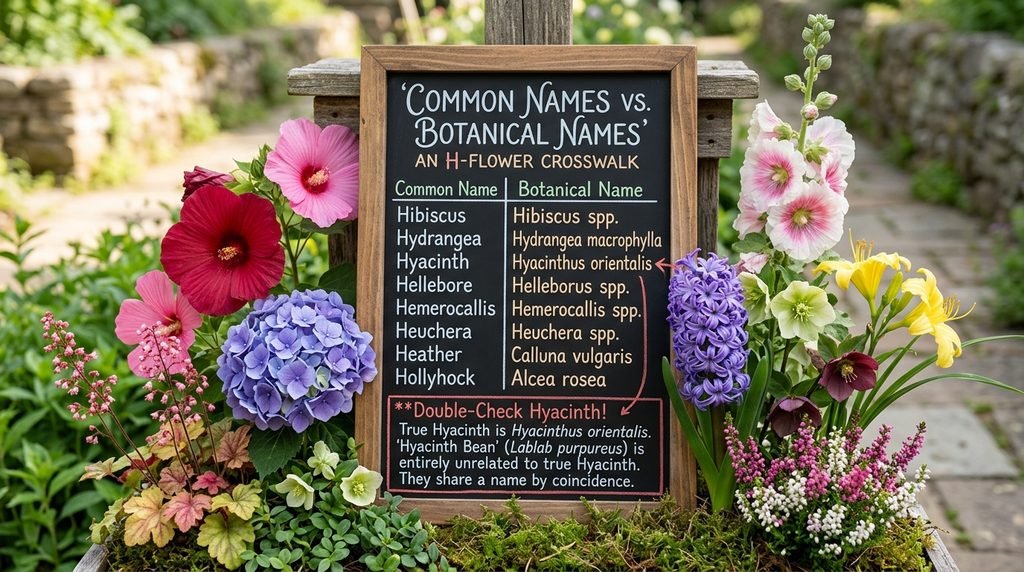
| Common Name | Botanical Name |
| Hibiscus | Hibiscus spp. |
| Hydrangea | Hydrangea macrophylla (and related species) |
| Hyacinth | Hyacinthus orientalis |
| Hellebore | Helleborus spp. |
| Hemerocallis | Hemerocallis spp. |
| Heuchera | Heuchera spp. |
| Heather | Calluna vulgaris |
| Hollyhock | Alcea rosea |
Hyacinth is the one most worth double-checking before ordering, since “Hyacinth Bean” (Lablab purpureus) and true Hyacinth (Hyacinthus orientalis) are entirely unrelated plants that share a name purely by coincidence.
What These Flowers Have Represented Over Time
Flower meanings shift by culture and era, but they still influence what people choose for gifts, weddings, and memorials, so they’re worth covering honestly rather than skipping. Hyacinth has long carried associations with rebirth and sport, tracing back to Greek mythology and the story of Hyacinthus, a youth whose death was said to have given rise to the flower. Hollyhock, in Victorian flower language, was often tied to ambition and fruitfulness, likely a reflection of how dramatically tall the plant grows in a single season.
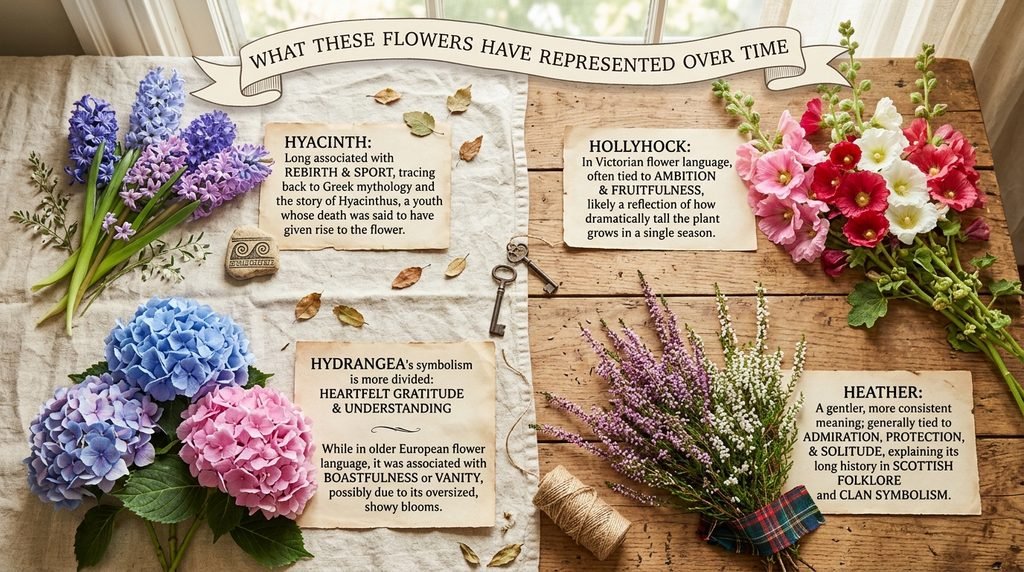
Hydrangea’s symbolism is more divided than most — in some traditions it represents heartfelt gratitude and understanding, while in others, particularly older European flower language, it was associated with boastfulness or vanity, possibly due to its oversized, showy blooms. Heather carries a gentler, more consistent meaning across most traditions, generally tied to admiration, protection, and solitude, which likely explains its long history in Scottish folklore and clan symbolism.
Bringing the List Together
Flowers that start with H cover an unusually wide range — from low-maintenance staples like Hemerocallis to climate-picky specialists like Himalayan Blue Poppy — which is exactly why sorting by growing conditions first makes more practical sense than sorting by the alphabet. Anyone working through this guide should be able to walk away with a short, realistic shortlist based on their actual yard, rather than a long name to look up later.
Frequently Asked Questions
What are the easiest flowers that start with H for a beginner to grow?
Hemerocallis, Heather, and Hollyhock are the most forgiving of the group, tolerating average soil and inconsistent care without much trouble.
Which H-flowers are toxic to pets?
Hellebore, Hydrangea, and Hyacinth bulbs all carry some level of toxicity risk to dogs and cats, with Hellebore posing the most serious risk if ingested.
Do Hyssop plants really deter garden pests?
Many gardeners plant Hyssop near cabbage and kale because it’s believed to discourage cabbage moths, though results vary by garden and pest pressure.
How long does it take Horned Violet to bloom from seed?
Typically around six to eight weeks, making it one of the fastest-blooming options on this list, especially in cooler spring weather.
Can Hydrangea flower color really be changed with soil pH?
Yes, for certain species like Hydrangea macrophylla — more acidic soil tends to produce blue blooms, while more alkaline soil shifts the color toward pink.
What’s the difference between Hyacinth and Hyacinth Bean?
They’re unrelated plants that happen to share a name — true Hyacinth is a spring bulb, while Hyacinth Bean is a fast-growing flowering vine.
Which H-flowers tolerate shade best?
Hosta, Hellebore, and Hepatica are the strongest shade performers on this list, with Hellebore and Hepatica both blooming earlier than most shade plants.
Is Himalayan Blue Poppy difficult to grow?
Yes — it needs cool summers, consistently moist soil, and acidic conditions, which makes it a poor fit for many climates even among experienced gardeners.