

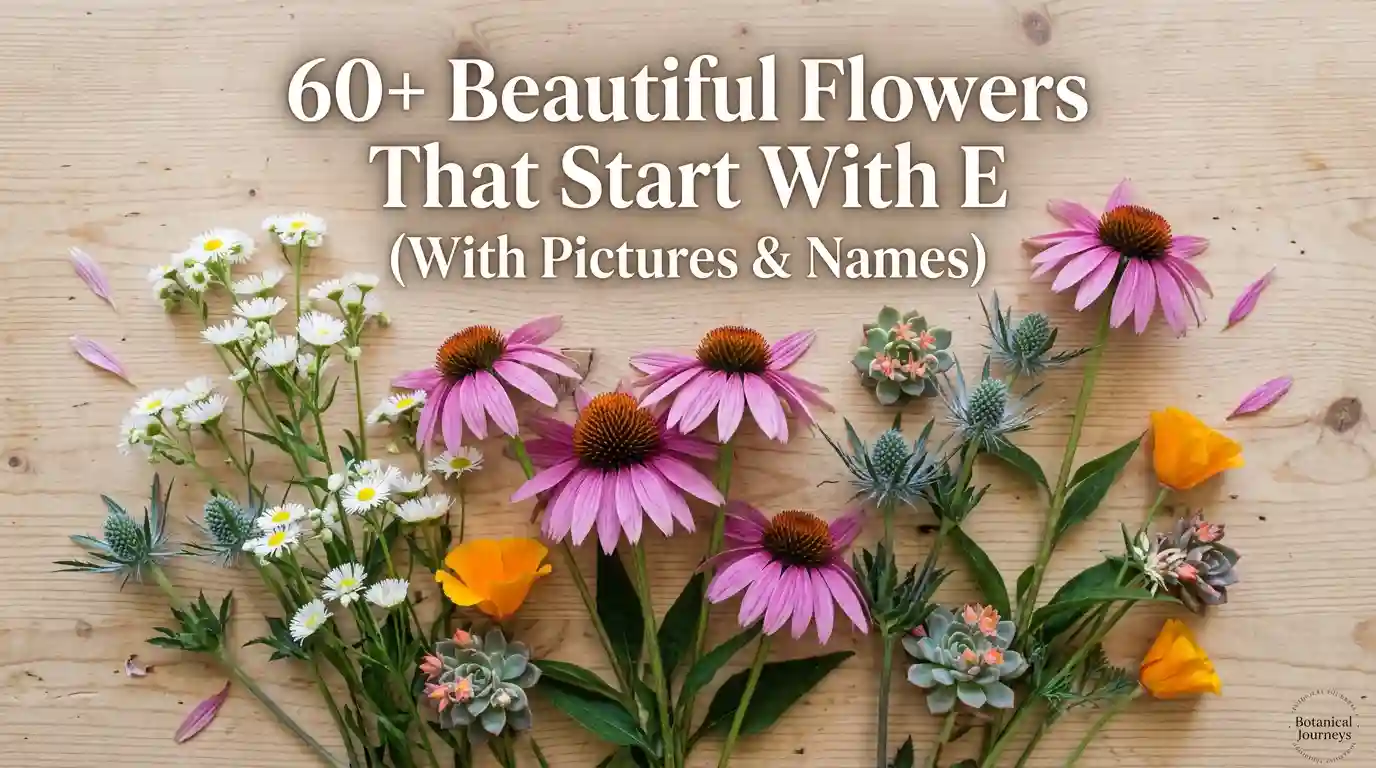
Finding beautiful flowers that start with E can be surprisingly challenging. Unlike flowers beginning with more common letters, E flowers include a fascinating mix of garden classics, wildflowers, native plants, and unusual exotic species that many gardeners have never encountered.
A simple alphabetical list rarely helps gardeners make good planting decisions. Some E flowers thrive in intense sunlight, while others prefer woodland shade. Certain varieties bloom for months with minimal care, while a few require more specialized growing conditions.
This guide takes a practical approach by organizing flowers by growing requirements rather than presenting a giant alphabetical directory at the beginning. This makes it easier to identify flowers that actually fit a particular garden.
Later in the article, a complete alphabetical index provides quick reference access to more than 60 flowers that start with E. The goal is not simply to list names but to help gardeners choose flowers that will flourish.
Quick Picks Worth Growing First
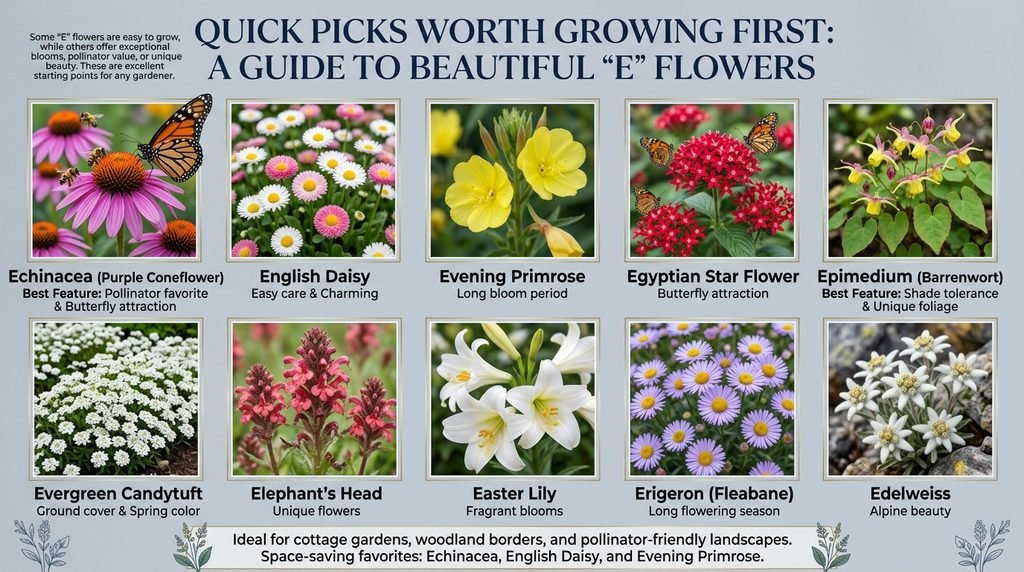
Some E flowers stand out because they are easy to grow. Others earn their place through exceptional blooms, pollinator value, or unusual appearance.
For gardeners who want quick recommendations, the following flowers are excellent starting points.
| Flower | Best Feature |
| Echinacea | Pollinator favorite |
| English Daisy | Easy care |
| Evening Primrose | Long bloom period |
| Egyptian Star Flower | Butterfly attraction |
| Epimedium | Shade tolerance |
| Evergreen Candytuft | Ground cover |
| Elephant’s Head | Unique flowers |
| Easter Lily | Fragrant blooms |
| Erigeron | Long flowering season |
| Edelweiss | Alpine beauty |
These flowers cover a wide range of garden situations. Some work best in cottage gardens, while others thrive in woodland borders or pollinator-friendly landscapes.
Gardeners with limited space often find Echinacea, English Daisy, and Evening Primrose especially rewarding.
What Actually Thrives Without Constant Attention
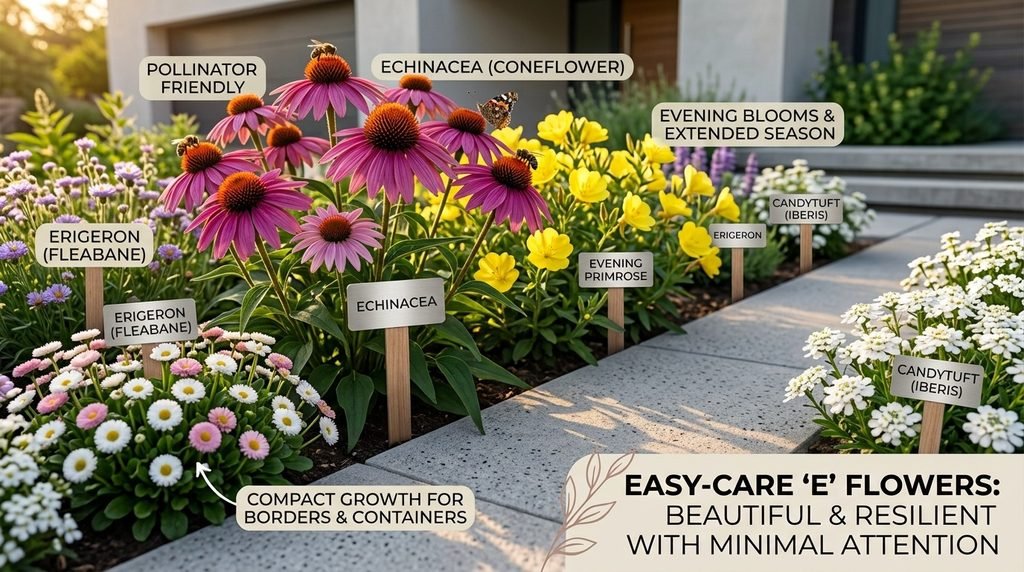
Many gardeners prefer flowers that remain attractive without requiring daily maintenance. Fortunately, several flowers that start with E perform exceptionally well with minimal intervention.
The following selections adapt well to average growing conditions and tolerate occasional neglect.
| Flower | Care Level | Drought Tolerance |
| Echinacea | Easy | High |
| Erigeron | Easy | Moderate |
| Evening Primrose | Easy | High |
| English Daisy | Easy | Moderate |
| Evergreen Candytuft | Easy | Moderate |
Echinacea remains one of the most dependable perennial flowers available. Once established, it handles heat, drought, and changing weather remarkably well.
Evening Primrose is another reliable performer. Its bright flowers continue appearing long after many other plants have finished blooming.
Echinacea
Pollinator gardens often depend on Echinacea because bees and butterflies visit the flowers throughout summer. Strong stems and drought resistance make it a practical choice for low-maintenance landscapes.
English Daisy
Smaller gardens benefit from English Daisy because of its compact growth habit. The cheerful blooms work well in borders, containers, and pathways.
Evening Primrose
When many daytime flowers begin closing, Evening Primrose takes over. Its blooms often open during the evening, creating a unique display.
The Best E Flowers for Sunny Gardens
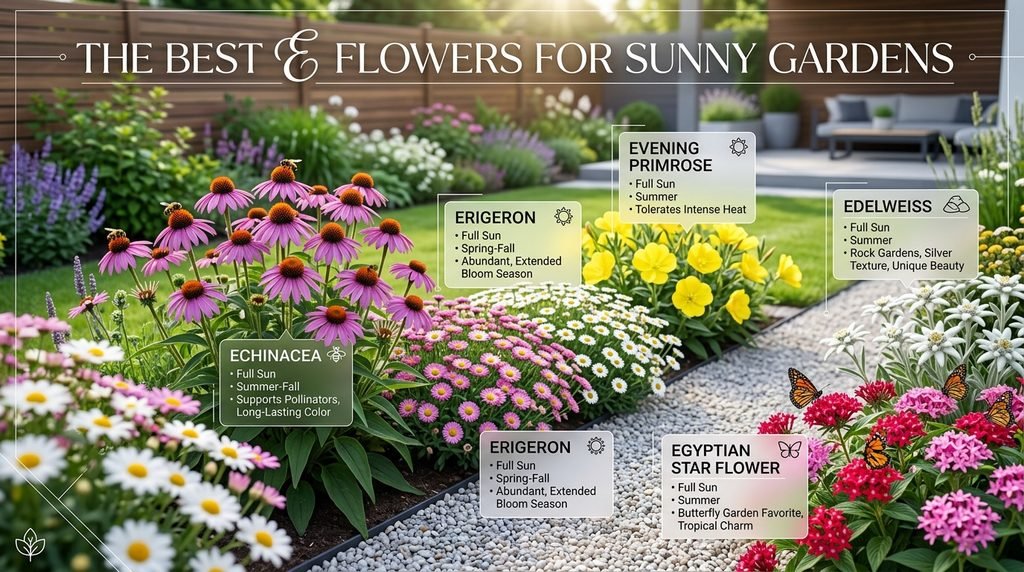
Full sun creates ideal growing conditions for many E flowers. However, selecting the right species remains important because not all flowers tolerate intense heat equally well.
The following flowers generally perform best when they receive at least six hours of direct sunlight.
| Flower | Sun Requirement | Bloom Season |
| Echinacea | Full Sun | Summer–Fall |
| Evening Primrose | Full Sun | Summer |
| Erigeron | Full Sun | Spring–Fall |
| Egyptian Star Flower | Full Sun | Summer |
| Edelweiss | Full Sun | Summer |
These flowers provide color across multiple seasons while supporting pollinators and beneficial insects.
Erigeron stands out because it flowers heavily for extended periods, often producing blooms for months.
Egyptian Star Flower
Butterfly gardens benefit greatly from Egyptian Star Flower. Clusters of colorful blooms attract pollinators while adding tropical charm.
Edelweiss
Originating from mountainous regions, Edelweiss brings distinctive texture and silver-toned beauty to rock gardens and alpine plantings.
Erigeron
Few flowers bloom as generously as Erigeron. Its daisy-like flowers can cover plants for much of the growing season.
Shade-Loving E Flowers Worth Planting
Many gardeners assume colorful flowers require full sunlight. However, several E flowers perform exceptionally well in shaded environments.
These selections help brighten woodland gardens and partially shaded landscapes.
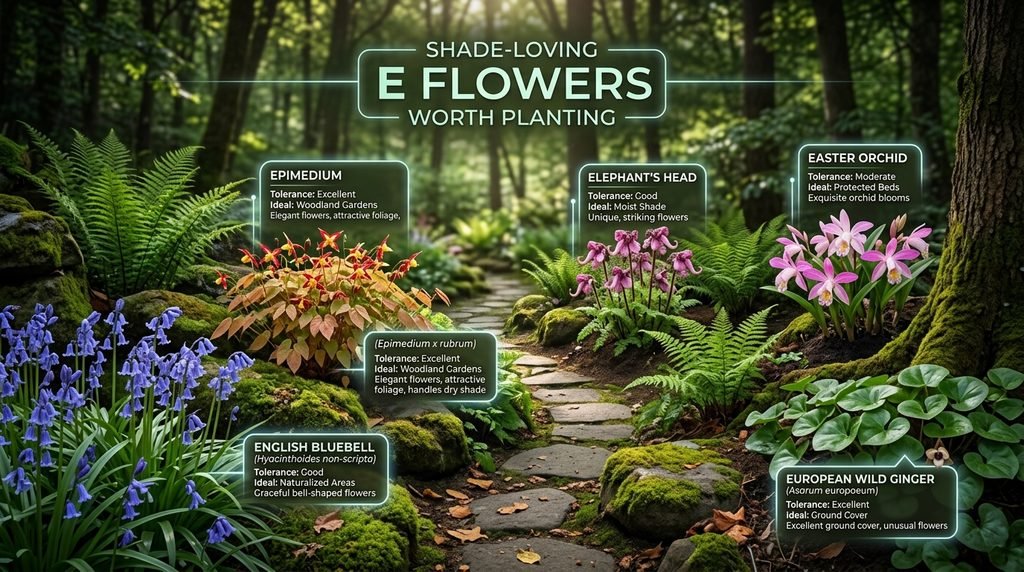
| Flower | Shade Tolerance | Ideal Setting |
| Epimedium | Excellent | Woodland gardens |
| European Wild Ginger | Excellent | Ground cover |
| Elephant’s Head | Good | Moist shade |
| Easter Orchid | Moderate | Protected beds |
| English Bluebell | Good | Naturalized areas |
Shade gardens often struggle with limited color. These flowers help solve that problem by producing attractive blooms where many plants fail.
Epimedium deserves particular attention because it combines elegant flowers with attractive foliage.
Epimedium
Dry shade is one of the most difficult gardening conditions. Epimedium handles it better than many flowering plants while producing delicate spring blooms.
English Bluebell
Woodland pathways and naturalized plantings frequently feature English Bluebells because of their graceful bell-shaped flowers.
Fast Bloomers for Immediate Color
Some flowers require years of patience. Others provide impressive displays within a single growing season.
Gardeners seeking rapid results often prefer the following E flowers.
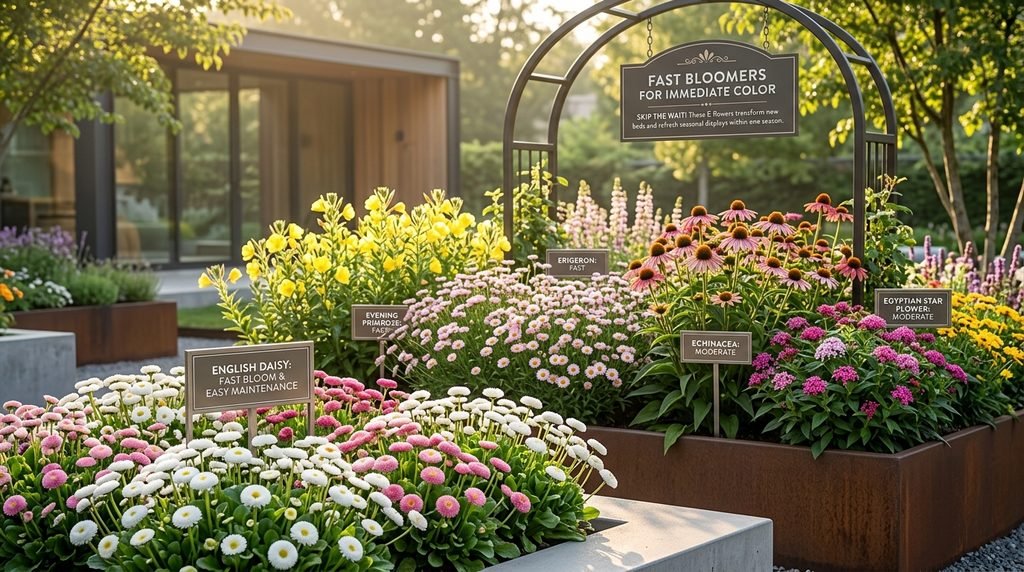
| Flower | Bloom Speed |
| English Daisy | Fast |
| Evening Primrose | Fast |
| Erigeron | Fast |
| Egyptian Star Flower | Moderate |
| Echinacea | Moderate |
Fast-blooming flowers are particularly useful for filling new beds and refreshing seasonal displays.
English Daisy remains a favorite because it combines quick flowering with easy maintenance.
Companion Planting Combinations That Work Best
A well-designed flower bed rarely depends on a single plant. Companion planting helps create longer bloom periods, better pollinator activity, and a more balanced garden design.
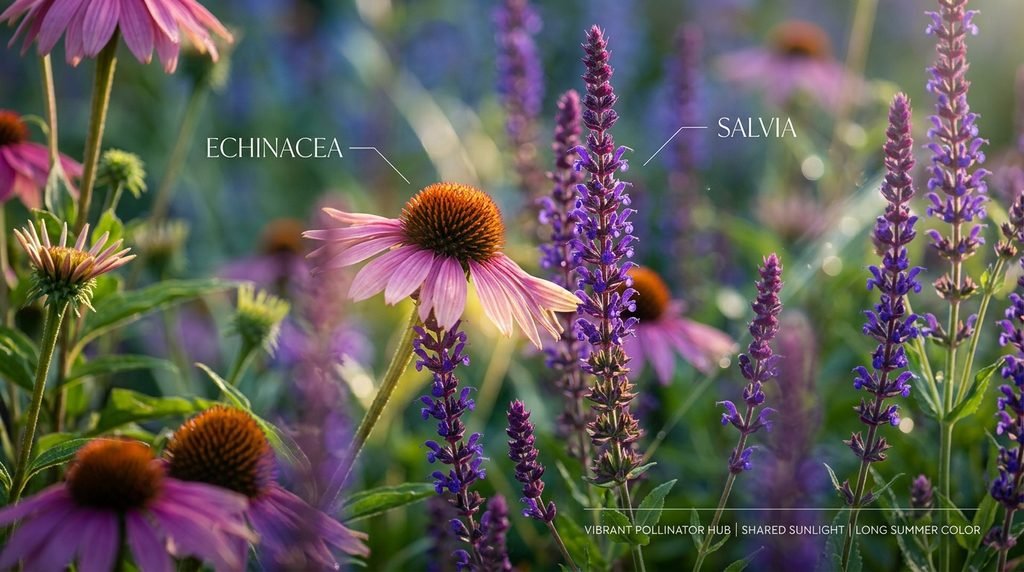
Many flowers that start with E pair naturally with other perennials and annuals because they share similar growing conditions. The following combinations are especially useful for gardeners looking to maximize color and plant health.
| E Flower | Companion Plants | Main Benefit |
| Echinacea | Black-Eyed Susan, Salvia | Pollinator attraction |
| English Daisy | Pansy, Viola | Spring color |
| Evening Primrose | Coreopsis, Yarrow | Drought tolerance |
| Erigeron | Lavender, Catmint | Long flowering display |
| Egyptian Star Flower | Butterfly Weed | Pollinator support |
| Epimedium | Ferns, Hosta | Shade garden texture |
| Evergreen Candytuft | Creeping Phlox | Ground-cover combination |
These combinations work because the plants share similar moisture and sunlight requirements. Instead of competing with one another, they create complementary displays.
Echinacea paired with Salvia remains one of the strongest combinations for attracting bees and butterflies throughout summer.
USDA Hardiness Zone Guide
Before selecting any flower, it helps to understand whether it suits the local climate. Hardiness zones provide valuable guidance and improve long-term planting success.
The flowers below cover a wide range of climate conditions.
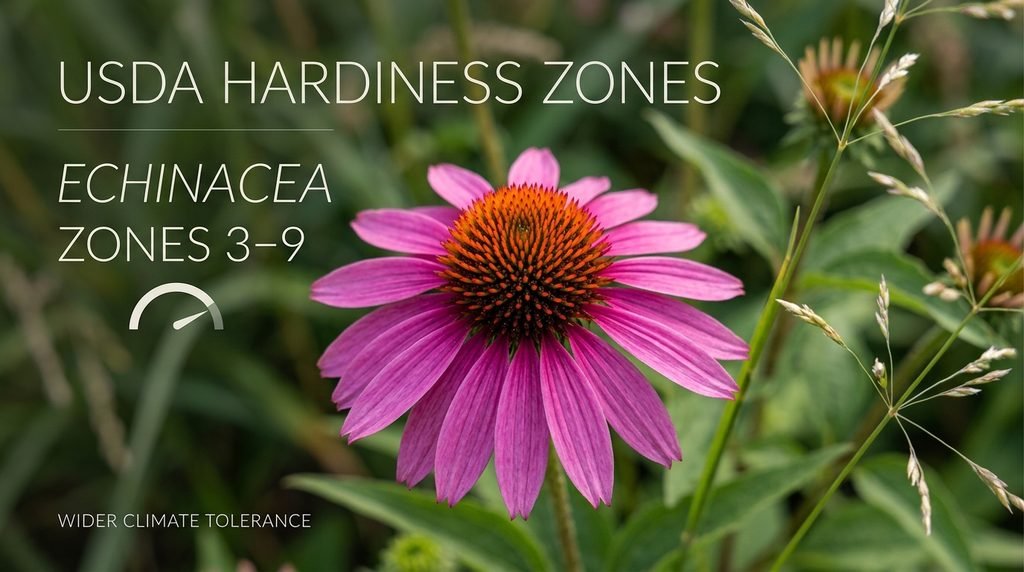
| Flower | USDA Zones |
| Echinacea | 3–9 |
| English Daisy | 4–8 |
| Evening Primrose | 4–9 |
| Egyptian Star Flower | 10–11 |
| Epimedium | 4–9 |
| Edelweiss | 4–7 |
| Evergreen Candytuft | 3–9 |
| Erigeron | 5–9 |
| English Bluebell | 5–8 |
| Elephant’s Head | 3–8 |
Among these flowers, Echinacea and Evergreen Candytuft adapt to some of the widest climate ranges.
Gardeners in colder regions often find Edelweiss and Epimedium particularly rewarding because they tolerate lower temperatures well.
Common Mistakes Gardeners Make
Even easy-to-grow flowers can struggle when basic requirements are overlooked. Fortunately, most problems can be prevented through proper planning.
The following mistakes occur more frequently than many gardeners realize.
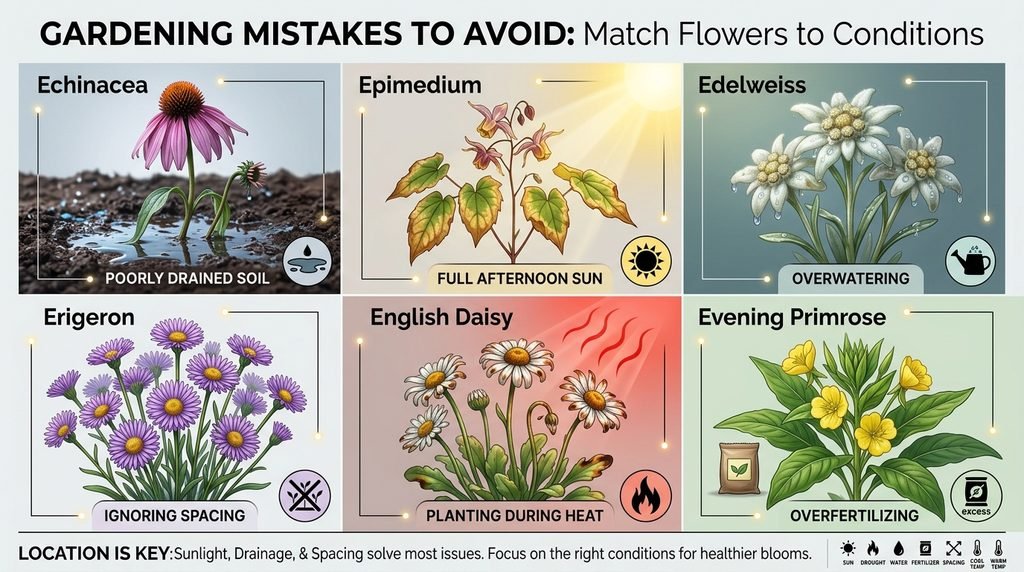
Mistakes to Avoid
- Planting Echinacea in poorly drained soil
- Growing Epimedium in full afternoon sun
- Overwatering Edelweiss
- Ignoring spacing requirements for Erigeron
- Planting English Daisy during extreme summer heat
- Overfertilizing Evening Primrose
- Allowing shade plants to dry out completely
Most of these problems relate to location rather than plant quality. Matching flowers to suitable growing conditions solves many issues immediately.
Gardeners who focus on sunlight, drainage, and spacing usually achieve stronger flowering displays.
If There Is Room for Only Three
Small gardens require careful plant selection. When space is limited, every plant should earn its place.
The following three flowers offer excellent value for a wide range of gardeners.
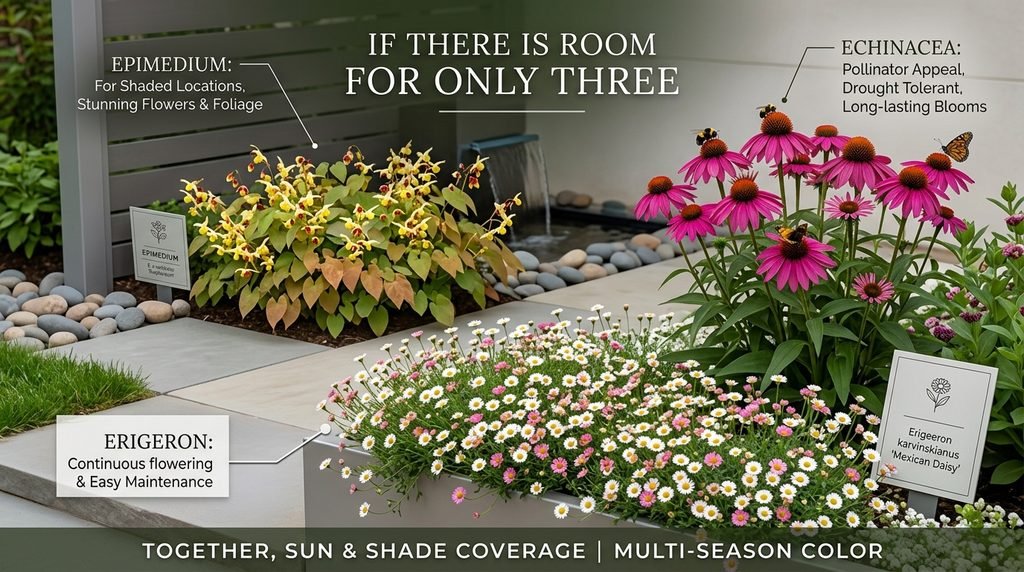
Echinacea
Strong pollinator appeal, drought tolerance, and long-lasting blooms make Echinacea one of the most versatile perennial flowers available.
Epimedium
For shaded locations, few plants provide such an attractive combination of flowers and foliage.
Erigeron
Continuous flowering and easy maintenance make Erigeron an excellent choice for borders, containers, and cottage gardens.
Together, these flowers provide coverage for sunny and shaded conditions while delivering color across multiple seasons.
Seasonal Flower Care Calendar
Flowers perform best when maintenance tasks happen at the right time. A simple seasonal schedule often prevents many common problems.
The following calendar focuses on several of the most popular flowers that start with E.
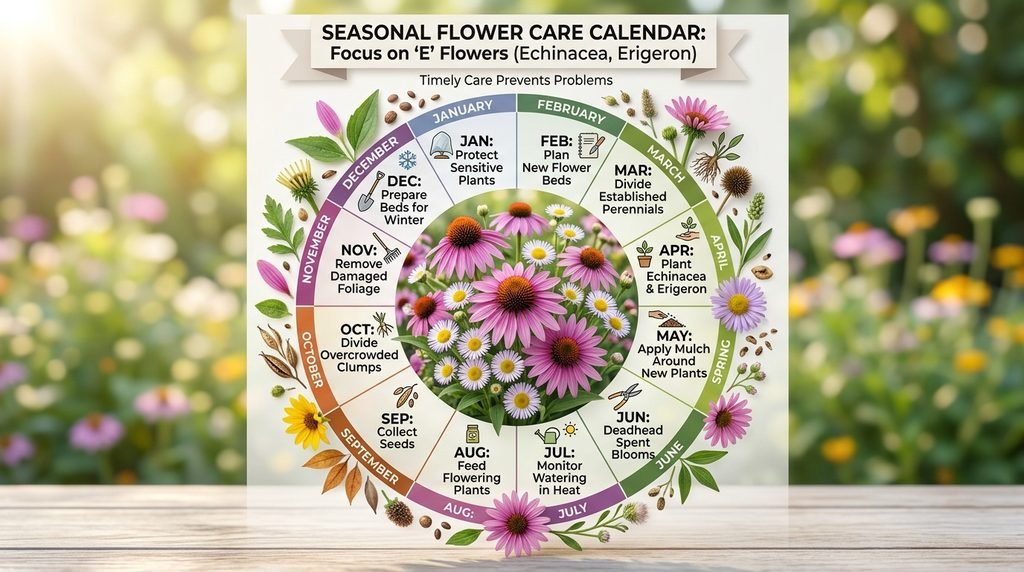
| Month | Recommended Task |
| January | Protect sensitive plants from severe frost |
| February | Plan new flower beds |
| March | Divide established perennials |
| April | Plant Echinacea and Erigeron |
| May | Apply mulch around new plants |
| June | Deadhead spent blooms |
| July | Monitor watering during hot weather |
| August | Feed flowering plants if necessary |
| September | Collect seeds |
| October | Divide overcrowded clumps |
| November | Remove damaged foliage |
| December | Prepare beds for winter |
Spring remains the busiest season because most planting and dividing activities occur during this period.
Autumn shifts attention toward cleanup, seed collection, and winter preparation.
Cost and Availability Notes
Not all flowers are equally easy to find. Some are widely available in garden centers, while others may require specialty nurseries.
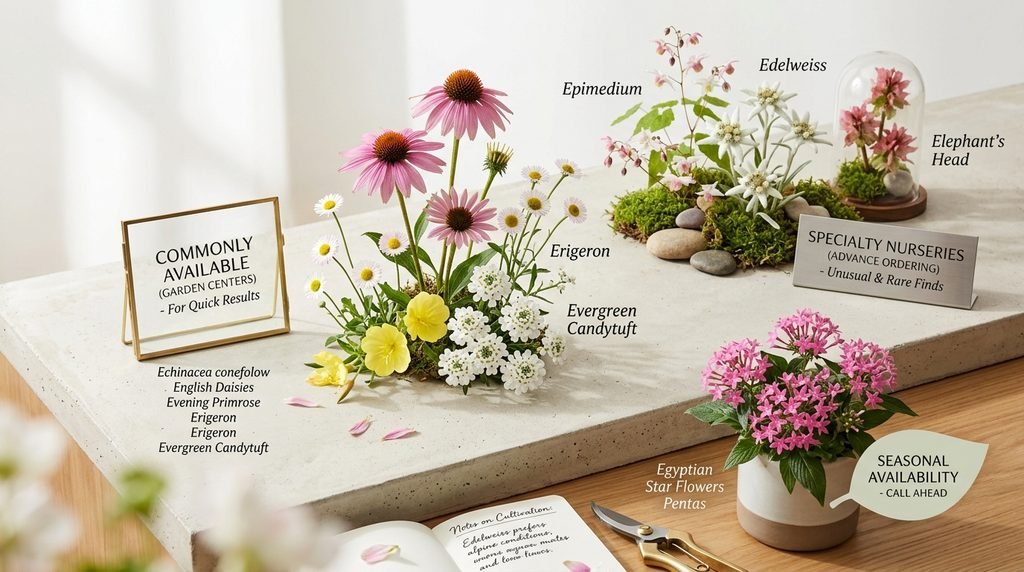
| Flower | Availability |
| Echinacea | Common |
| English Daisy | Common |
| Evening Primrose | Common |
| Erigeron | Common |
| Evergreen Candytuft | Common |
| Epimedium | Moderate |
| Edelweiss | Specialty Nurseries |
| Elephant’s Head | Specialty Nurseries |
| Egyptian Star Flower | Seasonal Availability |
Gardeners looking for quick results will usually find Echinacea, English Daisy, and Candytuft at large garden centers.
More unusual flowers, such as Edelweiss or Elephant’s Head, often require advance ordering from specialty growers.
Safety and Toxicity Considerations
Most ornamental flowers are grown purely for their beauty. However, some species may cause problems if consumed by pets or children.
Researching plant safety before planting is especially important in family gardens.
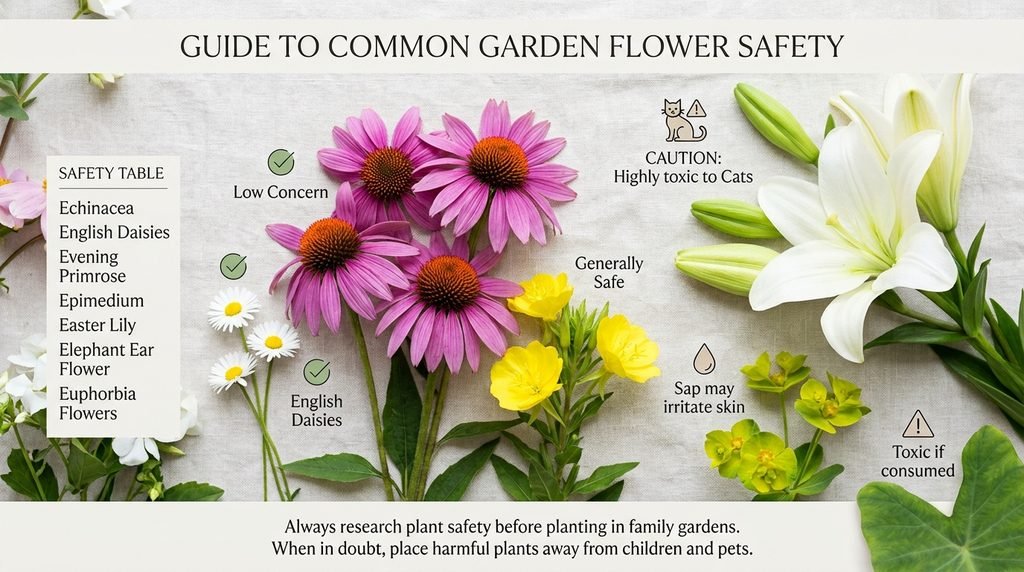
| Flower | Safety Note |
| Echinacea | Generally considered low concern |
| English Daisy | Low concern |
| Evening Primrose | Generally safe |
| Epimedium | Mild toxicity concern |
| Easter Lily | Toxic to cats |
| Elephant Ear Flower | Toxic if consumed |
| Euphorbia Flowers | Sap may irritate skin |
Easter Lily deserves special attention because it can be highly dangerous to cats.
Whenever uncertainty exists, placing potentially harmful plants away from children and pets is often the safest approach.
Flowers That Start With E by Color
Color plays a major role in garden design. Different shades create different moods and visual effects.
Purple Echinacea flowers add richness and attract pollinators. Their color works especially well when paired with yellow-flowering plants.
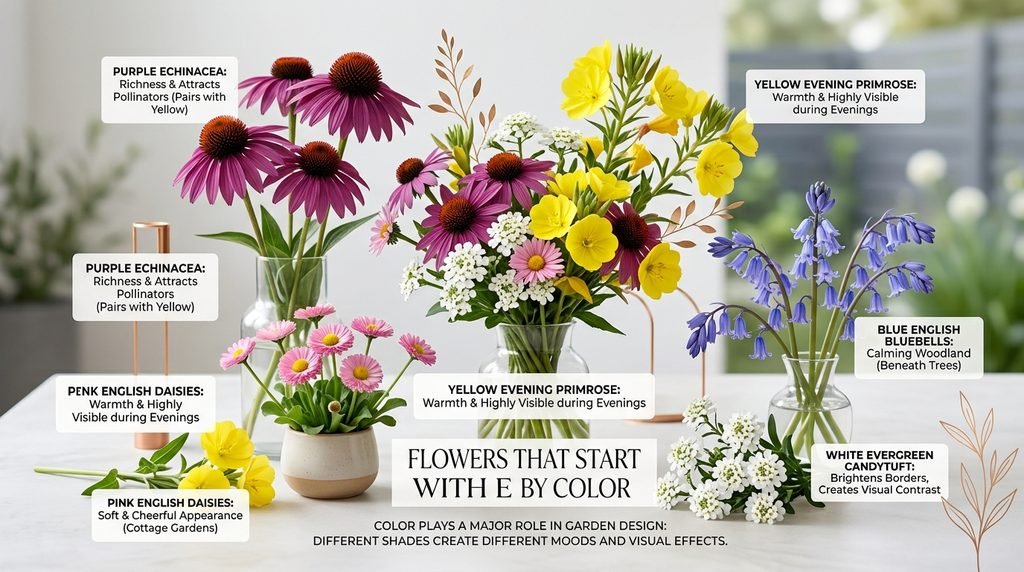
White flowers such as Evergreen Candytuft help brighten borders and create visual contrast throughout the growing season.
Pink English Daisies provide a soft, cheerful appearance that suits cottage gardens and spring displays.
Yellow Evening Primrose flowers add warmth and remain highly visible during evening hours.
Blue-toned English Bluebells create a calming woodland atmosphere beneath trees and shrubs.
60+ Flower Names That Start With E
The alphabetical index is placed near the end so it works as a reference rather than controlling the entire article. Some names below refer to species, cultivars, or commonly used horticultural names, so exact availability can vary by region.
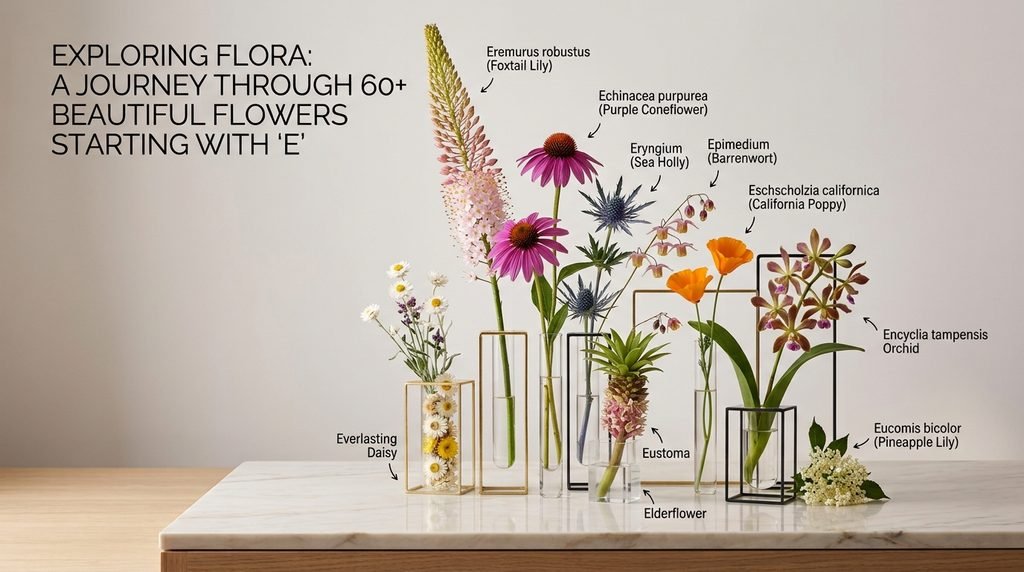
The list also includes garden flowers, wildflowers, bulbs, and less common ornamental plants. This gives readers a broader view of the many flowering plants represented by the letter E.
- Echinacea
- Echinops
- Echinocereus Flower
- Echeveria Flower
- Edelweiss
- Egyptian Star Flower
- Elderflower
- Elephant Ear Flower
- Elephant’s Head
- English Bluebell
- English Daisy
- English Lavender
- English Primrose
- English Rose
- English Violet
- Evening Primrose
- Evergreen Candytuft
- Evergreen Clematis
- Everlasting Daisy
- Everlasting Pea
- Erigeron
- Eremurus
- Erica
- Erica Heather
- Eryngium
- Erythrina
- Eschscholzia
- Escallonia Flower
- Eucomis
- Eupatorium
- Euphorbia Flower
- Eustoma
- Epimedium
- Epiphyllum Flower
- Epigaea
- Epilobium
- Eranthis
- Eremophila
- Eriogonum Flower
- Erythronium
- Eucryphia
- Eugenia Flower
- Eucalyptus Flower
- Exacum
- Exochorda
- Encyclia Orchid
- Epidendrum Orchid
- Encyclia tampensis
- Epidendrum radicans
- Eulophia Orchid
- Euphrasia
- Encelia
- Engelmannia
- Erigeron annuus
- Eriophyllum
- Eschscholzia californica
- Eustoma grandiflorum
- Echinacea purpurea
- Eryngium planum
- Erythrina crista-galli
- Epimedium grandiflorum
- Eremurus robustus
- Eucomis bicolor
- Erysimum
- Erysimum cheiri
This selection demonstrates how broad the E category can be. Echinacea and English Daisy suit familiar garden settings, while Eremurus, Eryngium, Eucomis, and Epimedium offer more distinctive shapes and textures.
For gardeners searching specifically for uncommon plants, orchid genera such as Encyclia and Epidendrum add another interesting group to explore.
Botanical Names That Make Identification Easier
Common names can vary between countries and even between gardening communities. Botanical names provide a more precise way to identify plants, especially when ordering seeds or comparing care requirements.
The following crosswalk connects several familiar E flower names with their botanical identities.
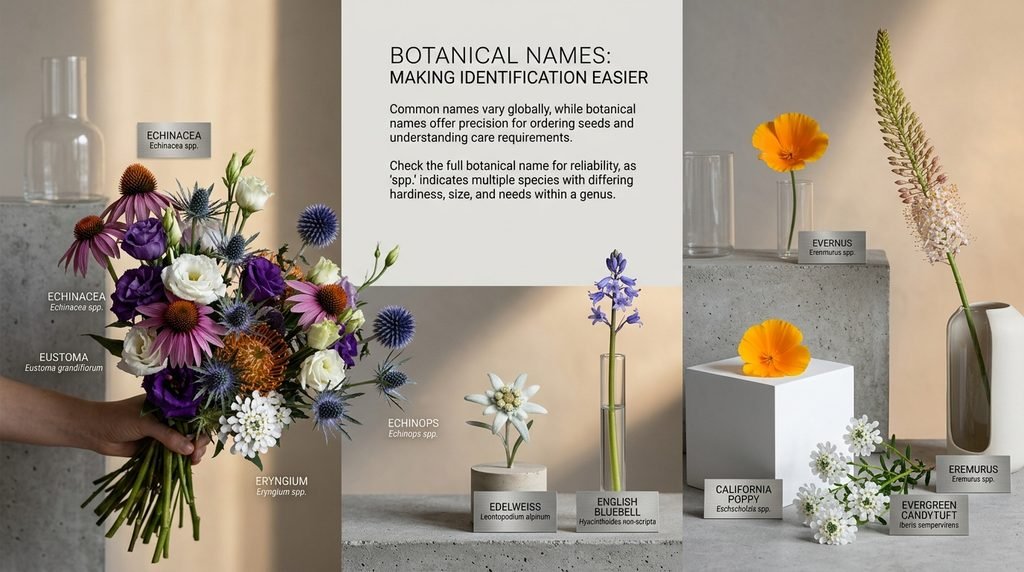
| Common Name | Botanical Name |
| Echinacea | Echinacea spp. |
| Echinops | Echinops spp. |
| Edelweiss | Leontopodium alpinum |
| English Daisy | Bellis perennis |
| English Bluebell | Hyacinthoides non-scripta |
| Evening Primrose | Oenothera spp. |
| Evergreen Candytuft | Iberis sempervirens |
| Erigeron | Erigeron spp. |
| Eremurus | Eremurus spp. |
| Eryngium | Eryngium spp. |
| Eustoma | Eustoma grandiflorum |
| Epimedium | Epimedium spp. |
| Eschscholzia | Eschscholzia spp. |
| Eucomis | Eucomis spp. |
| Erysimum | Erysimum spp. |
The use of “spp.” indicates that the common name can cover multiple species within a genus. This matters because hardiness, mature size, flowering period, and care requirements can differ between species.
When buying a particular plant, checking the full botanical name is therefore more reliable than relying on a common name alone.
What E Flowers Can Symbolize
Flowers often carry cultural meanings in addition to their horticultural value. These meanings can make particular varieties more appealing for gifts, celebrations, or themed gardens.
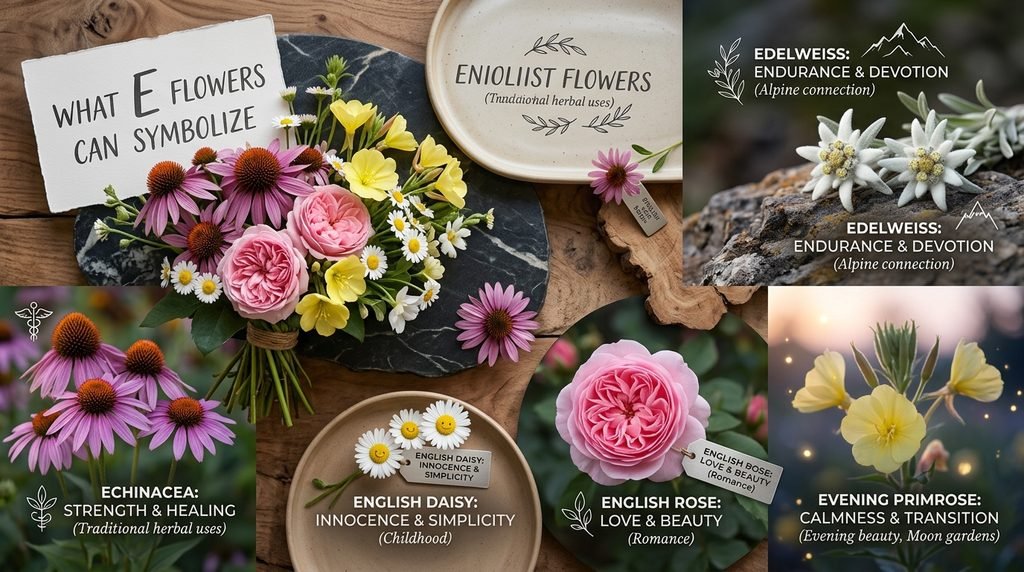
Echinacea is commonly associated with strength and healing because of its long history of use in traditional herbal practices. In ornamental gardens, its sturdy form also gives it a strong visual presence.
Edelweiss has long been connected with alpine landscapes, endurance, and devotion. Its association with high mountain environments contributes to its distinctive symbolism.
English Daisy is often linked with innocence, simplicity, and childhood. Its small, uncomplicated flowers reinforce those traditional associations.
English Rose carries broader associations with love, beauty, and romance. Different rose colors can add more specific meanings.
Evening Primrose has associations with calmness, transition, and evening beauty. Its unusual flowering behavior makes it especially interesting in moon gardens.
Frequently Asked Questions About Flowers That Start With E
1. What are the most popular flowers that start with E?
Echinacea, English Daisy, Evening Primrose, English Rose, Eustoma, and Evergreen Candytuft are among the better-known choices. They range from hardy garden perennials to popular cut flowers.
2. Which flowers that start with E are easiest to grow?
Echinacea, Evergreen Candytuft, English Daisy, and several Erigeron species are good choices for gardeners seeking relatively uncomplicated plants. Their exact performance still depends on sunlight, drainage, and climate.
3. Which E flowers grow well in full sun?
Echinacea, Echinops, Eryngium, Evening Primrose, Erigeron, and Eschscholzia generally prefer sunny locations. Many also perform best in soil that does not remain constantly wet.
4. Are there shade-loving flowers that start with E?
Yes. Epimedium is one of the strongest choices for shaded gardens. Some woodland plants beginning with E also perform well under filtered light.
5. Which E flowers attract bees and butterflies?
Echinacea, Echinops, Eryngium, Erigeron, and Evening Primrose can provide valuable resources for pollinating insects. Planting several species with overlapping bloom periods can make a garden more useful to pollinators.
6. Which flowers that start with E are good for containers?
Echeveria can provide an interesting container display in suitable climates, while compact Erysimum, English Daisy, and some Eustoma cultivars can also work well in containers. Drainage is especially important for plants that dislike wet roots.
7. Which E flowers are suitable for cottage gardens?
English Rose, English Daisy, Echinacea, Erysimum, and Echinops can fit naturally into cottage-style planting schemes. Combining different heights and bloom shapes creates a fuller effect.
8. Which E flowers are suitable for rock gardens?
Edelweiss is a classic alpine choice. Compact Eryngium and suitable Erigeron species can also complement rocky, well-drained planting areas.
9. Which E flowers have unusual shapes?
Echinops produces rounded flower heads, Eremurus develops tall flower spikes, and Eryngium has architectural blooms with spiky bracts. These plants are useful when a garden needs stronger structural contrast.
10. Are any flowers that start with E toxic?
Yes. Safety varies considerably between species. Some Euphorbia plants have irritating sap, while Elephant Ear plants can cause problems if eaten, so plant-specific identification is important before assessing safety.
11. Which E flowers are good for cutting gardens?
Eustoma, English Rose, Echinacea, Eryngium, and Eucalyptus flowering stems can contribute to cut-flower arrangements. Vase life and harvesting methods vary between plants.
12. Which E flowers bloom in spring?
English Daisy, English Bluebell, Epimedium, Eranthis, and Erythronium are among the E plants associated with spring flowering. Bloom timing can shift with climate and local weather.
Final Thoughts
The world of flowers that start with E reaches far beyond a few familiar garden names. From dependable Echinacea to elegant English Roses, unusual Eryngium, alpine Edelweiss, and shade-loving Epimedium, the group offers choices for many different landscapes.
The best selection depends on the conditions available. Sunny borders call for different plants than woodland beds, rock gardens, containers, or pollinator-focused spaces.
Gardeners should consider sunlight, drainage, climate, mature size, and maintenance needs before planting. With those factors matched correctly, even less familiar E flowers can become valuable additions to a garden.
Flowers That Start With E offer an especially useful mix of color, form, fragrance, wildlife value, and seasonal interest. A thoughtful combination can turn a simple planting area into a garden with much more depth and character.