

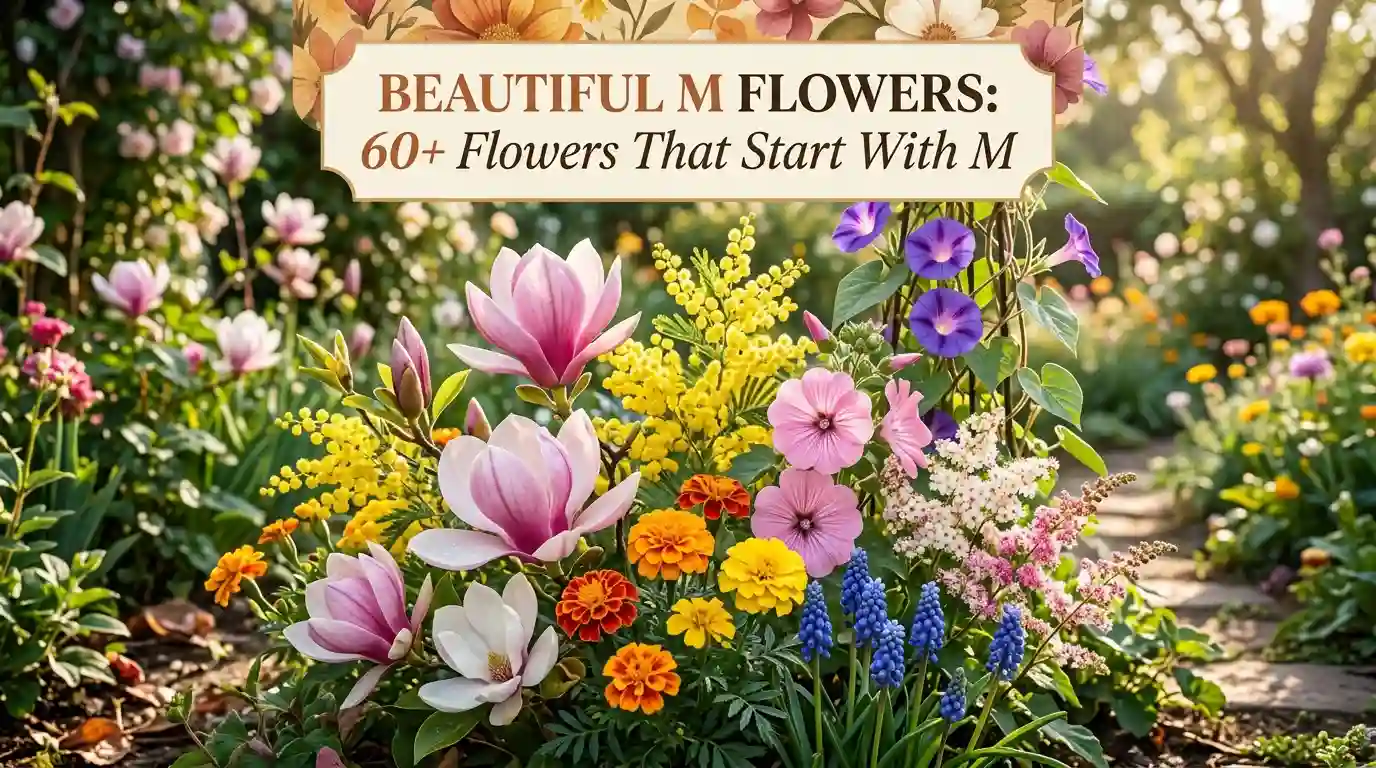
Most flower lists dump names in alphabetical order and leave the planning to you. This guide takes a different approach. It groups flowers that start with M by where and how they actually grow, so you can match a plant to your yard instead of scrolling through fifty names hoping one fits.
Sun exposure, bloom speed, and skill level decide whether a plant thrives or struggles. A gardener with a shady side yard does not need to read about full-sun marigolds first. Someone starting their first flower bed benefits more from a short list of forgiving picks than a wall of Latin names. That is the logic behind every section below.
This article still covers the technical ground you would expect: botanical names, native ranges, hardiness zones, and toxicity warnings, all checked against multiple horticultural references. But it leads with decisions, not definitions. Read the section that matches your situation first, then use the appendix at the end if you need the full name index or a botanical name lookup.
By the end, you should be able to pick three or four M flowers that fit your space, know when to plant them, and know which ones to keep away from pets. That is more useful than a name list alone.
Quick Take: Where to Start
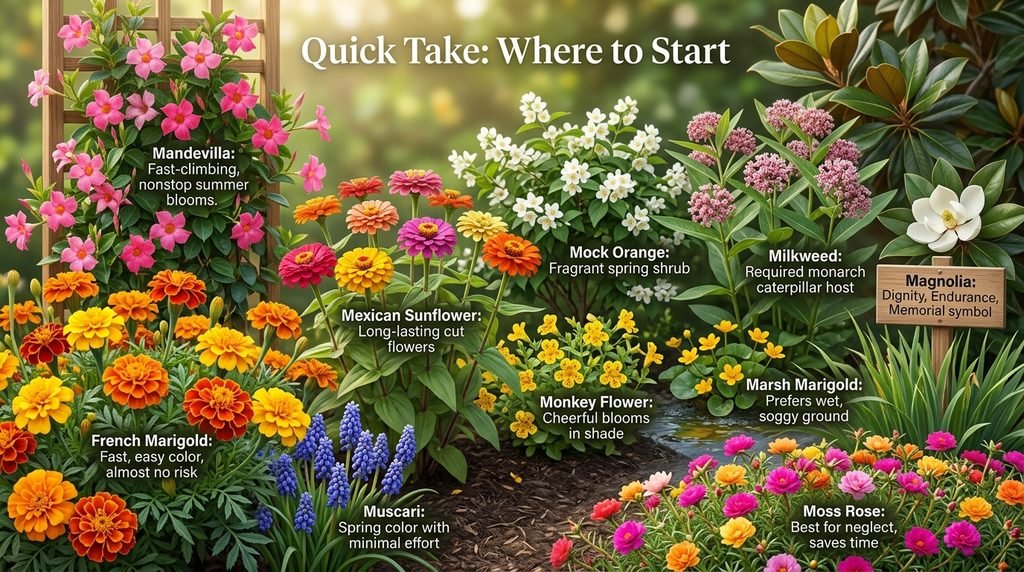
For beginners who want quick color with almost no risk of failure, French Marigold is hard to beat. It sprouts fast, blooms within weeks, and can handle inconsistent watering. If you garden in shade, Monkey Flower fills that gap with cheerful blooms. It performs well where many sun-loving flowers would struggle. Gardeners chasing fragrance should try Mock Orange. This shrub can perfume an entire yard for about two weeks each spring. For cut flowers, Mexican Sunflower is an excellent choice. Its blooms hold up well in a vase, and the plant continues producing new stems throughout the summer. Muscari, also known as Grape Hyacinth, is ideal for anyone who wants spring color with very little effort. Once the bulbs are planted, they require minimal attention.
Gardeners with wet, low-lying soil should consider Marsh Marigold. Unlike many garden flowers, it actually prefers consistently moist or soggy ground. If you want dramatic color with minimal upkeep, try Mandevilla. These vines climb trellises quickly and can produce flowers throughout the summer heat. Pollinator gardens benefit greatly from Milkweed.
It is the essential host plant for monarch butterfly caterpillars and can attract a variety of pollinators. Anyone short on time should consider Moss Rose. It tolerates neglect better than many other flowering plants, making it a practical choice for busy gardeners. Finally, if symbolism matters when choosing plants, Magnolia is worth considering. It has long been associated with dignity and endurance, making it a popular choice for memorial gardens.
What Actually Thrives in Full Sun
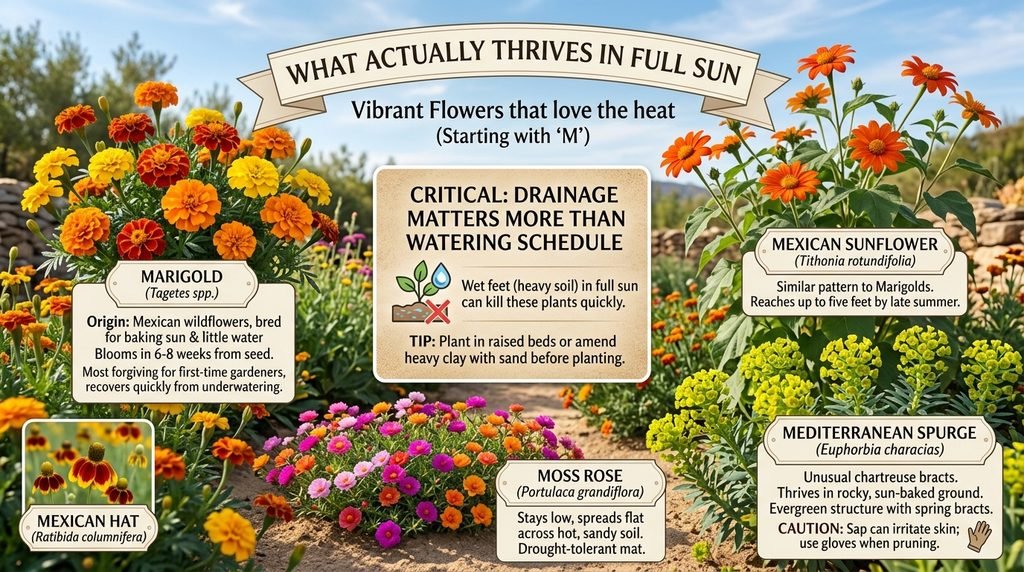
Full-sun flowers that start with M tend to come from hot, dry native ranges, which explains why they handle heat so well in cultivation. French and African Marigolds top this group, since both were bred from Mexican wildflowers used to baking summer sun with little water. Mexican Sunflower follows a similar pattern, producing orange, daisy-like blooms on stems that can reach five feet by midsummer. Moss Rose stays low and spreads flat across hot, sandy soil where other plants would scorch. Mediterranean Spurge brings unusual chartreuse flower bracts and thrives in the same rocky, sun-baked ground its name suggests.
These four plants share one requirement worth repeating: drainage matters more than watering schedule. Wet feet in full sun kills Moss Rose and Marigold faster than drought ever would. Plant them in raised beds or amend heavy clay with sand before setting seedlings out.
- Marigold (Tagetes spp.) — blooms in 6-8 weeks from seed
- Mexican Sunflower (Tithonia rotundifolia) — reaches full height by late summer
- Moss Rose (Portulaca grandiflora) — spreads as a low, drought-tolerant mat
- Mediterranean Spurge (Euphorbia characias) — evergreen structure with spring bracts
- Mexican Hat (Ratibida columnifera) — tolerates poor, rocky soil
Of this group, Marigold remains the most forgiving for a first-time gardener, since it recovers quickly from underwatering. Mediterranean Spurge needs the most caution, because its sap can irritate skin on contact, so gloves are worth using during pruning.
Shade-Tolerant Options Worth Planting
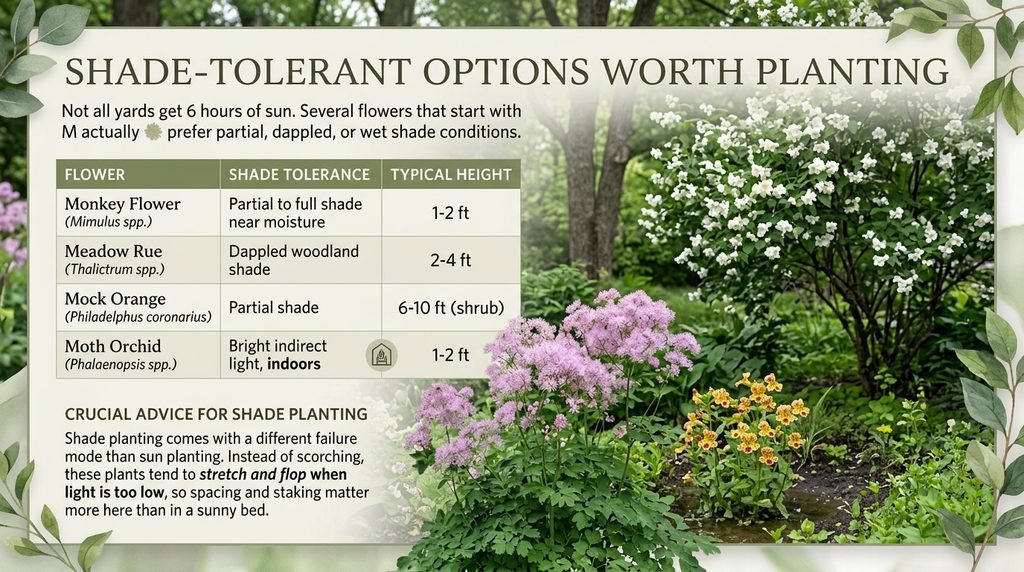
Not every yard gets six hours of direct sun, and several flowers that start with M actually prefer it that way. Monkey Flower produces snapdragon-like blooms in wet, partially shaded spots where grass often struggles anyway. Moth Orchid, grown almost exclusively indoors, needs bright but indirect light rather than direct sun, making it a natural fit for an east-facing window. Meadow Rue tolerates dappled woodland shade and adds airy, cloud-like flower clusters above fern-like foliage. Mock Orange handles partial shade reasonably well, though its bloom count drops slightly compared to full sun.
Shade planting comes with a different failure mode than sun planting. Instead of scorching, these plants tend to stretch and flop when light is too low, so spacing and staking matter more here than in a sunny bed.
| Flower | Shade Tolerance | Typical Height |
| Monkey Flower (Mimulus spp.) | Partial to full shade near moisture | 1-2 ft |
| Meadow Rue (Thalictrum spp.) | Dappled woodland shade | 2-4 ft |
| Mock Orange (Philadelphus coronarius) | Partial shade | 6-10 ft (shrub) |
| Moth Orchid (Phalaenopsis spp.) | Bright indirect light, indoors | 1-2 ft |
Meadow Rue stands out on this list for gardeners who want texture rather than bold color, since its flowers read more as a soft haze than a solid bloom. Monkey Flower, by contrast, rewards anyone with a damp, low corner of the yard that nothing else wants to grow in.
Fastest to Bloom (For Impatient Gardeners)
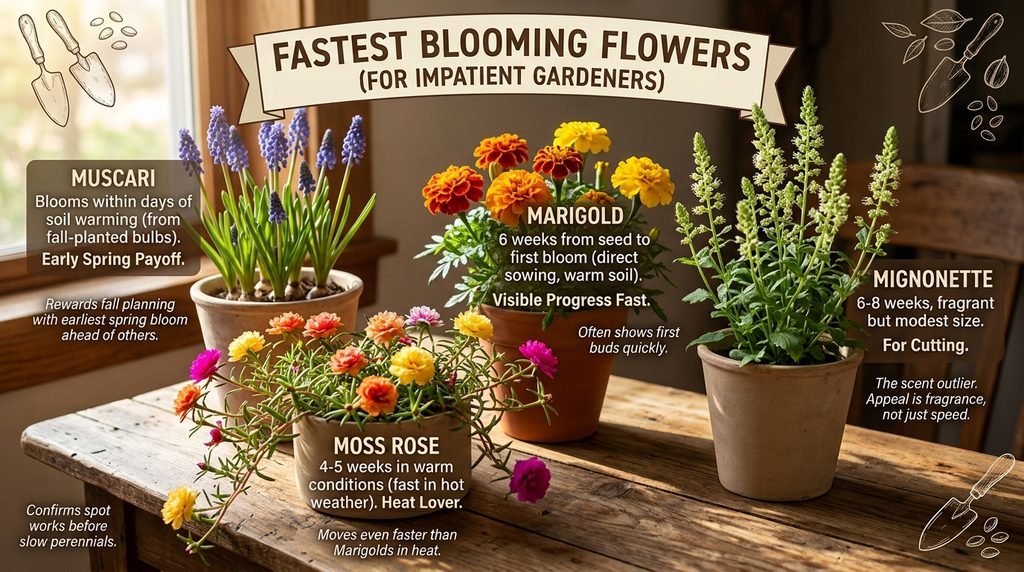
Some flowers reward patience over an entire season, while others give results within a month. Marigold seedlings often show their first flower buds within six weeks of sowing directly in warm soil. Moss Rose moves even faster in hot weather, sometimes flowering within four to five weeks of germination. Mignonette, though less showy, produces its small fragrant spikes quickly enough to work in a fast-turnaround cutting garden. Muscari bulbs, planted in fall, push up bloom spikes as soon as the soil warms in early spring, ahead of most other bulbs.
Speed to bloom matters most for renters, short-season climates, or gardeners testing a new bed before committing to permanent plantings. A fast bloomer confirms a spot works before you invest in slower perennials.
- Marigold — 6 weeks from seed to first bloom
- Moss Rose — 4-5 weeks in warm conditions
- Mignonette — 6-8 weeks, fragrant but modest in size
- Muscari — blooms within days of soil warming, from fall-planted bulbs
Marigold and Moss Rose both suit gardeners who want visible progress fast, while Muscari rewards fall planning with an early spring payoff. Mignonette is the outlier here, since its appeal is scent rather than visual speed.
The Forgiving Ones: Best for Beginners
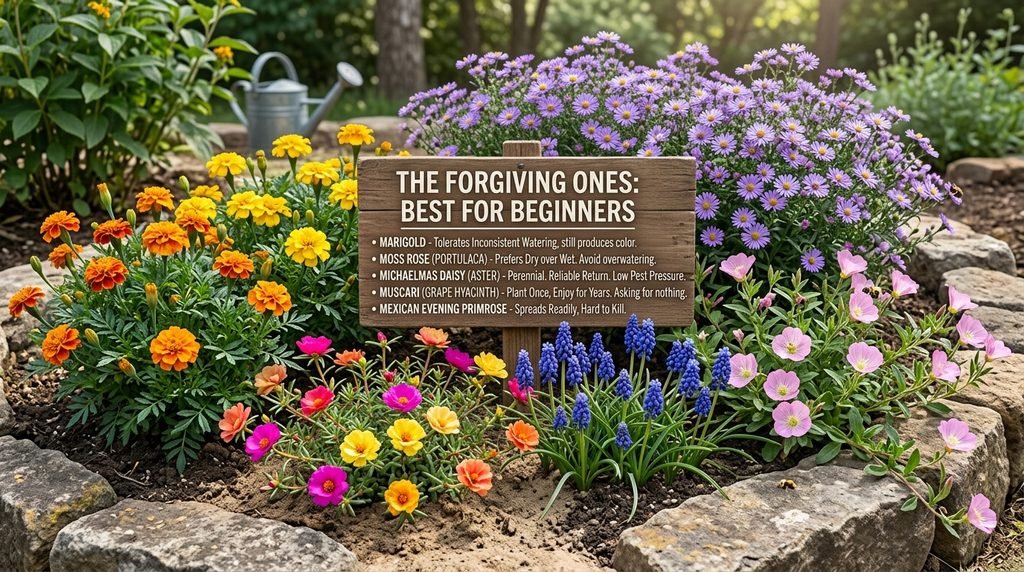
Beginners lose confidence fast when a plant dies within weeks of purchase. These forgiving flowers that start with M tend to survive common rookie mistakes like overwatering, underwatering, or forgetting to deadhead. Marigold tolerates nearly all of these errors and still produces color. Moss Rose actually performs better with some neglect, since overwatering is its main threat. Michaelmas Daisy, a fall-blooming aster relative, comes back reliably each year with almost no pest problems. Muscari asks for nothing beyond a hole in the ground each fall.
This group works well as a starter combination in a single bed, since none of them compete heavily for nutrients or fight each other for space.
- Marigold — thrives on inconsistent watering
- Moss Rose — prefers dry over wet conditions
- Michaelmas Daisy — perennial, low pest pressure
- Muscari — plant once, enjoy for years
- Mexican Evening Primrose — spreads readily, hard to kill
The main risk with this beginner group is not death but overgrowth. Mexican Evening Primrose in particular can spread further than intended, so beginners should plant it where a bit of wandering is welcome rather than a problem.
Skip These Unless You’re Experienced
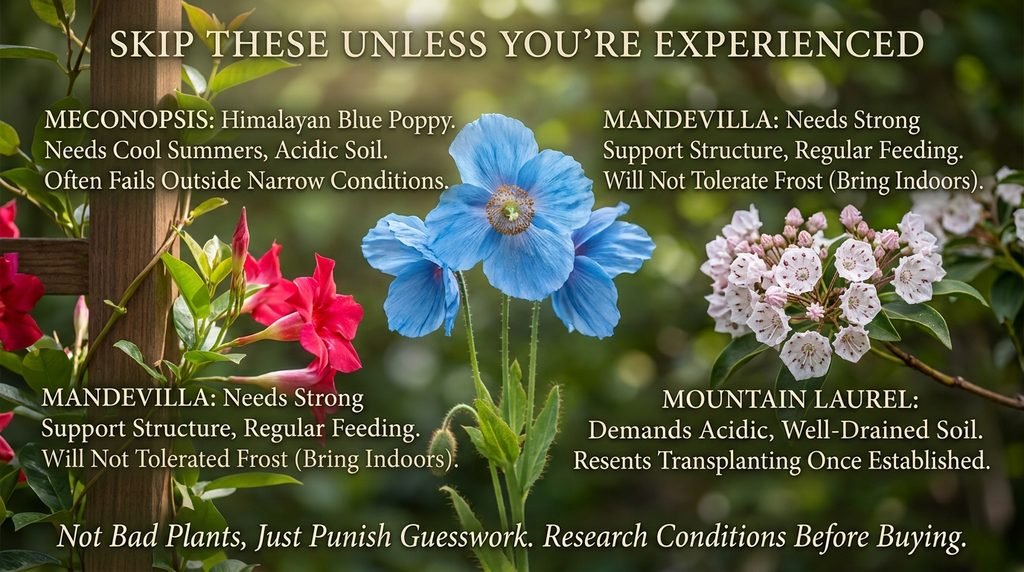
A handful of M flowers ask for specific conditions or careful handling, and beginners often give up on them before learning the trick. Meconopsis, the Himalayan Blue Poppy, needs cool summers and acidic soil that most home gardens do not naturally provide, and it frequently fails outside those narrow conditions. Mandevilla needs a strong support structure and regular feeding to bloom well, and it will not tolerate frost at all, meaning container growers must bring it indoors before the first cold snap. Mountain Laurel demands specific acidic, well-drained soil and resents transplanting once established, so a wrong first placement often means starting over.
These are not bad plants, just plants that punish guesswork. Anyone drawn to them should research their specific site conditions before buying, rather than treating them like a typical bedding plant.
Pairing Them Right: A Companion Planting Table
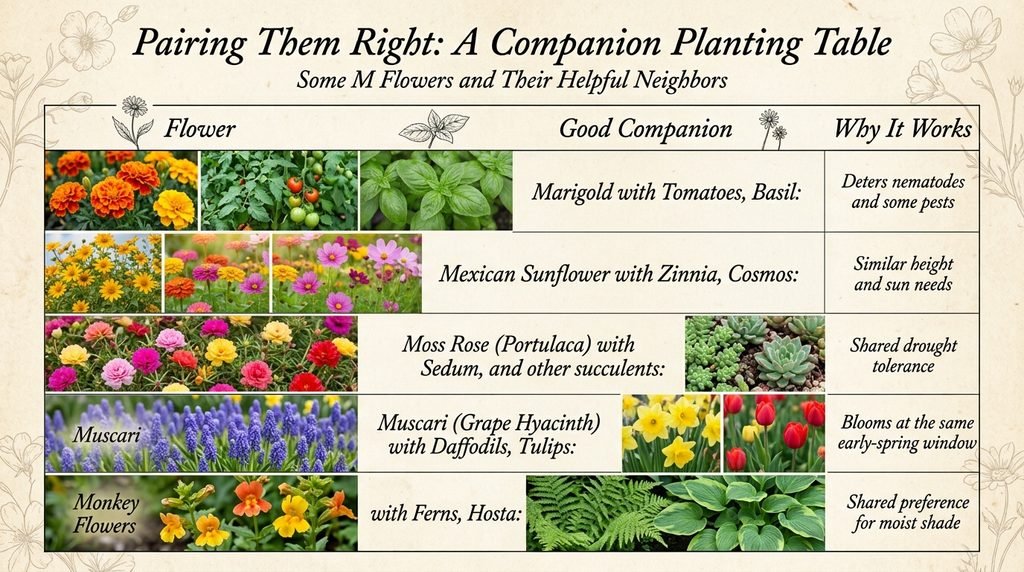
Some M flowers help their neighbors, either by repelling pests, sharing similar water needs, or filling a different height layer in the same bed. Marigold is the standout example, since its roots are known to deter certain soil nematodes that damage vegetable crops, making it a common companion in edible gardens. Matching bloom times and water needs also reduces the guesswork of caring for a mixed bed, since plants with wildly different requirements tend to compete rather than complement each other.
| Flower | Good Companion | Why It Works |
| Marigold | Tomatoes, Basil | Deters nematodes and some pests |
| Mexican Sunflower | Zinnia, Cosmos | Similar height and sun needs |
| Moss Rose | Sedum, other succulents | Shared drought tolerance |
| Muscari | Daffodils, Tulips | Blooms at the same early-spring window |
| Monkey Flower | Ferns, Hosta | Shared preference for moist shade |
Marigold’s pest-deterring reputation makes it worth tucking into vegetable rows, not just ornamental beds. Muscari pairs particularly well with larger spring bulbs, since its low height keeps it from shading out taller neighbors while they bloom together.
A Season-by-Season Care Calendar
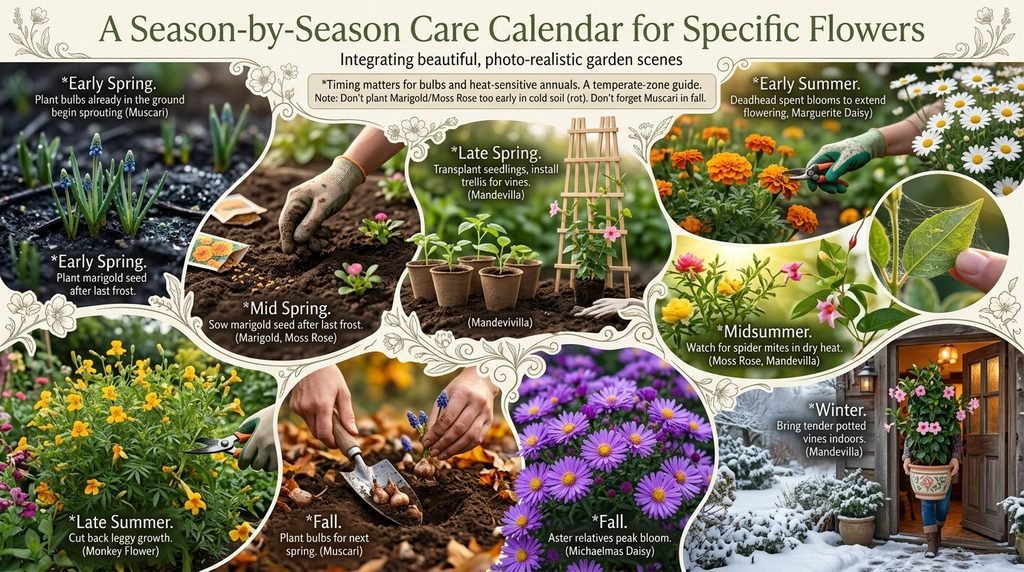
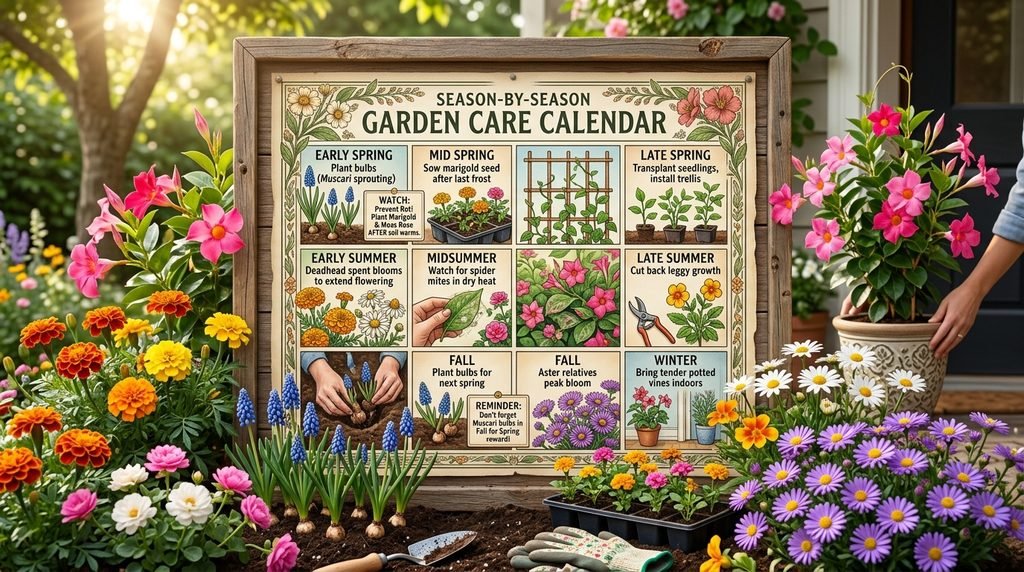
Timing matters more than most new gardeners expect, especially with bulbs and heat-sensitive annuals. The calendar below covers the top picks from earlier sections, tracking what to do across a typical temperate-zone year. Southern hemisphere or tropical gardeners should shift these months by roughly six.
| Month | Task | Flower(s) |
| Early Spring | Plant bulbs already in the ground begin sprouting | Muscari |
| Mid Spring | Sow marigold seed after last frost | Marigold, Moss Rose |
| Late Spring | Transplant seedlings, install trellis for vines | Mandevilla |
| Early Summer | Deadhead spent blooms to extend flowering | Marigold, Marguerite Daisy |
| Midsummer | Watch for spider mites in dry heat | Moss Rose, Mandevilla |
| Late Summer | Cut back leggy growth | Monkey Flower |
| Fall | Plant bulbs for next spring | Muscari |
| Fall | Aster relatives peak bloom | Michaelmas Daisy |
| Winter | Bring tender potted vines indoors | Mandevilla |
The biggest scheduling mistake gardeners make with this group is planting Marigold and Moss Rose too early, before the soil has warmed enough to prevent rot. Muscari, on the other hand, is easy to forget in fall since its reward does not appear until months later.
Common Beginner Mistakes With M Flowers
New gardeners tend to repeat the same handful of errors when growing flowers that start with M. Overwatering Moss Rose is probably the most frequent, since its succulent-like leaves make people assume it needs more water than it actually does. Planting Mandevilla in a spot with weak support is another common issue, leading to a tangled, floppy vine instead of a climbing showpiece. Skipping deadheading on Marigold shortens its bloom season considerably, since spent flowers signal the plant to stop producing new buds. Finally, many beginners plant Muscari bulbs too shallow, which leaves them vulnerable to frost heave and squirrel disturbance over winter.
Each of these mistakes is easy to avoid once you know the pattern, and none of them are fatal on the first try. Adjusting water, support, deadheading, and planting depth solves nearly every early problem with this group.
Caution: Which M Flowers Need Careful Placement
Several attractive flowers that start with M carry real toxicity risks, and this matters most in homes with pets or small children. Mountain Laurel ranks among the most dangerous, since every part of the plant contains compounds that affect the heart and nervous system if ingested. Milkweed, while essential for monarch butterflies, contains cardiac glycosides that are toxic to dogs, cats, and grazing livestock if eaten in quantity. Autumn Crocus, sometimes called Meadow Saffron, is dangerously toxic even in small amounts and has caused serious poisoning in both pets and people. Madagascar Periwinkle contains alkaloids used in chemotherapy drugs, which signals just how potent the plant is if eaten raw. Mandevilla sap can irritate skin and cause stomach upset if chewed, though it is less severe than the plants above.
The table below ranks the risk level for the M flowers most likely to cause an actual emergency versus mild discomfort.
| Flower | Toxic Part | Risk Level | Typical Symptom |
| Mountain Laurel | All parts | High | Heart irregularities, vomiting |
| Autumn Crocus (Meadow Saffron) | Bulb, all parts | High | Severe organ damage if untreated |
| Milkweed | Sap, leaves | Moderate–high | Cardiac effects, drooling |
| Madagascar Periwinkle | All parts | Moderate–high | Nervous system effects |
| Marsh Marigold | Sap, leaves | Moderate | Mouth irritation, drooling |
| Mandevilla | Sap | Mild–moderate | Skin irritation, stomach upset |
Mountain Laurel and Autumn Crocus deserve the strictest caution on this list, since both have documented cases of serious poisoning in pets. Marigold and Muscari, by contrast, are considered low risk and generally safe around curious dogs, making them a safer default for pet-owning households.
Grouping by Color for Design Planning

Yellow and Orange M Flowers: Marigold and Mexican Sunflower dominate this range, both throwing warm, saturated color from midsummer through frost. These suit beds that need to read as bold from a distance, since both hold their color well even in strong afternoon light. Mexican Hat adds a two-tone variation, with yellow petal tips fading to a darker red-brown base.
Purple and Blue M Flowers: Muscari leads this group with its tight clusters of deep blue-purple spring blooms, often planted in drifts for a carpet effect. Meconopsis, when conditions allow it to thrive, produces one of the truest blue tones found in any garden flower. Michaelmas Daisy closes out the color range in fall with soft lavender-purple petals around a yellow center.
Pink and Red M Flower:s Moss Rose covers this range in nearly every shade from soft pink to hot magenta, often on the same plant if left to self-seed. Mandevilla contributes glossy, trumpet-shaped pink or red blooms that read as tropical even in a temperate garden. Mock Orange, though primarily white, sometimes shows a faint pink blush in certain cultivars.
White M Flowe:rs Mock Orange and Magnolia both lean into fragrant white blooms, though on very different scales, from a modest shrub to a mature flowering tree. Moth Orchid, grown indoors, offers a similarly elegant white with none of the outdoor maintenance either woody plant requires.
Cost and Availability Notes
Availability varies a lot among flowers that start with M. Big-box nurseries stock Marigold, Moss Rose, Muscari, and Mock Orange reliably every season, usually at low prices since all four are propagated cheaply from seed or bulb. Mandevilla is also widely available but costs noticeably more, since it is typically sold as an established potted vine rather than a seedling. Mountain Laurel and Meconopsis are far less predictable finds, often requiring a specialty nursery or a mail-order supplier that specializes in native or alpine plants. Michaelmas Daisy sits in between, common at general nurseries in early fall but harder to find during spring shopping season.
Budget-conscious gardeners can build an entire M-flower bed from big-box purchases alone using Marigold, Moss Rose, and Muscari, without ever needing a specialty order.
Full Name Index (Quick Reference)
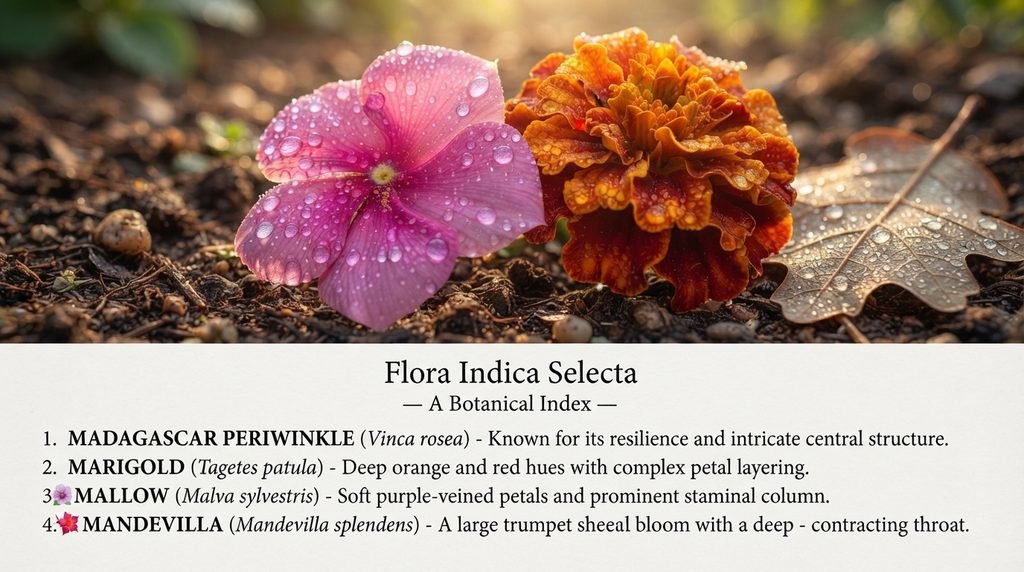
For readers who want a complete list rather than a guided path, the names below cover every flower mentioned in this guide, plus a few additional entries that did not fit neatly into the sections above.
- Magnolia (Magnolia grandiflora, M. stellata)
- Madagascar Periwinkle (Catharanthus roseus)
- Mallow (Malva sylvestris)
- Maltese Cross (Lychnis chalcedonica)
- Mandevilla (Mandevilla splendens)
- Marguerite Daisy (Argyranthemum frutescens)
- Marigold (Tagetes spp.)
- Marsh Mallow (Althaea officinalis)
- Marsh Marigold (Caltha palustris)
- Marvel of Peru / Four O’Clock (Mirabilis jalapa)
- May Apple (Podophyllum peltatum)
- Meadow Cranesbill (Geranium pratense)
- Meadow Rue (Thalictrum spp.)
- Meadow Saffron / Autumn Crocus (Colchicum autumnale)
- Meadowsweet (Filipendula ulmaria)
- Meconopsis / Himalayan Blue Poppy (Meconopsis betonicifolia)
- Mediterranean Spurge (Euphorbia characias)
- Mesembryanthemum / Livingstone Daisy
- Mexican Bush Sage (Salvia leucantha)
- Mexican Evening Primrose (Oenothera speciosa)
- Mexican Fire Plant (Euphorbia cyathophora)
- Mexican Hat (Ratibida columnifera)
- Mexican Petunia (Ruellia simplex)
- Mexican Sunflower (Tithonia rotundifolia)
- Michaelmas Daisy (Symphyotrichum novi-belgii)
- Mignonette (Reseda odorata)
- Milk Thistle (Silybum marianum)
- Milkweed (Asclepias syriaca, A. tuberosa)
- Mimosa Tree (Albizia julibrissin)
- Mina Lobata / Spanish Flag (Ipomoea lobata)
- Miniature Rose (Rosa, dwarf cultivars)
- Mock Orange (Philadelphus coronarius)
- Money Plant / Lunaria (Lunaria annua)
- Monkey Flower (Mimulus spp.)
- Montbretia / Crocosmia (Crocosm×a x crocosmiiflora)
- Moonflower (Ipomoea alba)
- Morning Glory (Ipomoea purpurea, I. tricolor)
- Moss Campion (Silene acaulis)
- Moss Phlox (Phlox subulata)
- Moss Rose (Portulaca grandiflora)
- Moss Verbena (Glandularia pulchella)
- Moth Orchid (Phalaenopsis spp.)
- Mountain Avens (Dryas octopetala)
- Mountain Bluet (Centaurea montana)
- Mountain Laurel (Kalmia latifolia)
- Mullein (Verbascum thapsus)
- Muscari / Grape Hyacinth (Muscari armeniacum)
- Musk Mallow (Malva moschata)
- Musk Rose (Rosa moschata)
- Musk Thistle (Carduus nutans)
- Myrtle / Vinca (Vinca minor)
- Turk’s Cap / Malvaviscus (Malvaviscus arboreus)
This brings the total to 50 named entries, spanning annuals, perennials, bulbs, shrubs, vines, and a couple of trees. Several, like Marsh Marigold and Mountain Laurel, appear here specifically because they carry warnings covered earlier and deserve a second look before planting near pets.
Botanical Name Reference
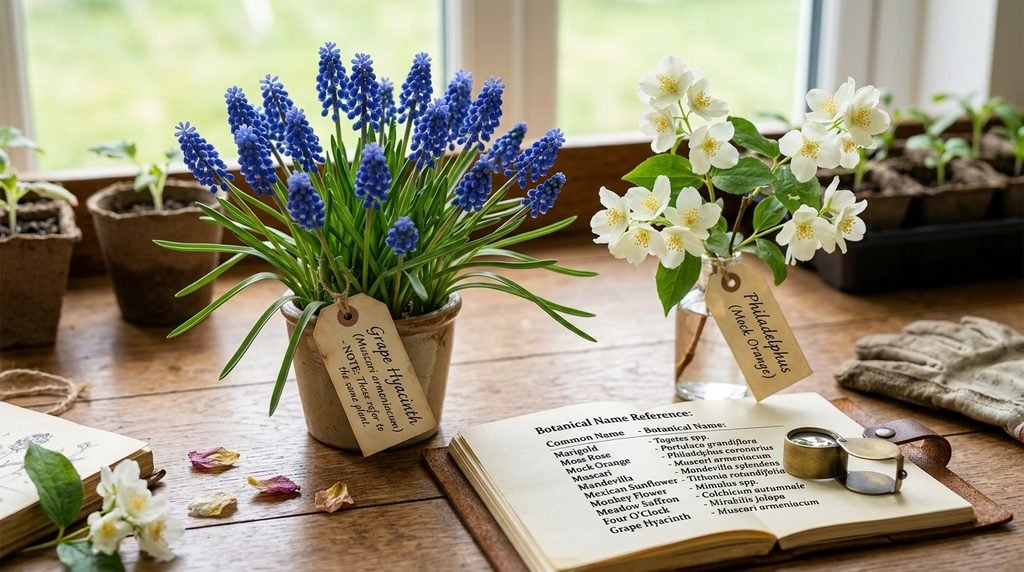
Nursery tags rarely use common names consistently, which causes real confusion at checkout. A shopper looking for “Mock Orange” might walk past a tag reading only “Philadelphus” without realizing it is the same plant. The table below matches the common names used throughout this guide to their botanical equivalents, so cross-referencing at a nursery or online catalog is faster.
| Common Name | Botanical Name |
| Marigold | Tagetes spp. |
| Moss Rose | Portulaca grandiflora |
| Mock Orange | Philadelphus coronarius |
| Muscari | Muscari armeniacum |
| Mandevilla | Mandevilla splendens |
| Mexican Sunflower | Tithonia rotundifolia |
| Monkey Flower | Mimulus spp. |
| Meadow Saffron | Colchicum autumnale |
| Four O’Clock | Mirabilis jalapa |
| Grape Hyacinth | Muscari armeniacum |
A few of these names double up across regions, which is worth noting before you order online. “Grape Hyacinth” and “Muscari” refer to the same plant, so buying both by accident is a common and harmless mistake, just an unnecessary one.
What These Flowers Represent
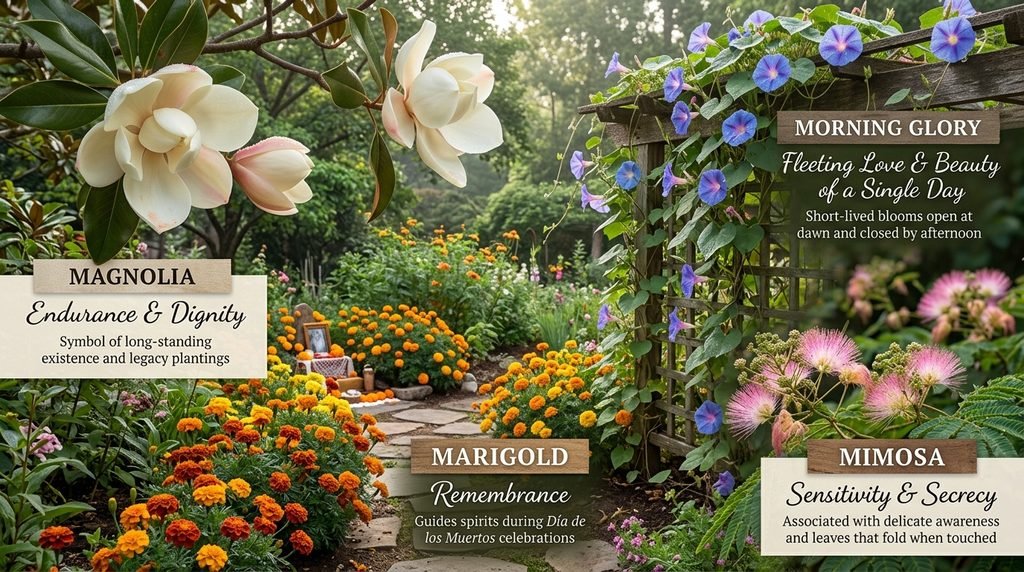
Marigold carries strong symbolic weight in several cultures, most visibly in Día de los Muertos celebrations across Mexico, where its bright orange color is believed to guide spirits back to visit the living. That association with remembrance and connection across generations gives the flower meaning well beyond its garden use.
Magnolia’s symbolism leans toward endurance and dignity, likely tied to how long the tree has existed relative to more recently cultivated flowering plants, with fossil records showing magnolias predating bees as pollinators. Gardeners often choose Magnolia for memorial or legacy plantings for exactly this reason.
Morning Glory’s short-lived bloom, open at dawn and closed by afternoon, has made it a common symbol for fleeting love or the beauty of a single day. This contrasts with longer-blooming flowers on this list and gives Morning Glory a slightly bittersweet meaning in floral tradition.
Mimosa, with its soft, feathery pink blooms, is associated in some traditions with sensitivity and secrecy, possibly linked to the way certain related plants fold their leaves when touched. That physical responsiveness gave rise to a broader symbolic idea of delicacy and quiet awareness.
Conclusion
Flowers that start with M cover nearly every growing condition a home gardener might face, from full sun to deep shade, from four-week annuals to slow-growing trees. Choosing by growing context first, rather than alphabetically, makes it far easier to land on a plant that will actually thrive in your specific yard. Whether you start with a forgiving Marigold or work up to a finicky Meconopsis, the right M flower is usually a matter of matching plant to place rather than luck.
Frequently Asked Questions
What are the easiest flowers that start with M for beginners?
Marigold, Moss Rose, and Muscari are the most forgiving choices. All three tolerate common beginner mistakes like inconsistent watering and late planting.
Which flowers that start with M are toxic to dogs?
Mountain Laurel, Milkweed, Autumn Crocus, and Madagascar Periwinkle are the main concerns. Mountain Laurel and Autumn Crocus carry the highest risk and should be kept out of reach entirely.
Do any M flowers grow well in shade?
Yes. Monkey Flower and Meadow Rue both tolerate partial to full shade, especially in moist soil. Moth Orchid also thrives indoors away from direct sun.
What is the fastest-blooming flower that starts with M?
Moss Rose often blooms within four to five weeks of germination in warm weather, making it one of the quickest options on this list.
Can Marigold and Mexican Sunflower be planted together?
Yes, both share similar sun and water needs, and their contrasting heights work well in a mixed bed without one shading out the other.
Is Muscari the same plant as Grape Hyacinth?
Yes, Muscari is the botanical name and Grape Hyacinth is the common name for the same fall-planted, spring-blooming bulb.
Which M flower is best for attracting monarch butterflies?
Milkweed is essential, since it is the only host plant monarch caterpillars can eat. It also provides nectar for adult butterflies and other pollinators.
What flowers that start with M should experienced gardeners try?
Meconopsis, Mandevilla, and Mountain Laurel all reward more advanced technique, since each has specific soil, support, or climate requirements that punish guesswork.