

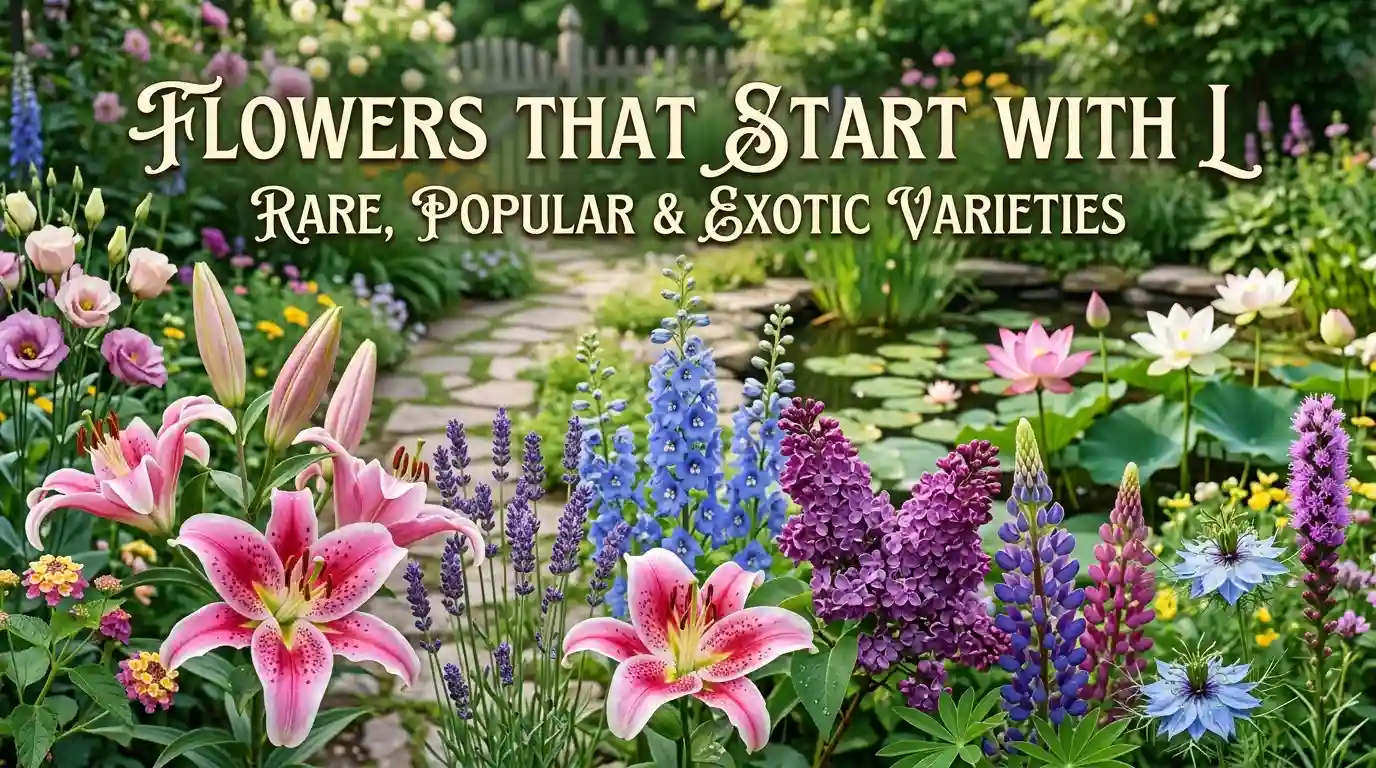
L covers some of the most widely grown flowers in the world — Lavender, Lilac, and Lily among them — alongside quieter, less common picks like Lewisia and Lithodora. Treating all of these as one flat alphabetical list glosses over just how differently they behave in an actual garden, from full-sun Mediterranean natives to shade-loving woodland perennials.
This guide organizes L-flowers by growing conditions first: how much sun a spot receives, how quickly color is needed, and how much hands-on care a plant realistically demands. That structure means a reader can go straight to the section that matches their yard instead of scrolling through dozens of unrelated names.
The complete alphabetical index of L-flowers still appears in this article, positioned near the end as a quick-reference appendix rather than the organizing framework. Anyone who already has a specific name in mind can jump directly there.
What follows draws on widely available L-flowers found at nurseries and seed suppliers, along with a handful of less common but genuinely worthwhile picks for gardeners looking to branch out from the obvious choices.
Quick Take: Standout L-Flowers Worth Growing
These ten make the list for practical reasons that go beyond simply looking good.
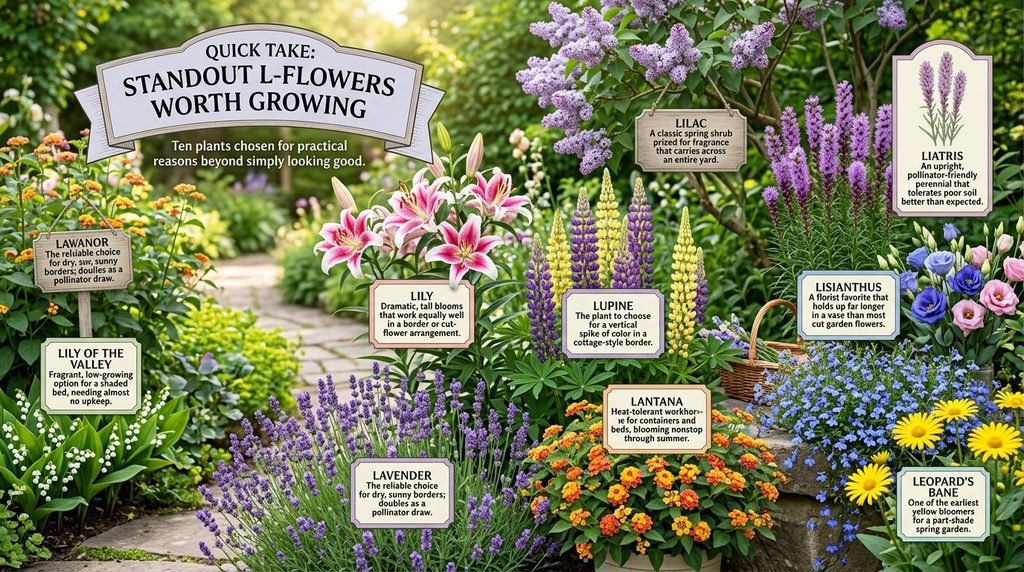
- Lavender — the reliable choice for a dry, sunny border that also doubles as a pollinator draw.
- Lilac — a classic spring shrub prized for fragrance that carries across an entire yard.
- Lily — dramatic, tall blooms that work equally well in a border or a cut-flower arrangement.
- Lantana — a heat-tolerant workhorse for containers and beds that bloom nonstop through summer.
- Lupine — the plant to choose for a vertical spike of color in a cottage-style border.
- Lisianthus — a florist favorite that holds up far longer in a vase than most cut garden flowers.
- Liatris — an upright, pollinator-friendly perennial that tolerates poor soil better than expected.
- Lobelia — a low, trailing option that fills gaps in containers and hanging baskets reliably.
- Lily of the Valley — a fragrant, low-growing option for a shaded bed that needs almost no upkeep.
- Leopard’s Bane — one of the earliest yellow bloomers to show up in a part-shade spring garden.
Full-Sun L-Flowers That Handle Real Heat
A large share of L-flowers are genuinely built for hot, dry, full-sun conditions rather than merely tolerating them. Lavender and Lantana stand out here, both performing better in lean soil and consistent sun than in rich, well-watered beds.
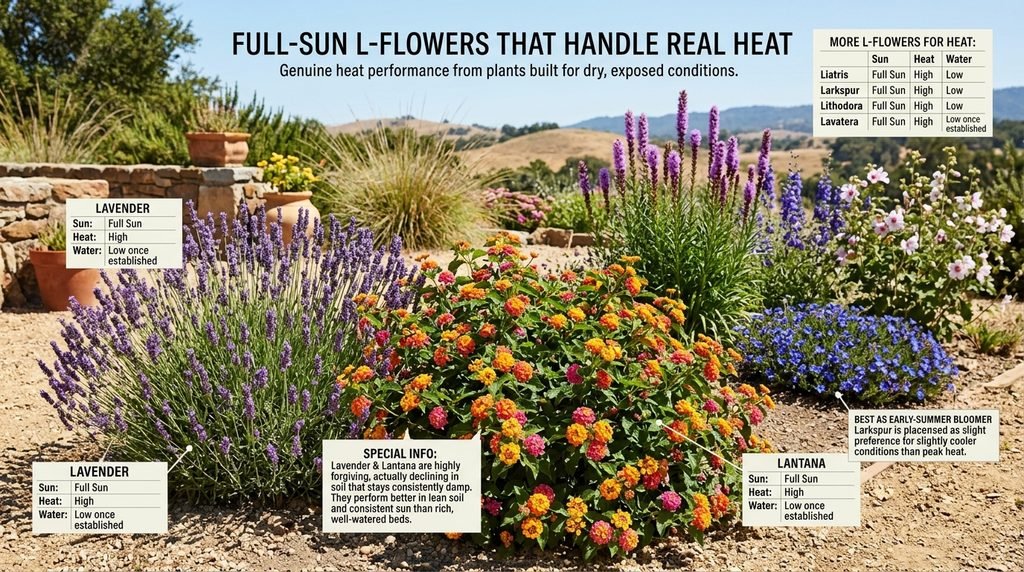
| Flower | Sun Requirement | Heat Tolerance | Watering Once Established |
| Lavender | Full sun | High | Low |
| Lantana | Full sun | High | Low |
| Liatris | Full sun | High | Low to moderate |
| Larkspur | Full sun | Moderate | Moderate |
| Lithodora | Full sun | Moderate | Low |
| Lavatera (Tree Mallow) | Full sun | High | Low to moderate |
Lavender and Lantana are the two most forgiving choices for genuinely dry, exposed spots, since both actually decline in soil that stays consistently damp. Larkspur handles full sun well but prefers slightly cooler conditions than the others in this group, so it tends to perform best as an early-summer bloomer rather than a plant that carries through peak heat.
Shade and Part-Shade Options Worth Planting
Several L-flowers are well suited to filtered or indirect light, which makes them useful for beds that don’t get consistent sun. Lily of the Valley and Leopard’s Bane are two of the most dependable shade performers in this group.
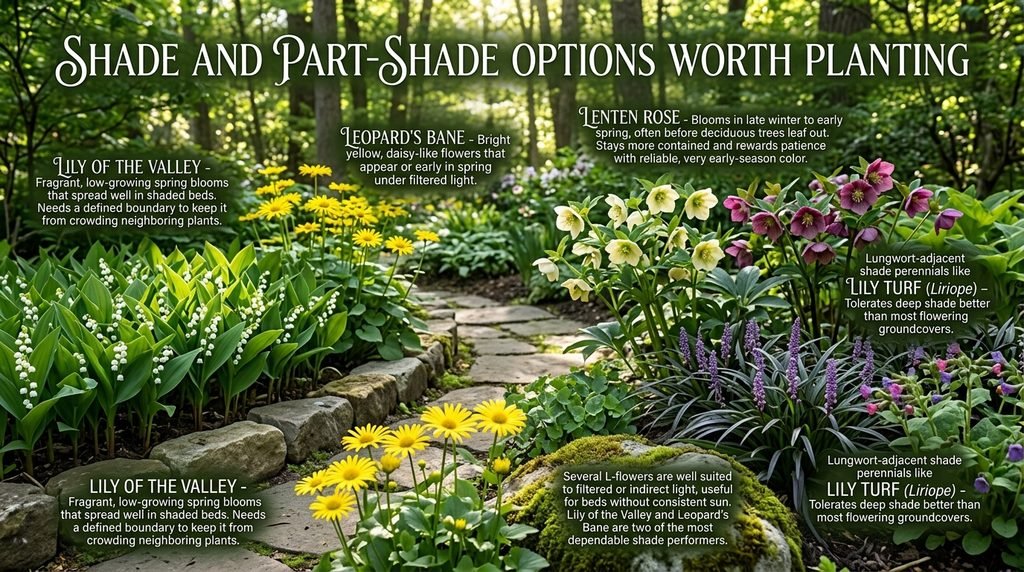
- Lily of the Valley — fragrant, low-growing spring blooms that spread well in shaded beds
- Leopard’s Bane — bright yellow, daisy-like flowers that appear early in spring under filtered light
- Lenten Rose — blooms in late winter to early spring, often before deciduous trees leaf out
- Lungwort-adjacent shade perennials like Lily Turf (Liriope) — tolerates deep shade better than most flowering groundcovers.
Lily of the Valley spreads readily once established, which makes it a strong groundcover option but one that needs a defined boundary to keep it from crowding out neighboring plants. Lenten Rose, by contrast, stays more contained and rewards patience with reliable, very early-season color that few other shade plants can match.
Which L-Flowers Bloom the Fastest
For anyone planting on a schedule, bloom speed varies widely across this letter. Lobelia and Love-in-a-Mist are the fastest options, both capable of flowering within a couple of months of sowing.
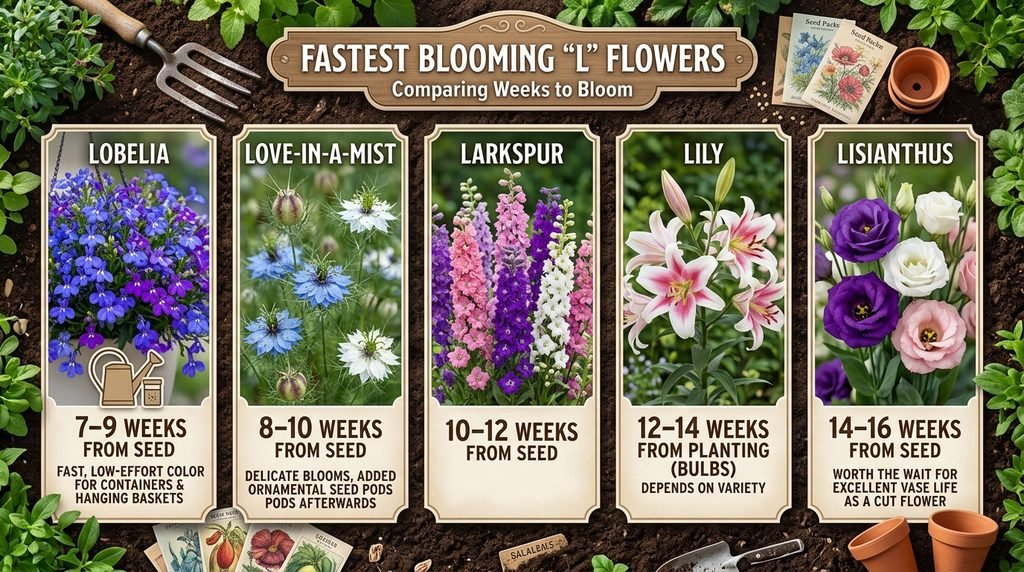
- Lobelia — often blooms within 7–9 weeks from seed
- Love-in-a-Mist — typically 8–10 weeks from seed to first bloom
- Larkspur — usually flowers within 10–12 weeks from seed
- Lisianthus — slower to establish, generally 14–16 weeks from seed to bloom
- Lily — bulbs typically bloom within 12–14 weeks of planting, depending on the variety
Lobelia is the practical pick for fast, low-effort color in containers and hanging baskets, while Love-in-a-Mist offers a similar timeline with the added benefit of ornamental seed pods once the flowers fade. Lisianthus takes considerably longer to bloom than most annuals on this list, but its long vase life as a cut flower makes the wait worthwhile for gardeners growing it specifically for arrangements.
Matching L-Flowers to Gardening Experience
Some L-flowers tolerate real neglect, while a few ask for more precise conditions than a first-time gardener might expect. Lantana, Lobelia, and Liatris are dependable starting points that handle average soil and inconsistent watering without much trouble. Lisianthus sits at the more demanding end — it’s slow to germinate, sensitive to overwatering, and prone to stem rot in humid conditions, which makes it a plant better suited to someone who already has a season or two of experience under their belt.
- Solid starting points: Lantana, Lobelia, Liatris, Lavender
- Manageable with some attention: Lily (watch for pest pressure from lily beetles), Lupine (dislikes being transplanted once established)
- Better left to experienced growers: Lisianthus (slow, humidity-sensitive germination), Lewisia (needs sharp drainage and struggles with wet crowns)
A Shortlist If Space Is Tight
For a small garden, three L-flowers can cover most practical needs without redundancy. Lavender supplies fragrance and pollinator activity for a sunny edge, Lobelia fills in low, trailing color for containers or border gaps, and Lily of the Valley anchors a shaded corner with reliable, low-maintenance spring bloom. Between the three, a small space gets scent, ground-level fill, and shade coverage without any of them competing for the same role.
Pairing L-Flowers With Good Neighbors
Companion planting tends to work best when nearby plants share similar sun and water needs, or when one plant offers the other a practical benefit, such as pest deterrence or shared pollinator traffic. Getting the pairing wrong usually shows up gradually, with one plant thriving while its neighbor quietly struggles.
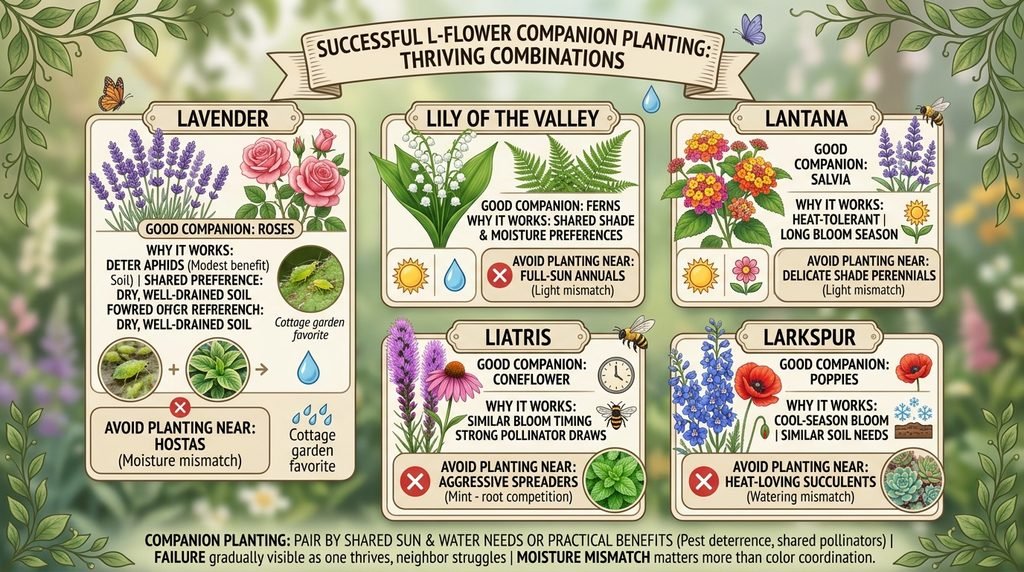
| Flower | Good Companion | Why It Works | Avoid Planting Near |
| Lavender | Roses | Lavender’s scent is thought to help deter aphids near roses | Hostas (moisture mismatch) |
| Lily of the Valley | Ferns | Shared shade and moisture preferences | Full-sun annuals (light mismatch) |
| Lantana | Salvia | Both heat-tolerant and share a long bloom season | Delicate shade perennials (light mismatch) |
| Liatris | Coneflower | Similar bloom timing, both strong pollinator draws | Aggressive spreaders like mint (root competition) |
| Larkspur | Poppies | Similar cool-season bloom timing and soil needs | Heat-loving succulents (watering mismatch) |
The Lavender-and-rose pairing is a long-standing favorite in cottage gardens, and while the aphid-deterrent effect is modest rather than dramatic, the shared preference for dry, well-drained soil makes the pairing practical regardless. The broader pattern across this table is that most L-flower companion failures come down to a moisture mismatch, so checking that detail matters more than color coordination when choosing a neighbor.
A Month-by-Month Calendar for the Top Picks
Timing plays a real role in how well several L-flowers establish and bloom. Lily bulbs need a defined fall or spring planting window depending on the variety, and Lavender benefits from a specific pruning schedule to stay compact and productive.
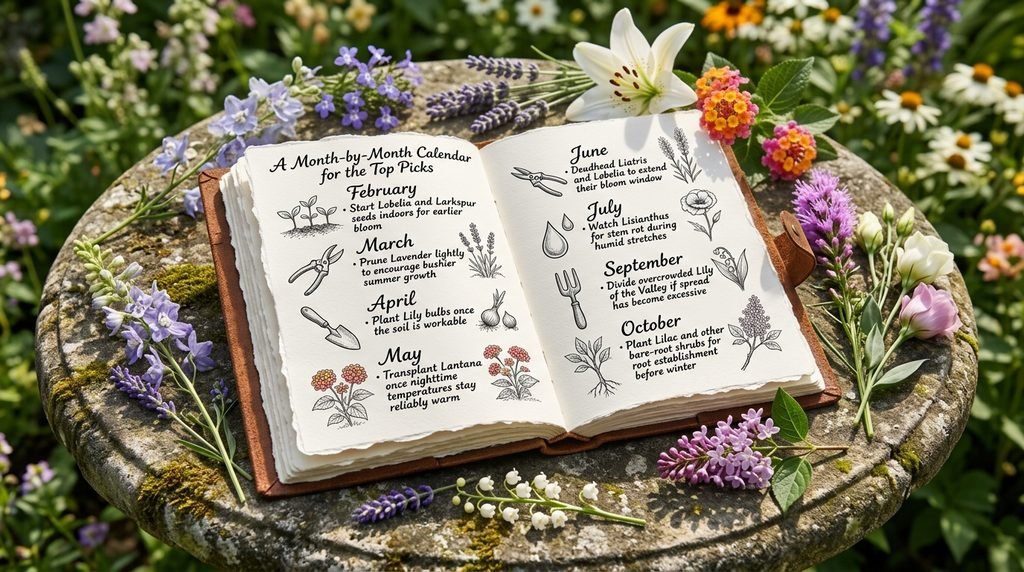
| Month | Task |
| February | Start Lobelia and Larkspur seeds indoors for earlier bloom |
| March | Prune Lavender lightly to encourage bushier summer growth |
| April | Plant Lily bulbs once the soil is workable |
| May | Transplant Lantana once nighttime temperatures stay reliably warm |
| June | Deadhead Liatris and Lobelia to extend their bloom window |
| July | Watch Lisianthus for signs of stem rot during humid stretches |
| September | Divide overcrowded Lily of the Valley if spread has become excessive |
| October | Plant Lilac and other bare-root shrubs for root establishment before winter |
The March Lavender pruning is easy to skip but matters — plants left unpruned for several seasons tend to become woody and bloom less reliably over time. The October planting window for Lilac gives roots time to establish before winter dormancy, which typically leads to stronger spring growth than a spring-only planting schedule.
Where Real Caution Is Needed
Several L-flowers carry genuine risk to pets, and a few affect livestock and humans as well, so this information deserves clear treatment. True Lily species are especially dangerous to cats — even small amounts of pollen or petal material can cause acute kidney failure, and prompt veterinary treatment is often necessary after exposure. Lily of the Valley contains cardiac glycosides throughout the plant, including the water in a vase holding cut stems, and ingestion can cause serious heart-related symptoms in both pets and humans. Larkspur contains toxic alkaloids that pose a well-documented risk to grazing livestock, particularly cattle, and Lantana produces toxic berries if eaten, especially before they fully ripen.
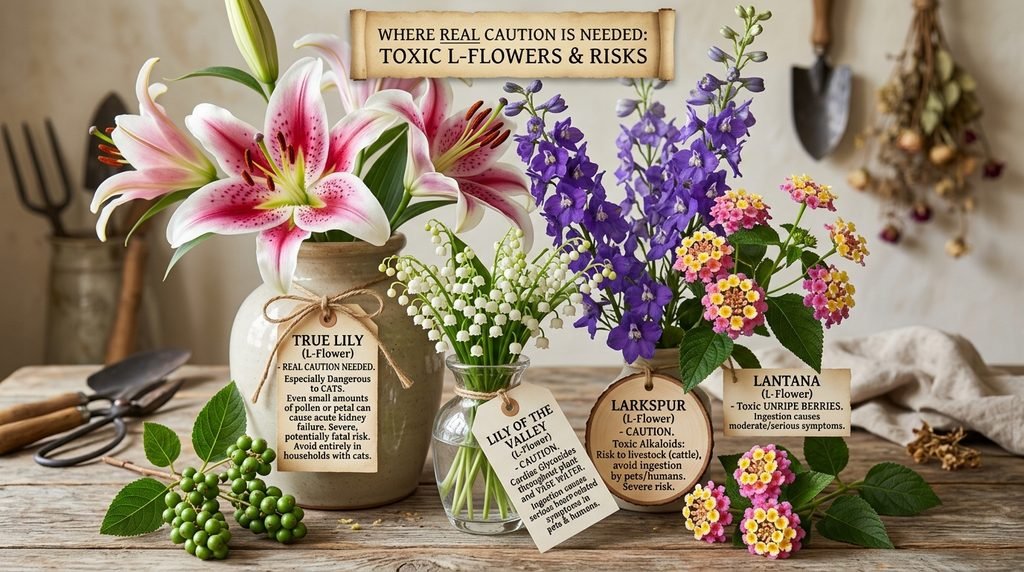
| Flower | Toxic To | Main Risk | Symptom Severity |
| Lily (true lilies) | Cats especially; also dogs | Ingestion (all plant parts, including pollen) | Severe, potentially fatal in cats |
| Lily of the Valley | Pets, humans | Ingestion | Severe |
| Larkspur | Livestock, humans | Ingestion | Severe |
| Lantana | Pets, humans | Ingestion of unripe berries | Moderate |
Lily deserves the most urgent caution of this group, and any household with cats should avoid true lilies entirely rather than trying to manage exposure, since even minimal contact has been linked to severe kidney damage. Lily of the Valley is a close second in seriousness, and its cut flowers should be kept well away from pets even in a vase of water, since the toxins can leach into the water itself.
Color Groupings Across the L-Flowers
Purple and lavender-blue is the signature color of this letter, showing up in Lavender, Lilac, Larkspur, and Liatris, making this the range most associated with a classic, cottage-garden look.
Pink and white appear in Lily, Lily of the Valley, and many Lisianthus varieties, a pairing that reads as soft and romantic, which explains why both show up so often in wedding arrangements.
Orange and red come through in Lantana and certain Lily varieties, both of which hold their color well through direct summer sun without the fading some paler tones show by midsummer.
Yellow and gold are common in Leopard’s Bane and Lachenalia, both of which bring an early, cheerful note that stands out against still-bare late-winter or early-spring gardens.
The Full Alphabetical List of L-Flowers
Anyone who came here specifically for the name list can find it below, gathering every flower mentioned above along with a few additional L-names worth knowing.
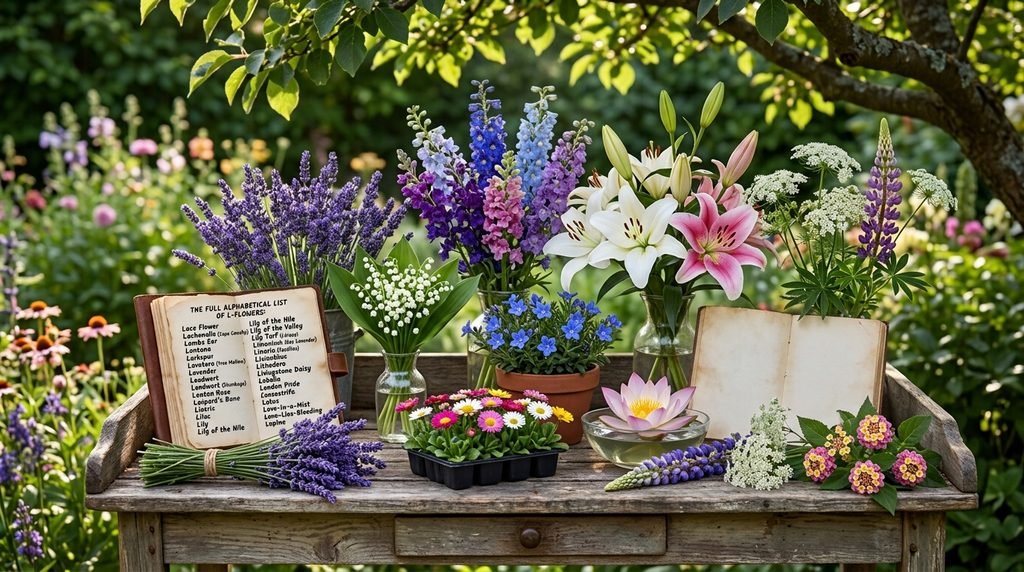
- Lace Flower
- Lachenalia (Cape Cowslip)
- Lambs Ear
- Lantana
- Larkspur
- Lavatera (Tree Mallow)
- Lavender
- Leadwort (Plumbago)
- Lenten Rose
- Leopard’s Bane
- Lewisia
- Liatris
- Lilac
- Lily
- Lily of the Nile
- Lily of the Valley
- Lily Turf (Liriope)
- Limonium (Sea Lavender)
- Linaria (Toadflax)
- Lisianthus
- Lithodora
- Livingstone Daisy
- Lobelia
- London Pride
- Loosestrife
- Lotus
- Love-in-a-Mist
- Love-Lies-Bleeding
- Lupine
Several of these, like Lithodora and Livingstone Daisy, are less commonly stocked at big-box nurseries and more often found through specialty growers or seed catalogs, which is worth knowing before planning a shopping trip around them.
Common Names vs. Botanical Names
Botanical names help avoid confusion when ordering online, especially for L-flowers where several common names describe more than one unrelated plant. This table covers the botanical names for the most frequently grown picks on this list.
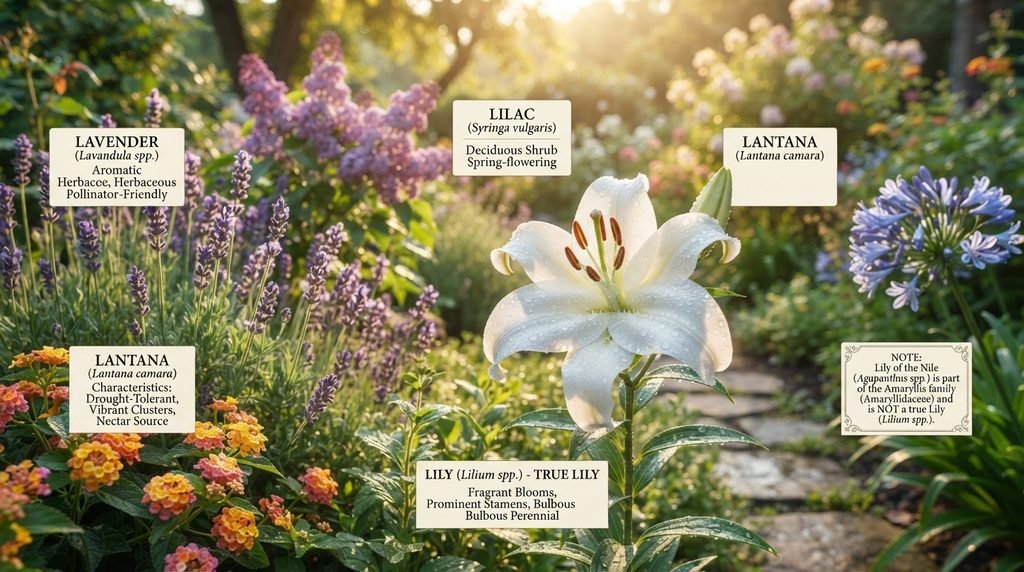
| Common Name | Botanical Name |
| Lavender | Lavandula spp. |
| Lilac | Syringa vulgaris |
| Lily | Lilium spp. |
| Lantana | Lantana camara |
| Lupine | Lupinus spp. |
| Liatris | Liatris spicata |
| Lily of the Valley | Convallaria majalis |
Lily of the Nile is worth double-checking before ordering, since it’s actually a common name for Agapanthus, a plant that isn’t a true lily at all and belongs to a completely different botanical family than Lilium.
What These Flowers Have Meant to People Over Time
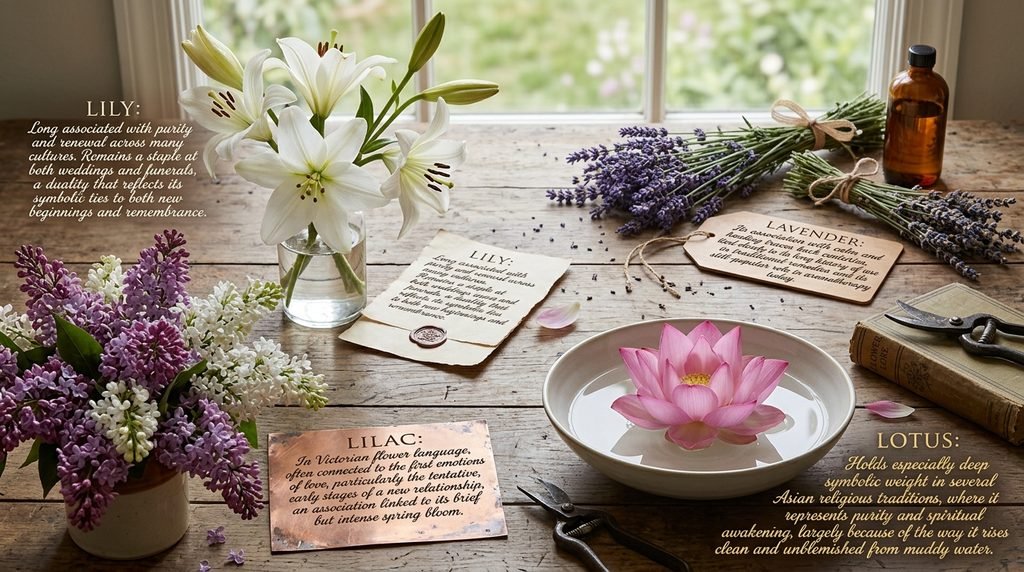
Flower symbolism continues to shape how people choose plants for weddings, memorials, and gifts, and L-flowers carry some of the richest history in this regard. Lily has long been associated with purity and renewal across many cultures, and it remains a staple at both weddings and funerals, a duality that reflects its symbolic ties to both new beginnings and remembrance. Lavender’s association with calm and healing traces back centuries, tied closely to its long history of use in traditional remedies and its still-popular role in aromatherapy today.
Lilac, in Victorian flower language, was often connected to the first emotions of love, particularly the tentative, early stages of a new relationship, an association some sources link to its brief but intense spring bloom. Lotus holds especially deep symbolic weight in several Asian religious traditions, where it represents purity and spiritual awakening, largely because of the way it rises clean and unblemished from muddy water.
Bringing the L-Flowers Together
Flowers that start with L span an unusually wide range, from drought-tolerant Mediterranean natives like Lavender to shade-loving woodland perennials like Lily of the Valley, and that range is exactly why sorting by growing conditions works better than a flat alphabetical list. Anyone using this guide should be able to match their own sun, shade, and experience level to a realistic shortlist of L-flowers rather than working through dozens of names to find the right fit.
Frequently Asked Questions
What are the easiest flowers that start with L for a beginner to grow?
Lantana, Lobelia, and Liatris are the most forgiving choices, tolerating average soil and inconsistent watering without much trouble.
Which L-flowers are toxic to pets?
True Lily species pose the most serious risk, especially to cats, while Lily of the Valley and Lantana also carry notable toxicity concerns.
How fast does Lobelia bloom from seed?
Typically within seven to nine weeks, making it one of the fastest-blooming options among flowers that start with L.
Is Lily really dangerous for cats?
Yes, extremely — even small amounts of pollen or petal material can cause acute kidney failure in cats, and prompt veterinary care is essential after any exposure.
What’s the difference between Lily and Lily of the Nile?
True lilies belong to the genus Lilium, while Lily of the Nile refers to Agapanthus, an entirely different plant that isn’t related to true lilies at all.
Do Lavender plants really deter pests near roses?
Many gardeners believe Lavender’s scent helps discourage aphids near roses, though the effect is modest and shouldn’t be relied on as a sole pest-control method.
Which L-flowers tolerate shade best?
Lily of the Valley, Leopard’s Bane, and Lenten Rose handle shaded, filtered-light conditions better than most other flowers on this list.
Is Lisianthus difficult to grow from seed?
Yes, it germinates slowly and is sensitive to humidity and overwatering, which makes it better suited to gardeners with some prior growing experience.
What are good companion plants for Lavender?
Roses work well due to similar dry-soil preferences, while moisture-loving plants like Hostas are better kept in a separate, more consistently watered bed.
When should Lily bulbs be planted?
Most varieties are planted in fall for spring and summer bloom, though some can also be planted in early spring depending on the specific type.
Do Liatris flowers attract pollinators?
Yes, significantly — Liatris is a strong draw for butterflies and bees, and its upright spikes tend to bloom over several weeks in mid to late summer.