

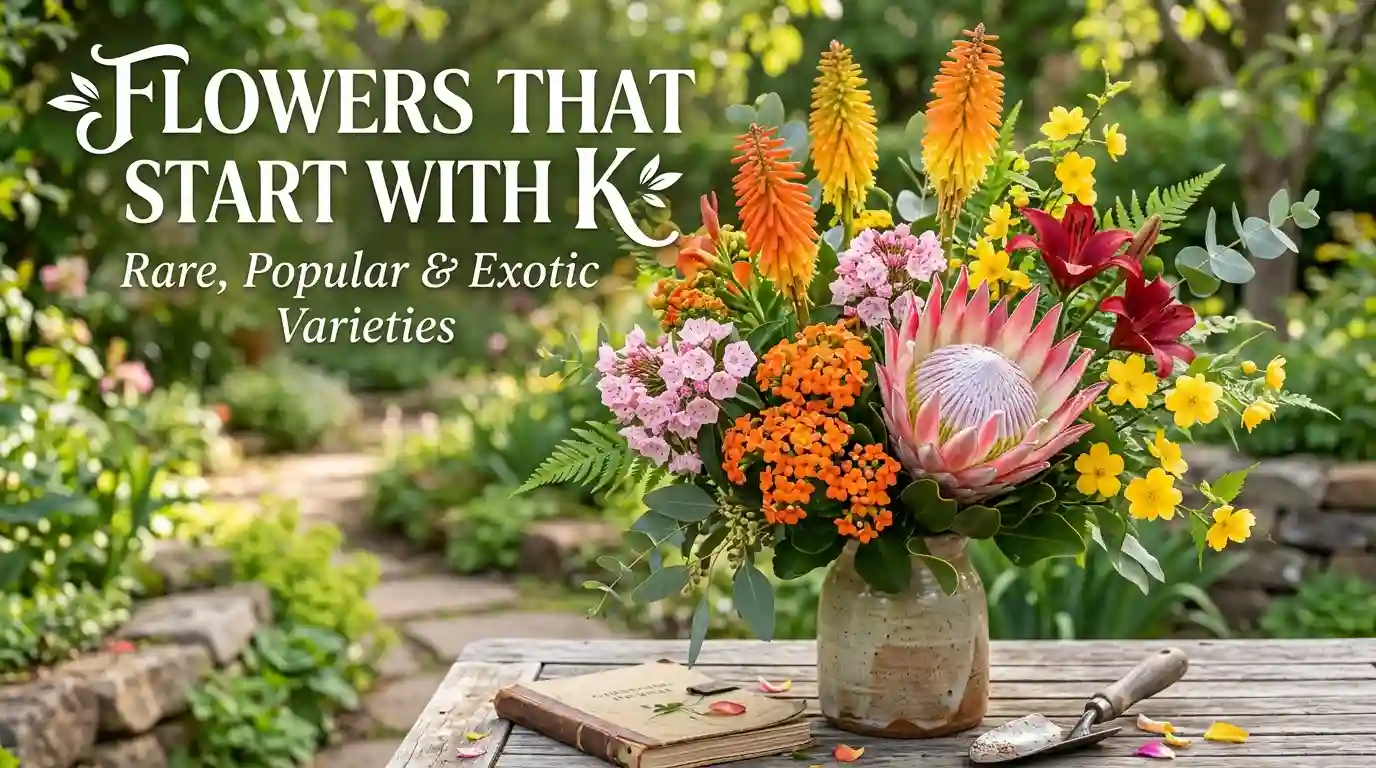
K is a smaller letter for flower names, but what it lacks in volume it makes up for in variety — the dramatic King Protea, the fiery spikes of Kniphofia, and the quiet, spring-blooming Kerria all share nothing except their first letter. Sorting them alphabetically doesn’t help much when the real question is which of these actually suits a specific yard.
This guide takes the opposite approach, grouping K-flowers by the conditions that determine whether they thrive: sun exposure, bloom timing, and how much hands-on care each one realistically needs. That structure lets a reader jump straight to the section relevant to their own garden instead of working through an unrelated list of names.
The full alphabetical index is still included, positioned near the end of this article as a reference appendix rather than the main framework. Anyone who already knows the name they’re looking for can head there directly.
The plants covered here include commonly available K-flowers found at nurseries and specialty growers, along with a few striking but less mainstream picks for gardeners looking to try something beyond the usual options.
Quick Take: Standout K-Flowers Worth Growing
These ten earn a spot on this list for specific, practical reasons rather than just visual appeal.
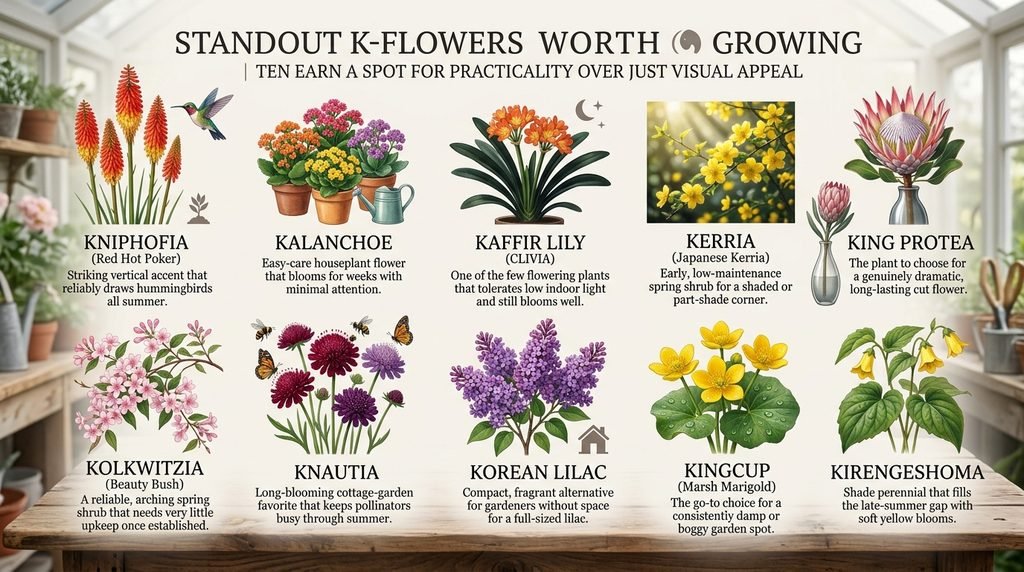
- Kniphofia (Red Hot Poker) — a striking vertical accent that draws hummingbirds reliably through summer.
- Kalanchoe — an easy-care houseplant flower that blooms for weeks with minimal attention.
- Kaffir Lily (Clivia) — one of the few flowering plants that tolerates low indoor light and still blooms well.
- Kerria (Japanese Kerria) — an early, low-maintenance spring shrub for a shaded or part-shade corner.
- King Protea — the plant to choose for a genuinely dramatic, long-lasting cut flower.
- Kolkwitzia (Beauty Bush) — a reliable, arching spring shrub that needs very little upkeep once established.
- Knautia — a long-blooming cottage-garden favorite that keeps pollinators busy through summer.
- Korean Lilac — a compact, fragrant alternative for gardeners without space for a full-sized lilac.
- Kingcup (Marsh Marigold) — the go-to choice for a consistently damp or boggy garden spot.
- Kirengeshoma — a shade perennial that fills the late-summer gap with soft yellow blooms.
Full-Sun K-Flowers That Handle Real Heat
Several K-flowers genuinely need full sun to perform well, and a few — particularly Kniphofia and King Protea — actually struggle in anything less. Knautia and Korean Lilac round out this group as dependable, heat-tolerant choices for an exposed bed.
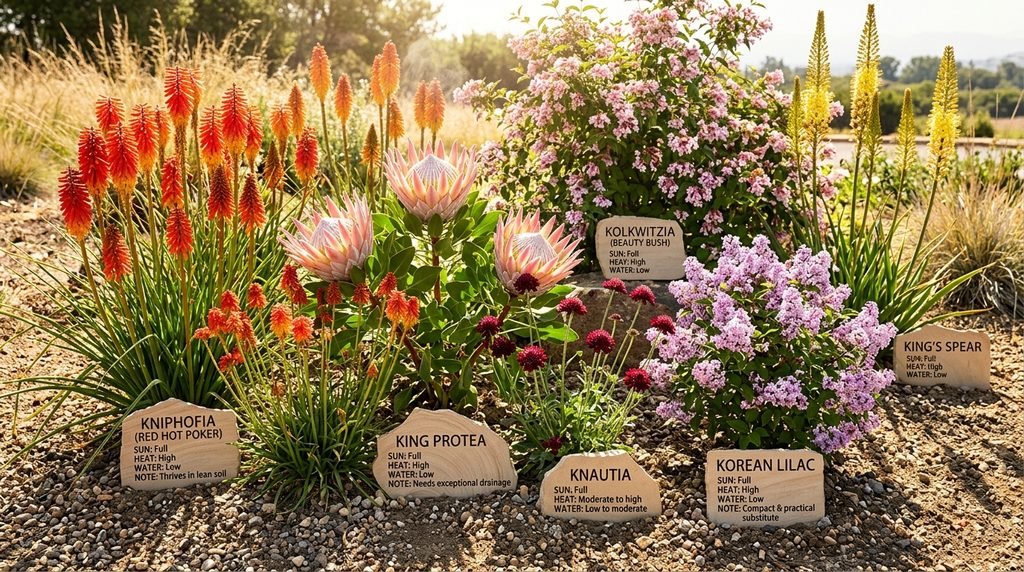
| Flower | Sun Requirement | Heat Tolerance | Watering Once Established |
| Kniphofia (Red Hot Poker) | Full sun | High | Low |
| King Protea | Full sun | High | Low |
| Knautia | Full sun | Moderate to high | Low to moderate |
| Korean Lilac | Full sun | High | Low |
| Kolkwitzia (Beauty Bush) | Full sun | High | Low |
| King’s Spear | Full sun | High | Low |
Kniphofia and King Protea are the strongest choices for lean, well-drained soil, since both actually decline in rich, consistently moist beds rather than benefiting from extra feeding. Korean Lilac stands out for handling both heat and a compact planting footprint, which makes it a practical substitute where a full-sized lilac simply won’t fit.
Shade and Part-Shade Options for K-Flowers
Not every K-flower wants full exposure, and a handful genuinely prefer filtered or indirect light. Kerria and Kirengeshoma are the two most reliable shade performers in this group, both tolerating deeper shade than most flowering shrubs and perennials.
- Kerria (Japanese Kerria) — bright yellow spring blooms that hold up well in part shade
- Kirengeshoma — soft yellow, bell-shaped flowers in late summer under filtered light
- Kaffir Lily (Clivia) — tolerates low indoor light better than most flowering houseplants
- Kenilworth Ivy — a low, shade-tolerant trailing plant with small purple flowers
Kerria is the more versatile of the two shrubs, since it also tolerates a fair amount of sun, while Kirengeshoma genuinely prefers the deeper, cooler shade of a woodland-style bed. Kaffir Lily deserves a mention here specifically because it’s one of the few flowering plants that performs indoors away from a bright window, which makes it a useful pick for lower-light rooms.
Which K-Flowers Bloom the Fastest
For anyone planting with a deadline in mind, K-flowers vary considerably in how quickly they reward the effort. Kalanchoe is the fastest by a wide margin, especially when started from an established cutting rather than seed.
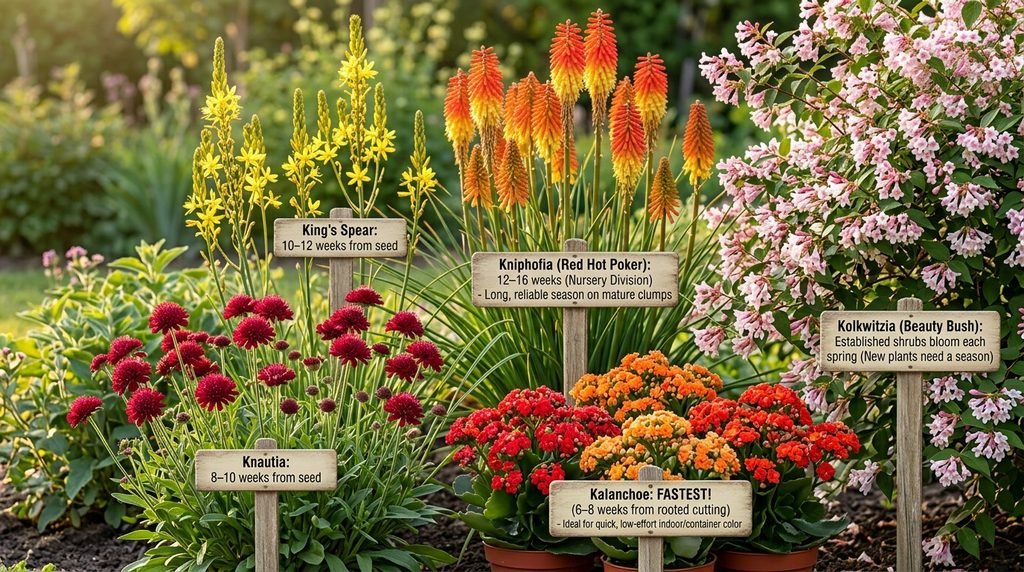
- Kalanchoe — often blooms within 6–8 weeks from a rooted cutting
- Knautia — typically 8–10 weeks from seed to first bloom
- King’s Spear — usually flowers within 10–12 weeks from seed
- Kniphofia — first-year bloom is possible but often takes 12–16 weeks from a nursery division
- Kolkwitzia — established shrubs bloom each spring reliably, but new plants often need a full season to settle in before flowering well
Kalanchoe is the practical choice for fast, low-effort color, particularly as an indoor or container plant that doesn’t depend on outdoor planting windows. Kniphofia takes longer to establish, but a mature clump rewards the wait with a much longer and more reliable bloom season than a first-year planting typically shows.
Matching K-Flowers to Gardening Experience
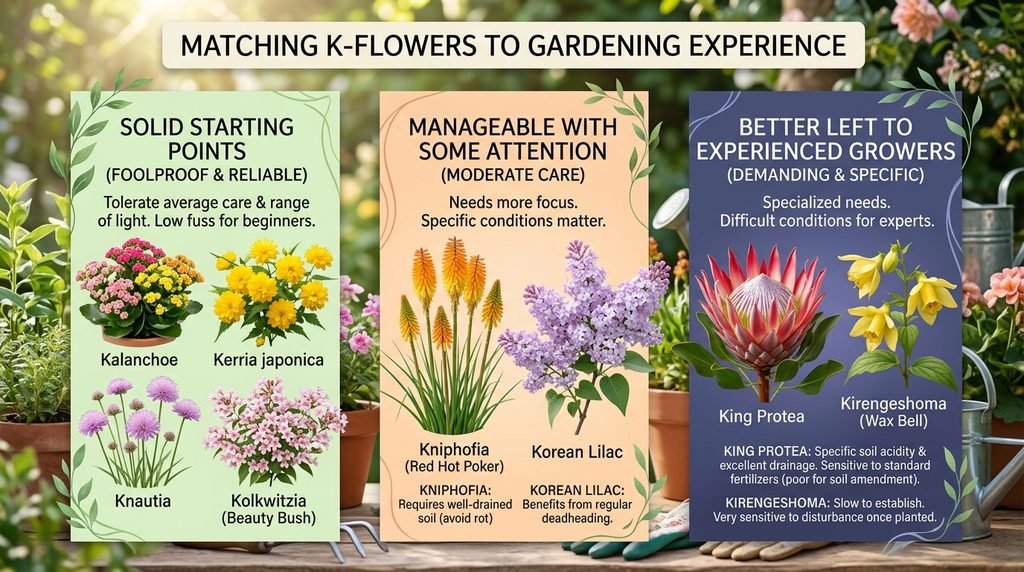
A few K-flowers are close to foolproof, while others ask for more specific conditions than a beginner might expect. Kalanchoe and Kerria are both reliable starting points, tolerating average care and a range of light conditions without much fuss. King Protea sits at the more demanding end of the spectrum — it needs excellent drainage, a specific soil acidity, and can be sensitive to standard garden fertilizers, which makes it a poor first project for someone still learning the basics of soil amendment.
- Solid starting points: Kalanchoe, Kerria, Knautia, Kolkwitzia
- Manageable with some attention: Kniphofia (needs well-drained soil to avoid rot), Korean Lilac (benefits from regular deadheading)
- Better left to experienced growers: King Protea (specific soil and drainage needs), Kirengeshoma (slow to establish, sensitive to disturbance once planted)
A Shortlist If Space Is Tight
For a small garden, three K-flowers can cover most practical needs without overlap. Kerria supplies reliable, low-maintenance spring color for a shaded or part-shade spot, Kniphofia adds a bold vertical accent and draws pollinators through summer, and Kalanchoe works well in containers for color that can move indoors when the weather turns. Between the three, a small space gets seasonal spring interest, summer height, and portable color that isn’t tied to a single bed.
Pairing K-Flowers With Good Neighbors
Companion planting generally works best when nearby plants share similar sun and water needs, or when one offers the other a practical benefit like pollinator traffic or shared soil preferences. Mismatches tend to show up gradually, with one plant thriving while its neighbor quietly falls behind.
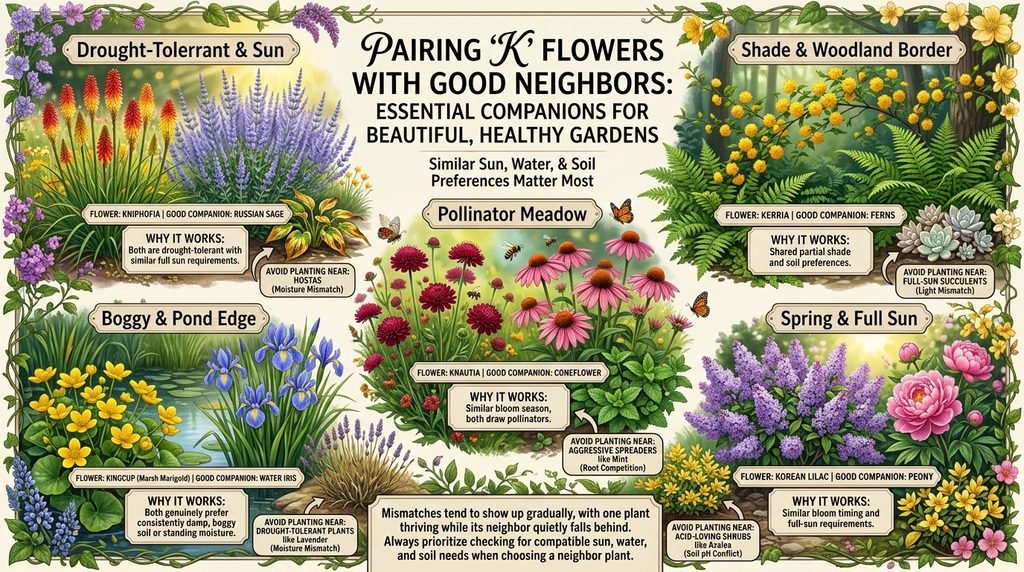
| Flower | Good Companion | Why It Works | Avoid Planting Near |
| Kniphofia | Russian Sage | Both are drought-tolerant with similar sun needs | Hostas (moisture mismatch) |
| Kerria | Ferns | Shared part-shade and soil preferences | Full-sun succulents (light mismatch) |
| Knautia | Coneflower | Similar bloom season, both draw pollinators | Aggressive spreaders like mint (root competition) |
| Kingcup (Marsh Marigold) | Water Iris | Both tolerate consistently damp or boggy soil | Drought-tolerant plants like Lavender (moisture mismatch) |
| Korean Lilac | Peony | Similar bloom timing and full-sun requirements | Acid-loving shrubs like Azalea (soil pH conflict) |
The Kingcup-and-Water-Iris pairing is especially useful for a boggy or pond-edge planting, since both genuinely prefer standing moisture that would rot the roots of most other flowering perennials. The broader lesson across this table is that K-flowers split fairly cleanly into dry-soil and wet-soil groups, so checking that match matters more than color or bloom time when choosing a neighbor.
A Month-by-Month Calendar for the Top Picks
Timing has a real effect on how well several K-flowers establish and bloom. Kerria benefits from pruning right after its spring bloom finishes, while Kniphofia clumps perform best when divided on a predictable schedule rather than left to grow indefinitely.
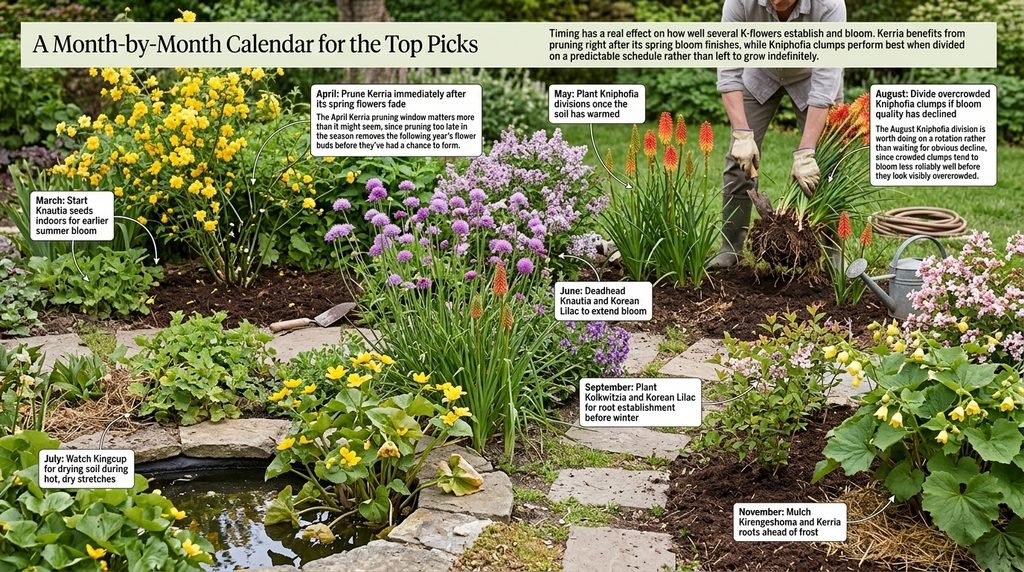
| Month | Task |
| March | Start Knautia seeds indoors for earlier summer bloom |
| April | Prune Kerria immediately after its spring flowers fade |
| May | Plant Kniphofia divisions once the soil has warmed |
| June | Deadhead Knautia and Korean Lilac to extend bloom |
| July | Watch Kingcup for drying soil during hot, dry stretches |
| August | Divide overcrowded Kniphofia clumps if bloom quality has declined |
| September | Plant Kolkwitzia and Korean Lilac for root establishment before winter |
| November | Mulch Kirengeshoma and Kerria roots ahead of frost |
The April Kerria pruning window matters more than it might seem, since pruning too late in the season removes the following year’s flower buds before they’ve had a chance to form. The August Kniphofia division is worth doing on a rotation rather than waiting for obvious decline, since crowded clumps tend to bloom less reliably well before they look visibly overcrowded.
Where Real Caution Is Needed
A few K-flowers carry genuine risk to pets or people, and that information matters more than aesthetics for anyone gardening around children or animals. Kalmia (Mountain Laurel) contains grayanotoxins that affect the heart and nervous system, and ingestion by pets or livestock can cause serious symptoms, including irregular heart rhythm in severe cases. Kalanchoe contains cardiac glycosides similar to those found in foxglove, and while a small nibble is unlikely to be fatal, ingestion by pets can cause vomiting, diarrhea, and in rare severe cases, heart problems. Knapweed is less a toxicity concern for humans and more a known cause of a neurological condition in horses that graze on it repeatedly over time.
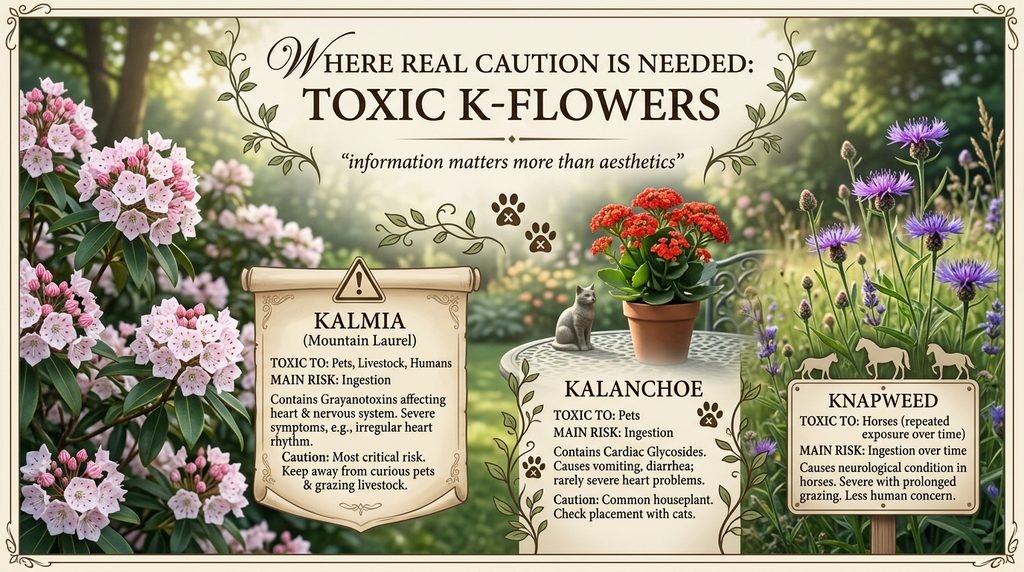
| Flower | Toxic To | Main Risk | Symptom Severity |
| Kalmia (Mountain Laurel) | Pets, livestock, humans | Ingestion | Severe |
| Kalanchoe | Pets | Ingestion | Mild to moderate, rarely severe |
| Knapweed | Horses (with repeated exposure) | Ingestion over time | Severe with prolonged grazing |
Kalmia deserves the most caution in this group, and it’s worth keeping it away from grazing livestock and curious pets rather than assuming a small amount is harmless. Kalanchoe is common as a houseplant, so it’s worth double-checking placement in homes with cats, since houseplants are a frequent source of accidental pet poisoning cases.
Color Groupings Across the K-Flowers
Orange and red show up strongly in Kniphofia and King Protea, both of which read as bold, high-contrast color that works best as a single focal point rather than blended into a softer palette.
Yellow and gold are common in Kerria, Kshowp, and Kirengeshoma, a combination that brings warmth to shaded beds where brighter, hotter tones might otherwise feel out of place.
Pink and purple appear in Kalanchoe, Korean Lilac, and Knautia, a pairing that works well in a cottage-style bed where softer tones blend easily with neighboring plants.
White and cream are less common at this letter but show up in certain Kalanchoe and Kolkwitzia varieties, both of which pair well as a neutral backdrop for bolder-colored neighbors.
The Full Alphabetical List of K-Flowers
Anyone who is here specifically for the name show can find it below, gathering every flower mentioned above along with a few additional K-names worth knowing.
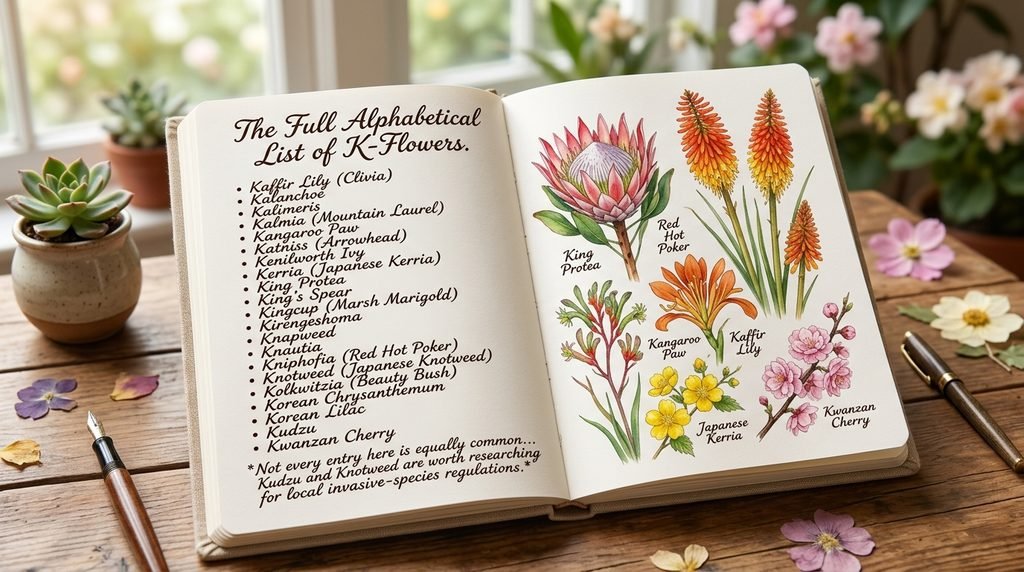
- Kaffir Lily (Clivia)
- Kalanchoe
- Kalimeris
- Kalmia (Mountain Laurel)
- Kangaroo Paw
- Katniss (Arrowhead)
- Kenilworth Ivy
- Kerria (Japanese Kerria)
- King Protea
- King’s Spear
- Kingcup (Marsh Marigold)
- Kirengeshoma
- Knapweed
- Knautia
- Kniphofia (Red Hot Poker)
- Knotweed (Japanese Knotweed)
- Kolkwitzia (Beauty Bush)
- Korean Chrysanthemum
- Korean Lilac
- Kudzu
- Kwanzan Cherry
Not every entry here is equally common at a typical nursery — Kudzu and Knotweed, for instance, are more often encountered as aggressive wild growth than as intentional garden plantings, and both are worth researching for local invasive-species regulations before considering them at all.
Common Names vs. Botanical Names
Botanical names help avoid confusion when ordering online, particularly for K-flowers where a few common names don’t clearly signal the plant family. This table covers the botanical names for the most frequently grown picks on this list.
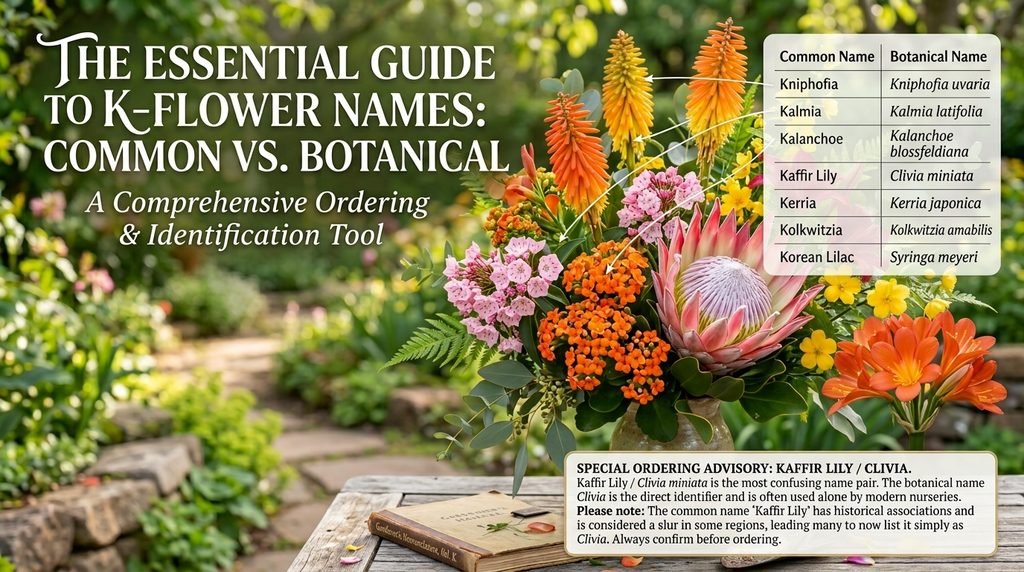
| Common Name | Botanical Name |
| Kniphofia | Kniphofia uvaria |
| Kalanchoe | Kalanchoe blossfeldiana |
| Kaffir Lily | Clivia miniata |
| Kerria | Kerria japonica |
| Kalmia | Kalmia latifolia |
| Kolkwitzia | Kolkwitzia amabilis |
| Korean Lilac | Syringa meyeri |
Kaffir Lily is the one most worth double-checking before ordering, since the botanical name Clivia gives no hint of the common name at all, and the common name itself has fallen out of use in some regions due to its association with a term now considered a slur in parts of southern Africa — many nurseries now list it simply as Clivia.
What These Flowers Have Meant to People Over Time
Flower symbolism still shapes how certain plants get chosen for gifts, gardens, and ceremonies, and K-flowers carry their own share of cultural history worth knowing. King Protea, as South Africa’s national flower, has long been associated with diversity, courage, and transformation, partly due to its resilience in fire-prone landscapes where it regenerates after burning. Kerria, in parts of East Asian garden tradition, has been linked to elegance and quiet grace, likely a reflection of its slender, arching branches and unfussy spring display.
Kingcup, also known as Marsh Marigold, carries older European folk associations with protection and good fortune, particularly in springtime traditions tied to warding off misfortune in the home. Kniphofia’s fiery, torch-like form has earned it informal associations with energy and boldness in more modern garden writing, a meaning that owes more to its striking appearance than to any deep historical tradition.
Bringing the K-Flowers Together
Flowers that start with K range from low-maintenance staples like Kerria to genuinely striking specialty picks like King Protea, and that range is exactly why sorting by growing conditions makes more sense than working through the alphabet. Anyone using this guide should be able to match their own sun, shade, and experience level to a realistic shortlist of K-flowers rather than sorting through the full name list one entry at a time.
Frequently Asked Questions
What are the easiest flowers that start with K for a beginner to grow?
Kalanchoe, Kerria, and Knautia are the most forgiving choices, tolerating average care and a range of light conditions without much trouble.
Which K-flowers are toxic to pets?
Kalmia and Kalanchoe both carry toxicity risks, with Kalmia posing the more serious threat if ingested by pets or livestock.
How fast does Kalanchoe bloom from a cutting?
Typically within six to eight weeks, making it one of the fastest-blooming options among flowers that start with K.
Is King Protea difficult to grow outside its native climate?
Yes, it needs specific well-drained, slightly acidic soil and can struggle with standard garden fertilizers, which makes it better suited to experienced growers.
What’s the difference between Kerria and other yellow spring shrubs?
Kerria is distinguished by its arching green stems that stay visibly green through winter, unlike many other spring-flowering shrubs with bare, gray branches.
Do Kniphofia flowers really attract hummingbirds?
Yes, their tubular, nectar-rich blooms are a strong draw for hummingbirds, especially during their peak bloom in early to mid-summer.
Which K-flowers tolerate shade best?
Kerria and Kirengeshoma handle part shade well, and Kaffir Lily is notable for tolerating even low indoor light better than most flowering plants.
Is Kaffir Lily safe to grow indoors with pets?
It carries some toxicity risk if ingested, so it’s worth placing it out of reach of curious cats or dogs rather than assuming it’s entirely harmless.
What are good companion plants for Kniphofia?
Russian Sage works well due to shared drought tolerance and sun needs, while moisture-loving plants like Hostas are better kept in a separate bed.
When should Kniphofia clumps be divided?
Typically every few years in late summer, once bloom quality starts to decline from overcrowding.
Do Knautia flowers bloom for a long season?
Yes, with regular deadheading, Knautia often continues blooming from early summer well into fall.