

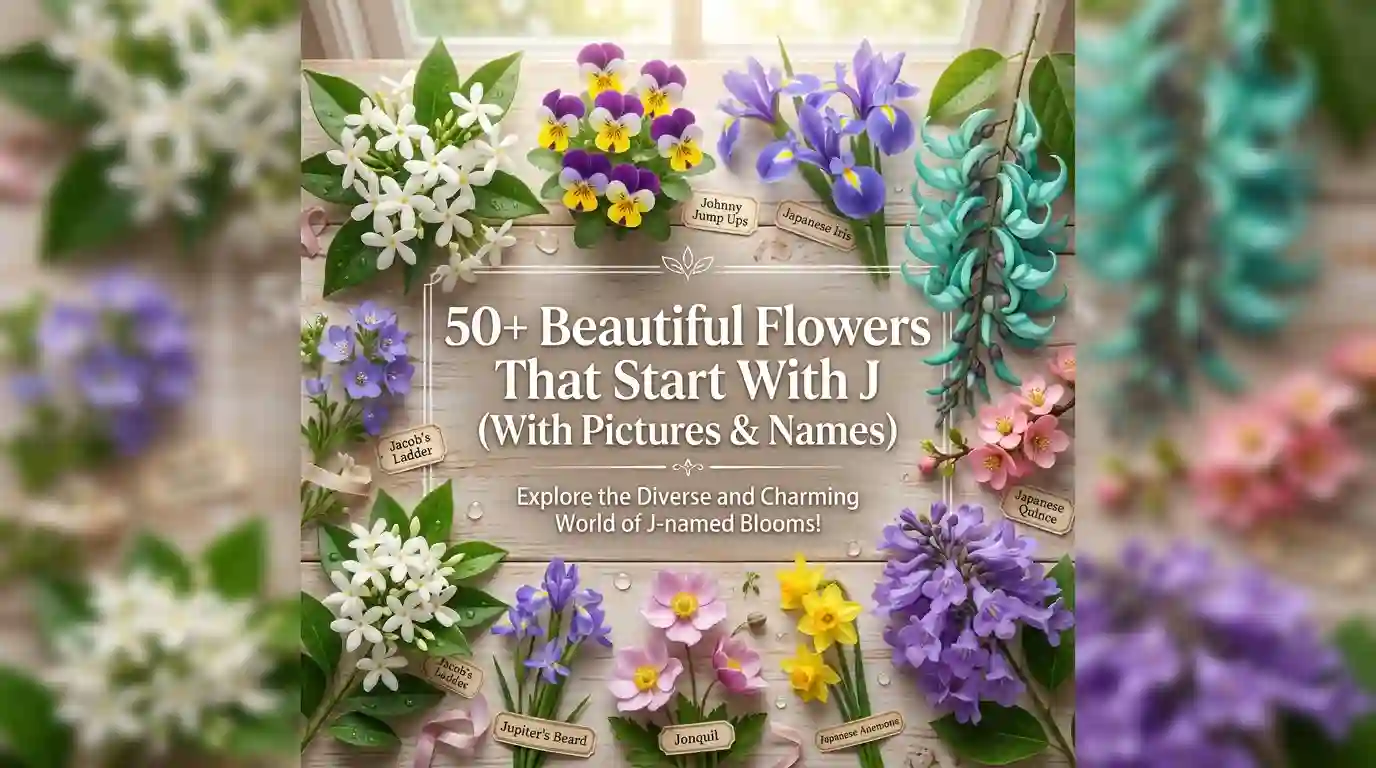
J is a smaller letter for flower names than most, but it still covers a genuinely wide range — fragrant vines like Jasmine, spring shrubs like Japanese Kerria, wildflowers like Jewelweed, and a few plants, like Jimsonweed, that are worth knowing mainly so they can be avoided. A flat A-to-Z rundown treats all of these the same way, which isn’t especially useful when the real question is what will actually grow well in a specific spot.
This guide sorts J-flowers by growing conditions first: how much sun a location gets, how quickly a bloom is needed, and how much gardening experience a plant realistically requires. That structure means a reader can skip straight to the section that matches their yard instead of working through fifty names to find the handful that fit.
The complete alphabetical list still appears in this article, positioned near the end as a quick-reference appendix rather than the organizing framework. Anyone who already knows what they’re looking for can jump there directly.
Every plant on this list reflects a genuinely documented flower or flowering plant with a common name starting with J — including several distinct Jasmine species and Japanese-prefixed plants, which make up a larger share of this letter than most others. Padding the count with invented names wouldn’t do a reader any favors, so this list stays honest about what’s actually out there.
Quick Take: The J-Flowers Worth Knowing First
These ten stand out for practical reasons that go beyond just looking nice in a photo.
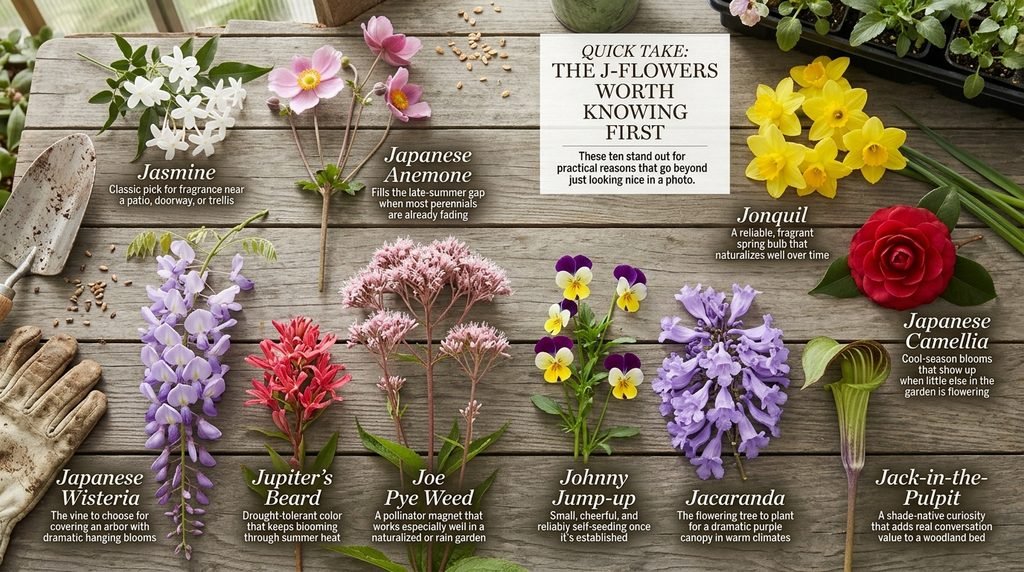
- Jasmine — the classic pick for fragrance near a patio, doorway, or trellis.
- Japanese Anemone — fills the late-summer gap when most perennials are already fading.
- Jonquil — a reliable, fragrant spring bulb that naturalizes well over time.
- Japanese Camellia — cool-season blooms that show up when little else in the garden is flowering.
- Jack-in-the-Pulpit — a shade-native curiosity that adds real conversation value to a woodland bed.
- Jacaranda — the flowering tree to plant for a dramatic purple canopy in warm climates.
- Johnny Jump-up — small, cheerful, and reliably self-seeding once it’s established.
- Joe Pye Weed — a pollinator magnet that works especially well in a naturalized or rain garden.
- Jupiter’s Beard — drought-tolerant color that keeps blooming through summer heat.
- Japanese Wisteria — the vine to choose for covering an arbor with dramatic hanging blooms.
Sun-Loving J-Flowers That Handle Real Heat
Several J-flowers genuinely prefer full sun and hold up well through sustained summer heat rather than just tolerating it. Jupiter’s Beard and Jacaranda are the two most heat-tolerant options here, both performing better with more direct sun rather than less.
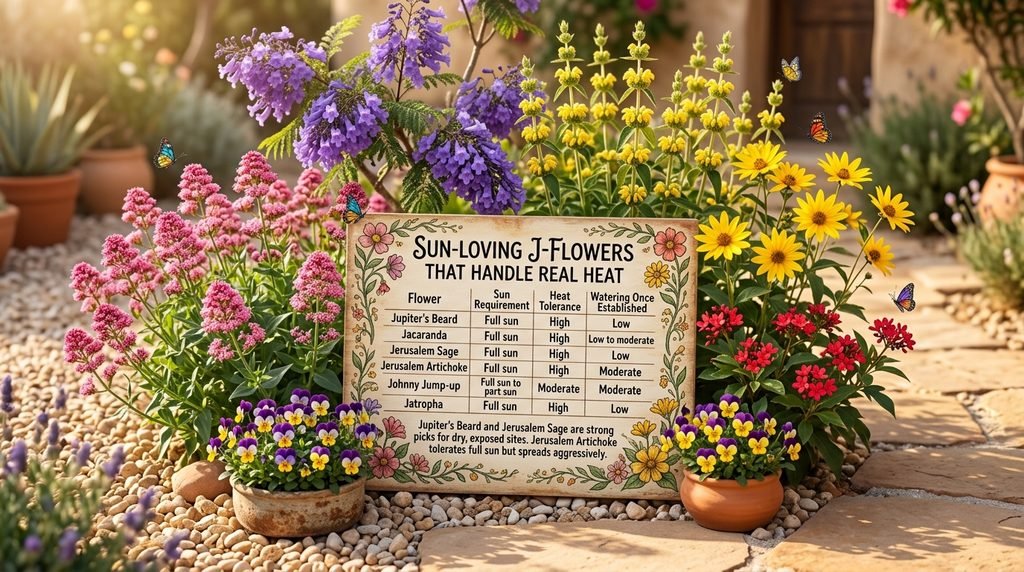
| Flower | Sun Requirement | Heat Tolerance | Watering Once Established |
| Jupiter’s Beard | Full sun | High | Low |
| Jacaranda | Full sun | High | Low to moderate |
| Jerusalem Sage | Full sun | High | Low |
| Jerusalem Artichoke | Full sun | High | Moderate |
| Johnny Jump-up | Full sun to part sun | Moderate | Moderate |
| Jatropha | Full sun | High | Low |
Jupiter’s Beard and Jerusalem Sage are the strongest picks for genuinely dry, exposed sites, since both actually perform worse in rich, consistently moist soil than in lean, well-drained conditions. Jerusalem Artichoke tolerates full sun well but spreads aggressively by underground tubers, so it needs a spot where that spread won’t crowd out neighboring plants.
Shade-Tolerant Options for Darker Corners
A handful of J-flowers are genuinely built for shaded or dappled locations rather than merely surviving there. Jack-in-the-Pulpit and Jewelweed are both native woodland plants that expect filtered light as a baseline condition, not a compromise.
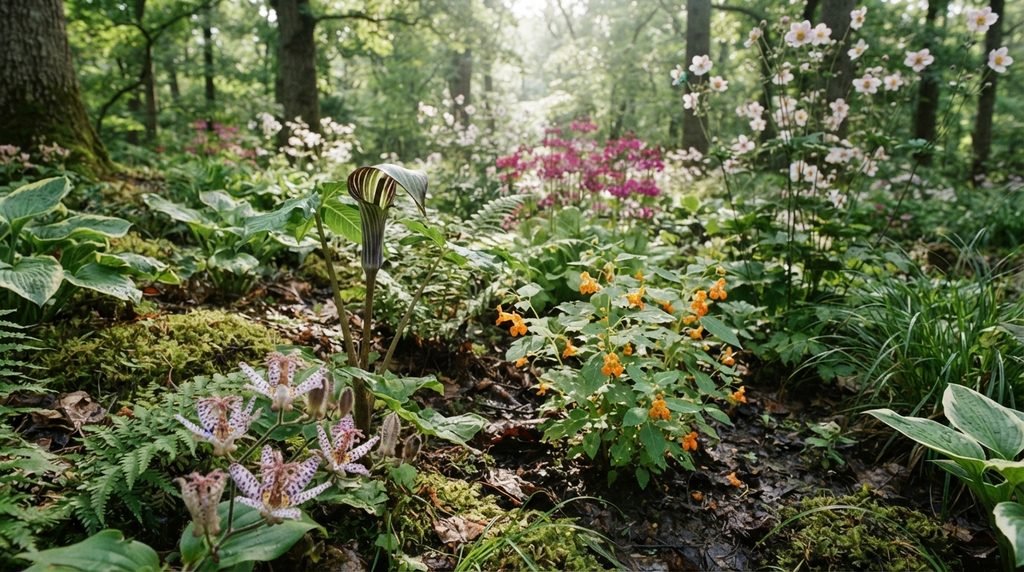
- Jack-in-the-Pulpit — a shade-native perennial with an unusual hooded flower structure
- Jewelweed — thrives in damp, shaded ground and often grows near streams or low-lying beds
- Japanese Toad Lily — blooms in late summer to fall under filtered light
- Japanese Primrose — prefers consistently moist, shaded soil
- Japanese Anemone — tolerates part shade well, especially in hot climates
Jack-in-the-Pulpit and Jewelweed both do best in a naturalized woodland setting rather than a formal bed, since neither responds well to being crowded by tidier ornamentals. Japanese Toad Lily stands out in this group for blooming later than most shade plants, which extends color into a season when shaded beds often go quiet.
Which J-Flowers Bloom the Fastest
For anyone planting on a deadline, bloom speed varies quite a bit across this letter. Johnny Jump-up and Jewelweed are the fastest options, both capable of flowering within a couple of months of sowing.
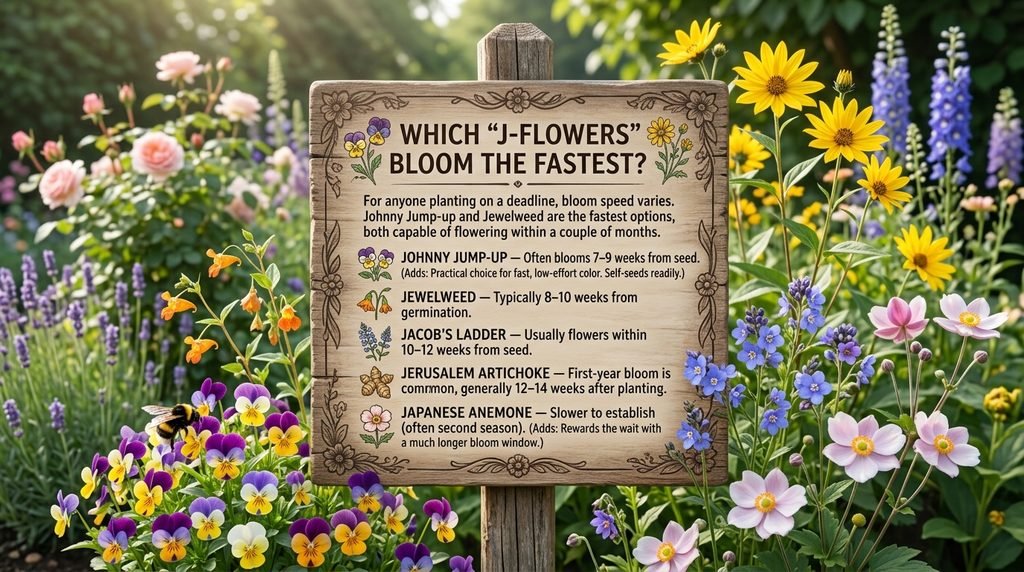
- Johnny Jump-up — often blooms within 7–9 weeks from seed
- Jewelweed — typically 8–10 weeks from germination to first bloom
- Jacob’s Ladder — usually flowers within 10–12 weeks from seed
- Jerusalem Artichoke — first-year bloom is common, generally 12–14 weeks after planting
- Japanese Anemone — slower to establish, often not flowering well until its second season
Johnny Jump-up is the practical choice for fast, low-effort color, and it tends to self-seed readily enough that a single planting can return for several seasons. Japanese Anemone takes longer to settle in, but it rewards the wait with a much longer bloom window once it’s established.
Matching J-Flowers to Gardening Experience
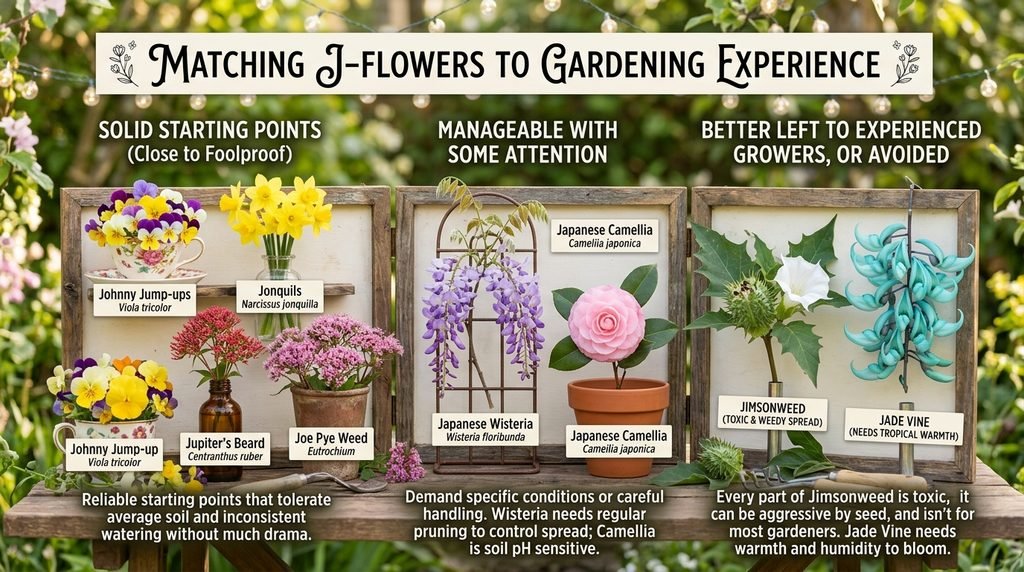
Some plants on this list are close to foolproof, while a few demand either specific conditions or careful handling. Johnny Jump-up, Jupiter’s Beard, and Jonquil are reliable starting points that tolerate average soil and inconsistent watering without much drama. Jimsonweed sits at the opposite end — every part of the plant is toxic, it can be aggressive in spreading by seed, and it’s not a plant most gardeners should introduce deliberately at all, regardless of experience level.
- Solid starting points: Johnny Jump-up, Jonquil, Jupiter’s Beard, Joe Pye Weed
- Manageable with some attention: Japanese Wisteria (needs regular pruning to control spread), Japanese Camellia (soil pH sensitive)
- Better left to experienced growers, or avoided: Jimsonweed (toxic, weedy spread), Jade Vine (needs tropical warmth and humidity to bloom reliably)
A Shortlist If Space Is Tight
For a small garden, three J-flowers can cover most of the practical ground without redundancy. Jasmine supplies fragrance and vertical interest on a trellis or fence, Johnny Jump-up fills in low, front-of-border color that reliably returns on its own, and Japanese Anemone anchors the late-summer season when most other perennials are winding down. Between the three, a small space gets scent, ground-level color, and seasonal timing that spans spring through fall.
Pairing J-Flowers With Good Neighbors
Companion planting works best when nearby plants share similar sun and water needs, or when one plant offers the other some practical benefit, such as shade for shallow roots or a pollinator draw that benefits a whole bed. A mismatch usually shows up slowly, with one plant thriving while its neighbor struggles quietly.
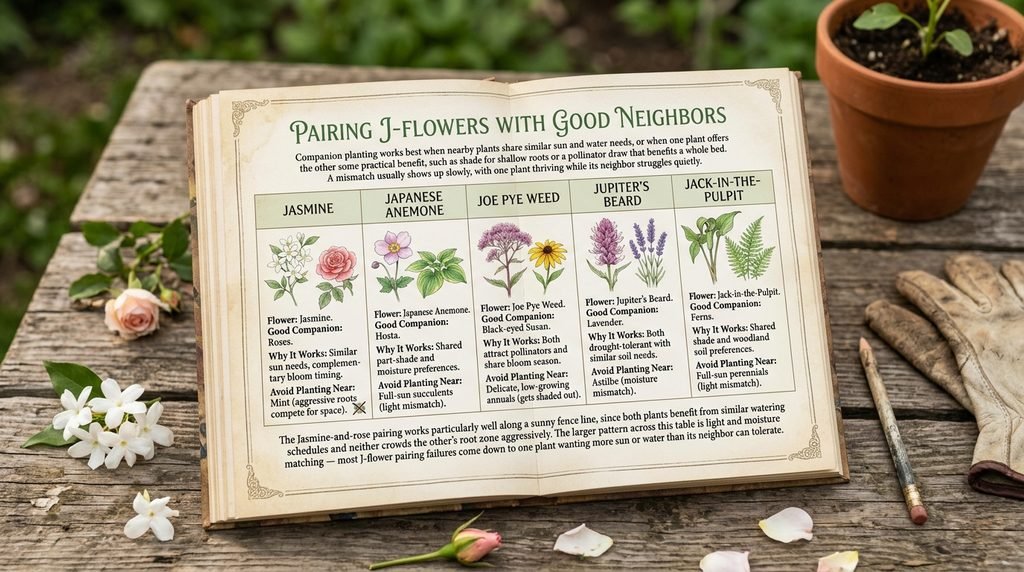
| Flower | Good Companion | Why It Works | Avoid Planting Near |
| Jasmine | Roses | Similar sun needs, complementary bloom timing | Mint (aggressive roots compete for space) |
| Japanese Anemone | Hosta | Shared part-shade and moisture preferences | Full-sun succulents (light mismatch) |
| Joe Pye Weed | Black-eyed Susan | Both attract pollinators and share bloom season | Delicate, low-growing annuals (gets shaded out) |
| Jupiter’s Beard | Lavender | Both drought-tolerant with similar soil needs | Astilbe (moisture mismatch) |
| Jack-in-the-Pulpit | Ferns | Shared shade and woodland soil preferences | Full-sun perennials (light mismatch) |
The Jasmine-and-rose pairing works particularly well along a sunny fence line, since both plants benefit from similar watering schedules and neither crowds the other’s root zone aggressively. The larger pattern across this table is light and moisture matching — most J-flower pairing failures come down to one plant wanting more sun or water than its neighbor can tolerate.
A Month-by-Month Calendar for the Top Picks
Timing plays a real role in how well several J-flowers perform, particularly bulbs and vines with specific planting windows. Jonquil needs a fall planting date to bloom on schedule, while Japanese Wisteria benefits from a defined pruning routine to keep it blooming rather than just growing foliage.
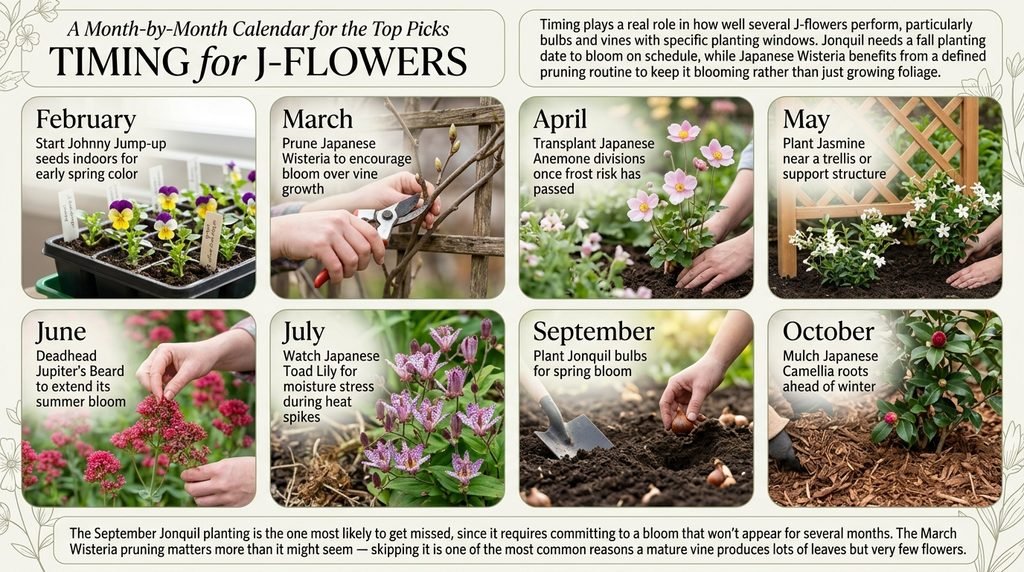
| Month | Task |
| February | Start Johnny Jump-up seeds indoors for early spring color |
| March | Prune Japanese Wisteria to encourage bloom over vine growth |
| April | Transplant Japanese Anemone divisions once frost risk has passed |
| May | Plant Jasmine near a trellis or support structure |
| June | Deadhead Jupiter’s Beard to extend its summer bloom |
| July | Watch Japanese Toad Lily for moisture stress during heat spikes |
| September | Plant Jonquil bulbs for spring bloom |
| October | Mulch Japanese Camellia roots ahead of winter |
The September Jonquil planting is the one most likely to get missed, since it requires committing to a bloom that won’t appear for several months. The March Wisteria pruning matters more than it might seem — skipping it is one of the most common reasons a mature vine produces lots of leaves but very few flowers.
Where Real Caution Is Needed
A few J-flowers carry genuine risk to people, pets, or livestock, and that information deserves clear treatment rather than a passing mention. Jimsonweed contains tropane alkaloids that are toxic if ingested in any amount, and it has a documented history of serious poisoning cases, including in livestock that graze on it accidentally. Jerusalem Cherry produces attractive but toxic berries containing solanine, which can cause vomiting and digestive upset if eaten, particularly a concern with pets or small children drawn to the bright fruit. Jack-in-the-Pulpit contains calcium oxalate crystals throughout the plant, which cause painful burning and irritation to the mouth and throat if chewed, though it’s rarely fatal.
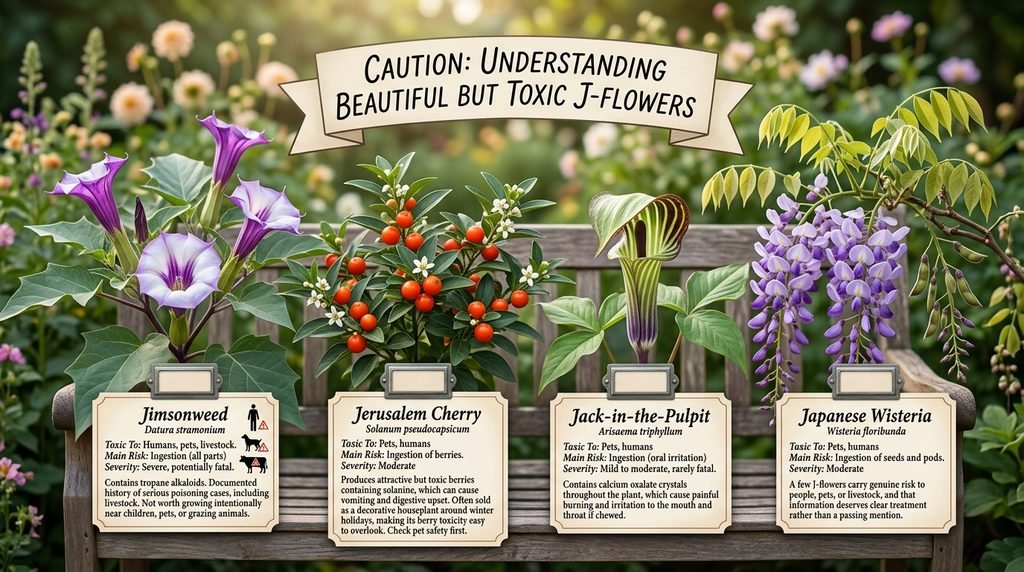
| Flower | Toxic To | Main Risk | Symptom Severity |
| Jimsonweed | Humans, pets, livestock | Ingestion (all plant parts) | Severe, potentially fatal |
| Jerusalem Cherry | Pets, humans | Ingestion of berries | Moderate |
| Jack-in-the-Pulpit | Pets, humans | Ingestion (oral irritation) | Mild to moderate |
| Japanese Wisteria | Pets, humans | Ingestion of seeds and pods | Moderate |
Jimsonweed deserves the most serious caution of the group and is generally not worth growing intentionally in a garden with children, pets, or grazing animals nearby. Jerusalem Cherry is often sold as a decorative houseplant around the winter holidays, which makes its berry toxicity easy to overlook if it’s brought indoors without checking pet safety first.
Color Groupings Across the J-Flowers
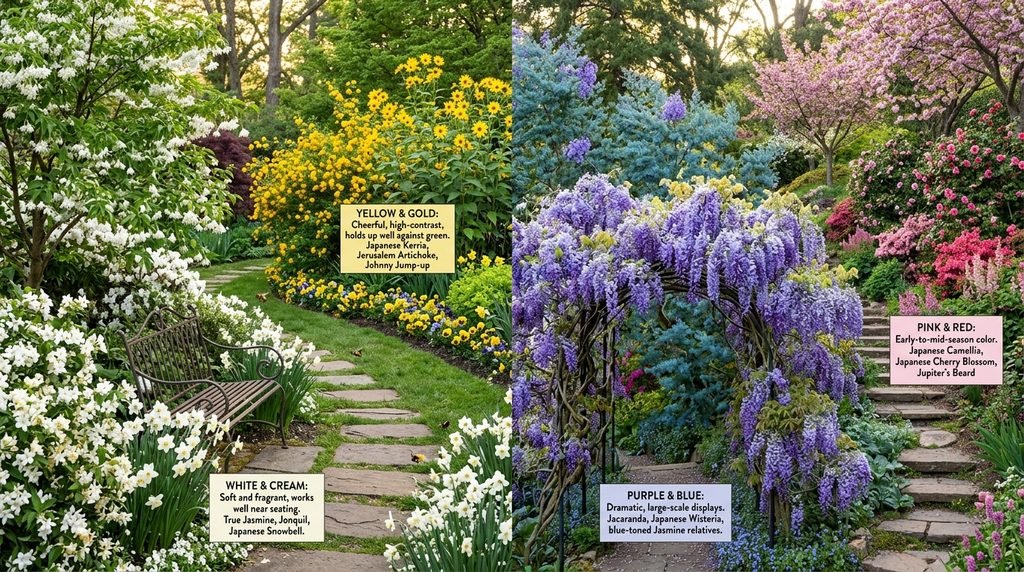
Purple and blue show up strongly in Jacaranda, Japanese Wisteria, and many Jasmine relatives with blue-toned foliage backdrops, making this the color range most associated with dramatic, large-scale J-flower displays.
White and cream dominate true Jasmine varieties along with Jonquil and Japanese Snowbell, a pairing that reads as soft and fragrant rather than bold, and works well near seating areas where scent matters as much as color.
Yellow and gold appear in Japanese Kerria, Jerusalem Artichoke, and Johnny Jump-up, all of which bring a cheerful, high-contrast note that holds up well against green foliage.
Pink and red are present in Japanese Camellia, Japanese Cherry Blossom, and Jupiter’s Beard, a combination that works particularly well for early-to-mid-season color before summer bloomers take over.
The Full List of 50+ Flowers That Start With J
Anyone who came here specifically for the complete name list can find it below, gathering every flower mentioned above along with additional genuine J-names worth knowing.
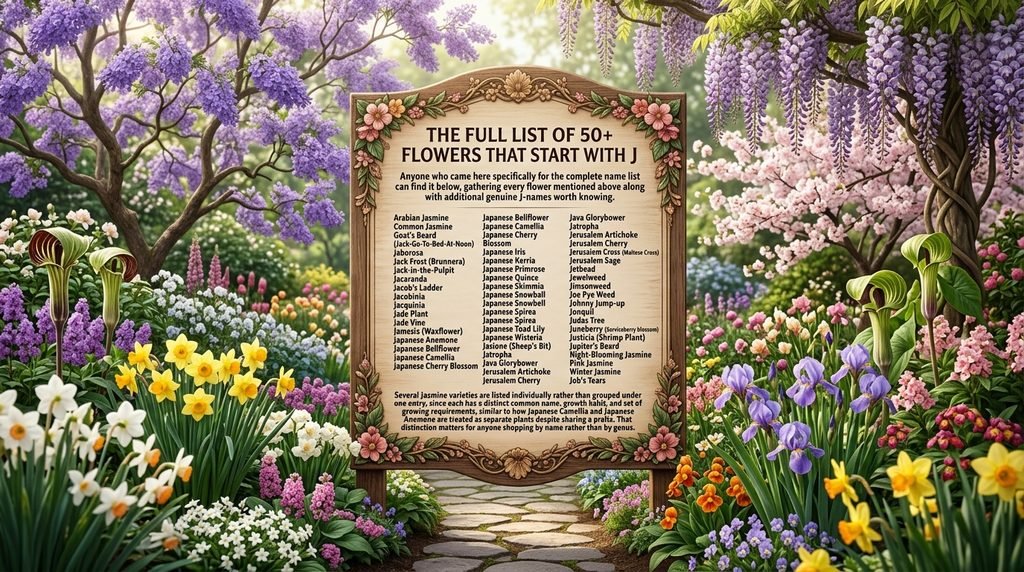
- Arabian Jasmine
- Common Jasmine
- Goat’s Beard (Jack-Go-To-Bed-At-Noon)
- Jaborosa
- Jack Frost (Brunnera)
- Jack-in-the-Pulpit
- Jacaranda
- Jacob’s Ladder
- Jacobinia
- Jacquinia
- Jade Plant
- Jade Vine
- Jamesia (Waxflower)
- Japanese Anemone
- Japanese Bellflower
- Japanese Camellia
- Japanese Cherry Blossom
- Japanese Iris
- Japanese Kerria
- Japanese Primrose
- Japanese Quince
- Japanese Skimmia
- Japanese Snowball
- Japanese Snowbell
- Japanese Spirea
- Japanese Toad Lily
- Japanese Wisteria
- Jasione (Sheep’s Bit)
- Jatropha
- Java Glorybower
- Jerusalem Artichoke
- Jerusalem Cherry
- Jerusalem Cross (Maltese Cross)
- Jerusalem Sage
- Jetbead
- Jewelweed
- Jimsonweed
- Joe Pye Weed
- Johnny Jump-up
- Jonquil
- Judas Tree
- Juneberry (Serviceberry blossom)
- Justicia (Shrimp Plant)
- Jupiter’s Beard
- Night-Blooming Jasmine
- Pink Jasmine
- Spanish Jasmine
- Star Jasmine
- Winter Jasmine
- Job’s Tears
Several Jasmine varieties are listed individually rather than grouped under one entry, since each has a distinct common name, growth habit, and set of growing requirements, similar to how Japanese Camellia and Japanese Anemone are treated as separate plants despite sharing a prefix. That distinction matters for anyone shopping by name rather than by genus.
Common Names vs. Botanical Names
Botanical names help avoid mix-ups when ordering online, especially with a letter like J where several unrelated plants share the “Japanese” or “Jasmine” prefix. This table covers the botanical names for the most frequently grown picks on this list.
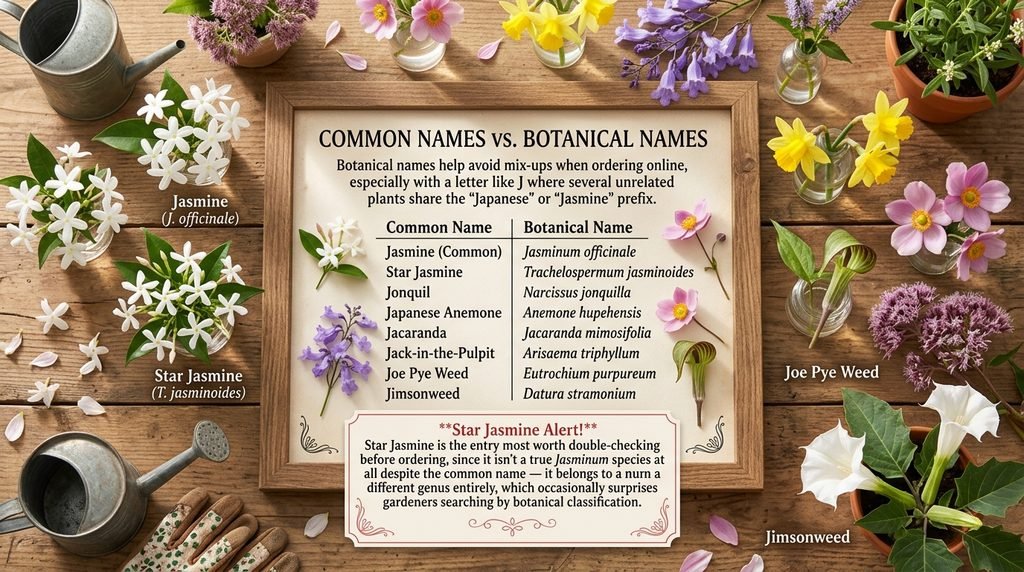
| Common Name | Botanical Name |
| Jasmine (Common) | Jasminum officinale |
| Star Jasmine | Trachelospermum jasminoides |
| Jonquil | Narcissus jonquilla |
| Japanese Anemone | Anemone hupehensis |
| Jacaranda | Jacaranda mimosifolia |
| Jack-in-the-Pulpit | Arisaema triphyllum |
| Joe Pye Weed | Eutrochium purpureum |
| Jimsonweed | Datura stramonium |
Star Jasmine is the entry most worth double-checking before ordering, since it isn’t a true Jasminum species at all despite the common name — it belongs to a different genus entirely, which occasionally surprises gardeners searching by botanical classification.
What These Flowers Have Meant to People Over Time
Flower symbolism still shapes how people choose plants for meaningful moments, even when it isn’t the primary reason for planting them. Jasmine has long been associated with love, sensuality, and purity across cultures from South Asia to the Mediterranean, and it remains a common feature in wedding garlands and religious offerings in several traditions. Jonquil, in Victorian flower language, was often tied to desire and a wish for affection returned, a meaning some sources connect to its early, eager spring bloom.
Japanese Cherry Blossom carries deep cultural weight in Japan, where it’s tied to the idea of impermanence and the beauty of a brief, fleeting moment, a concept closely linked to the tradition of hanami, or flower viewing. Jack-in-the-Pulpit has a more folkloric association in North American tradition, sometimes linked to mischief or trickery, likely inspired by its unusual hooded shape that seems to hide its true flower from view.
Bringing the J-Flowers Together
Flowers that start with J range from fragrant garden staples like Jasmine to genuinely risky plants like Jimsonweed, and that range is exactly why matching each one to the right growing conditions matters more than working through the alphabet in order. Anyone using this guide should be able to walk away with a short, realistic shortlist of J-flowers suited to their actual sun, shade, and experience level, rather than a long list of names to sort through later.
Frequently Asked Questions
What are the easiest flowers that start with J for a beginner to grow?
Johnny Jump-up, Jonquil, and Jupiter’s Beard are the most forgiving choices, tolerating average soil and inconsistent watering without much trouble.
Which J-flowers are toxic to pets?
Jimsonweed carries the most serious risk, while Jerusalem Cherry berries and Jack-in-the-Pulpit also pose real but generally less severe toxicity concerns.
How fast does Johnny Jump-up bloom from seed?
Typically within seven to nine weeks, making it one of the fastest-blooming options among flowers that start with J.
Is Jimsonweed safe to grow in a home garden?
No — every part of the plant is toxic if ingested, and it’s generally best avoided rather than managed, especially around children, pets, or livestock.
What’s the difference between Jasmine and Star Jasmine?
True Jasmine belongs to the genus Jasminum, while Star Jasmine is a different genus entirely that shares a similar fragrant, star-shaped flower and common name.
Do Japanese Wisteria vines need regular pruning to bloom well?
Yes — without routine pruning, mature vines often put energy into leaf growth instead of flowers, which is one of the most common reasons a Wisteria fails to bloom.
Which J-flowers tolerate shade best?
Jack-in-the-Pulpit, Jewelweed, and Japanese Primrose handle shaded, moist conditions better than most other flowers on this list.
Is Jade Vine difficult to grow outside the tropics?
Yes, it needs consistent warmth and high humidity to flower reliably, which makes it a poor fit for most climates outside greenhouse or tropical conditions.
What are good companion plants for Jasmine?
Roses work well due to similar sun requirements and bloom timing, while aggressive spreaders like mint should be planted well away from Jasmine’s root zone.
When should Jonquil bulbs be planted?
In early fall, several weeks before the ground freezes, so the bulbs can establish roots ahead of a spring bloom.