

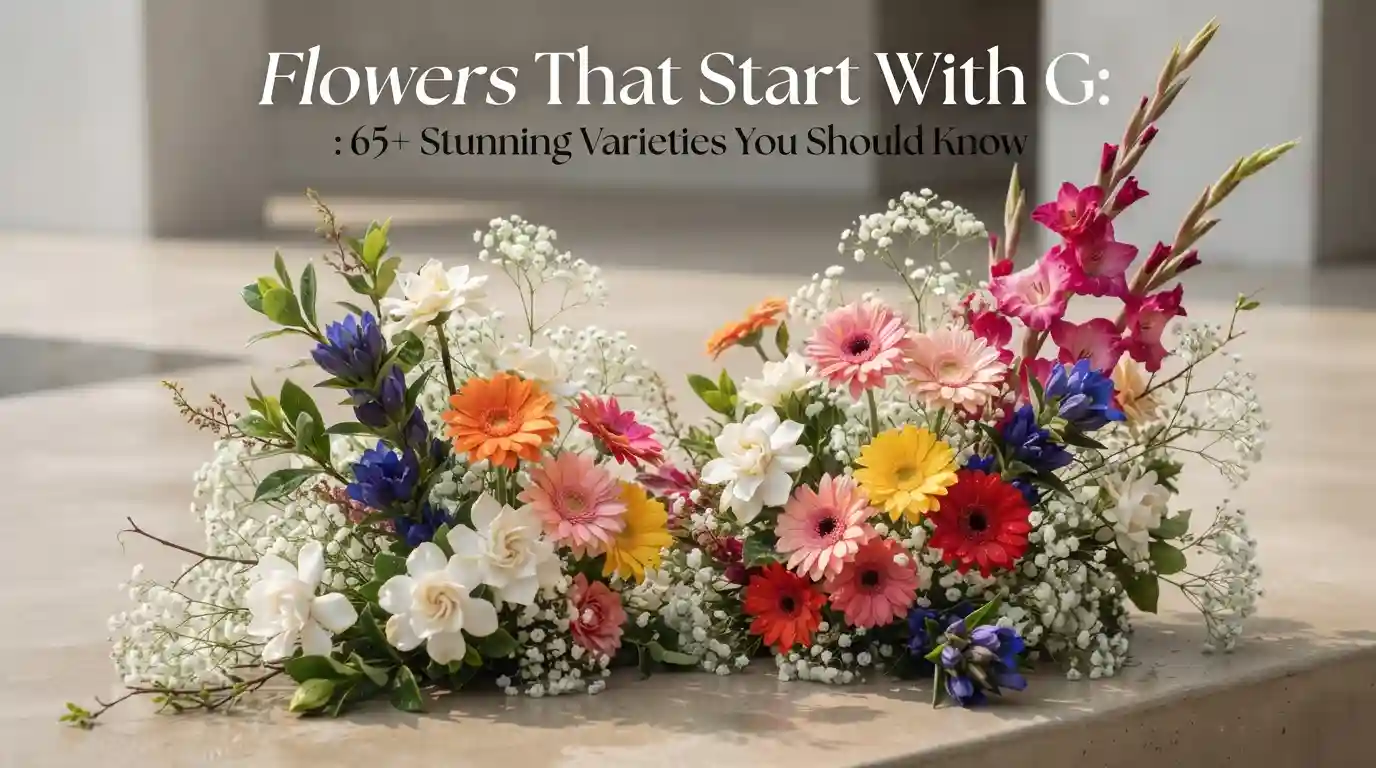
The world of flowers that start with G is much larger than a short list of familiar garden plants. It includes fragrant shrubs, colorful annuals, hardy perennials, bulbs, wildflowers, climbers, and unusual specialty plants.
Gardenia brings a strong fragrance and glossy foliage. Geraniums offer long-lasting garden color. Gladiolus creates tall flower spikes, while Gazania performs well in bright, sunny spaces. Gaillardia adds warm colors and is a popular choice for wildlife-friendly gardens.
Choosing among these plants is easier when growing conditions come first. A flower that thrives in full sun may struggle in deep shade. A tropical plant may need winter protection, while a hardy perennial can return year after year.
This guide therefore focuses on where each G flower works best, how much care it needs, and what makes it worth growing. The alphabetical index appears later, so the article remains useful as a gardening guide rather than becoming a simple name list.
10 G Flowers That Deserve a Place in the Garden
The strongest choices depend on the purpose of the planting. Some G flowers are selected for fragrance, while others are better for cut flowers, containers, pollinators, or long-lasting summer color.
The following ten varieties provide a useful starting point because each offers a different practical benefit.
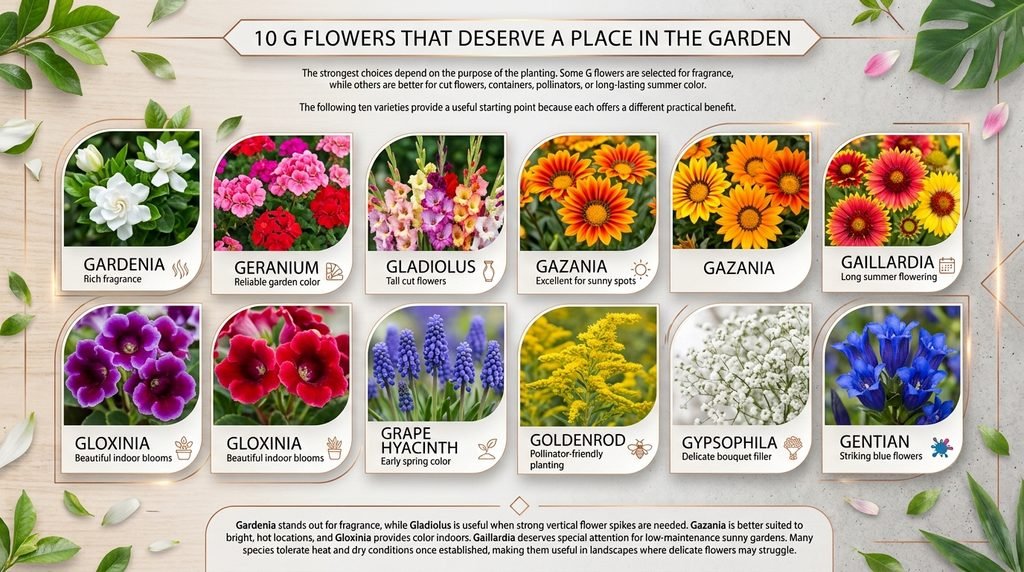
| Flower | Best Reason to Grow It |
| Gardenia | Rich fragrance |
| Geranium | Reliable garden color |
| Gladiolus | Tall cut flowers |
| Gazania | Excellent for sunny spots |
| Gaillardia | Long summer flowering |
| Gloxinia | Beautiful indoor blooms |
| Grape Hyacinth | Early spring color |
| Goldenrod | Pollinator-friendly planting |
| Gypsophila | Delicate bouquet filler |
| Gentian | Striking blue flowers |
Gardenia stands out for fragrance, while Gladiolus is useful when strong vertical flower spikes are needed. Gazania is better suited to bright, hot locations, and Gloxinia provides color indoors.
Gaillardia deserves special attention for low-maintenance sunny gardens. Many species tolerate heat and dry conditions once established, making them useful in landscapes where delicate flowers may struggle.
Full-Sun G Flowers for Bright Garden Beds
Full sun can be challenging, especially in regions with intense summer heat. The best plants for these locations need enough light to flower well and should match the available moisture.
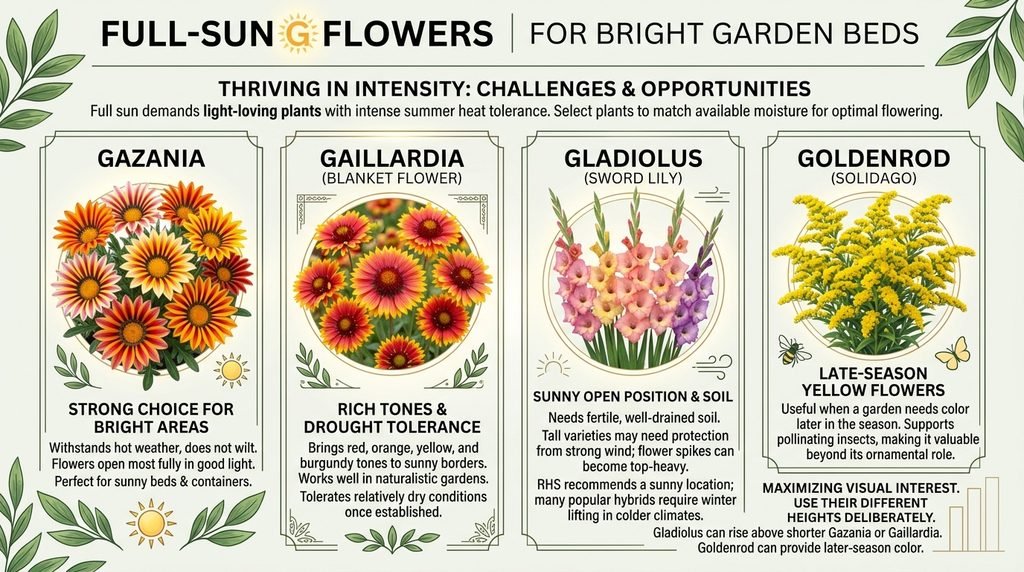
Several G flowers naturally fit sunny borders. Gazania, Gaillardia, Gladiolus, and Goldenrod can all contribute strong visual interest when placed in suitable soil.
Gazania
Its daisy-like flowers open most fully in good light, making it especially attractive in sunny beds and containers.
Gaillardia
Gaillardia brings red, orange, yellow, and burgundy tones to sunny borders. It works well in naturalistic gardens and can tolerate relatively dry conditions once established.
Gladiolus
Gladiolus needs a sunny, open position and fertile, well-drained soil. Tall varieties may also need protection from strong wind because their flower spikes can become top-heavy. The RHS recommends a sunny location and notes that many popular hybrids require winter lifting in colder climates.
Goldenrod
Goldenrod is useful when a garden needs late-season yellow flowers. It can also support pollinating insects, making it valuable beyond its ornamental role.
These plants are especially effective when their different heights are used deliberately. Gladiolus can rise above shorter Gazania or Gaillardia, while Goldenrod can provide later-season color.
G Flowers for Partial Shade and Protected Spaces
Not every flowering area receives six or more hours of direct sun. Courtyards, woodland edges, patios, and spaces beneath open tree canopies often have filtered light instead.
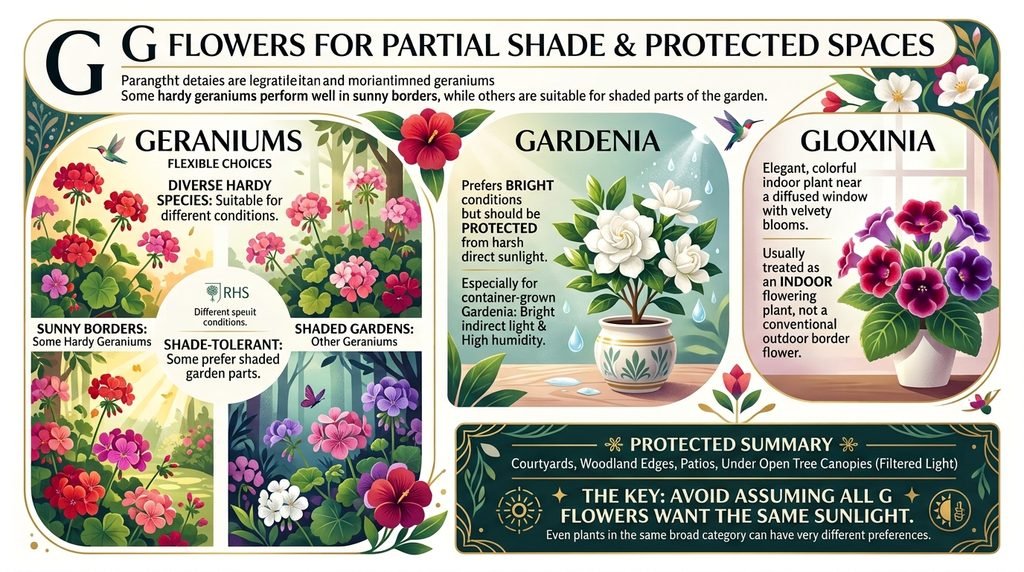
Geraniums provide one of the most flexible choices because different species suit different conditions. The RHS notes that some hardy geraniums perform well in sunny borders, while others are suitable for shaded parts of the garden.
Gardenia also prefers bright conditions but should be protected from harsh direct sunlight in many growing situations. For container-grown Gardenia, bright indirect light and high humidity are particularly important.
Gloxinia is another option, but it is usually treated as an indoor flowering plant rather than a conventional outdoor border flower.
The key is to avoid assuming that every G flower wants the same amount of sunlight. Even plants within the same broad category can have very different preferences.
The Easiest G Flowers for New Gardeners
Beginners usually benefit from flowers that tolerate ordinary garden conditions. Plants that require exact humidity, acidic soil, or careful winter protection can be rewarding, but they are not always the easiest first choices.
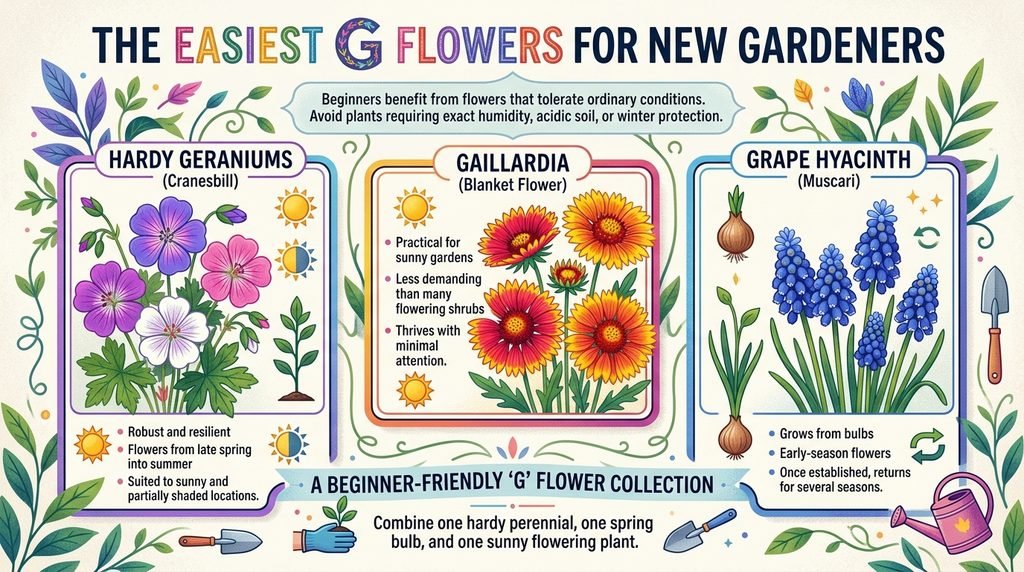
Hardy Geraniums are particularly beginner-friendly. They are generally robust, flower from late spring into summer, and come in forms suited to both sunny and partially shaded locations.
Gaillardia is another practical option for sunny gardens. It does not require the same level of attention as more demanding flowering shrubs.
Grape Hyacinth can also be useful for beginners because it grows from bulbs and provides early-season flowers. Once established in an appropriate location, it can return for several seasons.
A beginner-friendly G flower collection could therefore combine one hardy perennial, one spring bulb, and one sunny flowering plant.
Fragrant G Flowers for Patios and Entryways
Fragrance works best when flowers are planted close to places where people actually spend time. A scented plant at the far end of a large garden may look beautiful but have little sensory impact.
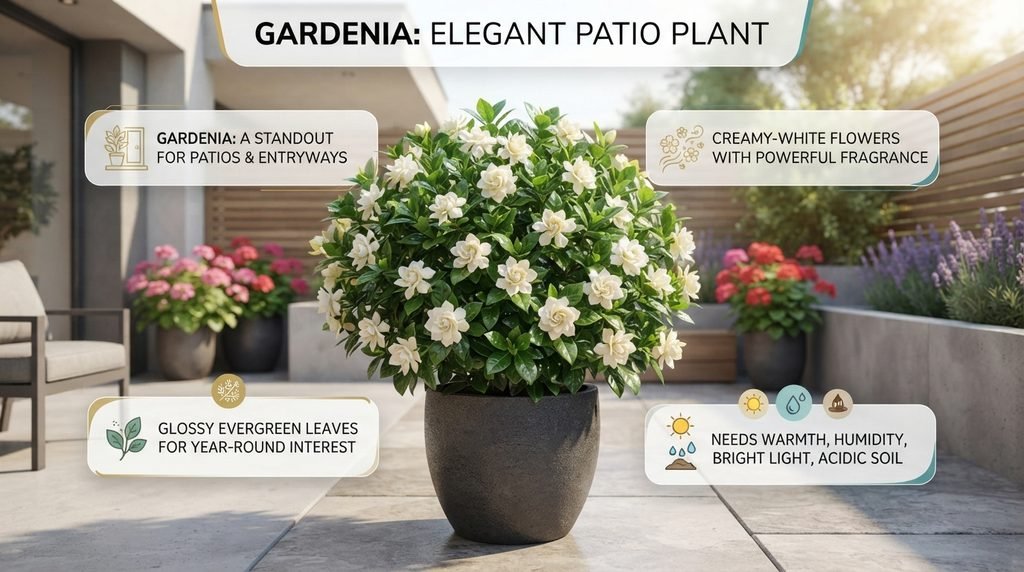
Gardenia is the standout choice in this group. Its creamy-white flowers have a powerful fragrance, and its glossy evergreen leaves provide visual interest outside the flowering period. The RHS describes Gardenia as a tender shrub that needs warmth, humidity, bright light, and acidic growing media.
Some Geraniums, especially scented-leaved types, can also contribute fragrance, although their scent is very different from that of gardenia.
For a small patio, Gardenia can be grown in a container where soil acidity, moisture, and temperature are easier to control. However, it is not the best choice for gardeners seeking a completely hands-off plant.
G Flowers That Make Excellent Cut Flowers
Cut flowers need more than attractive blooms. Strong stems, useful flower shapes, and a reasonable vase life can make a variety much more valuable for arrangements.
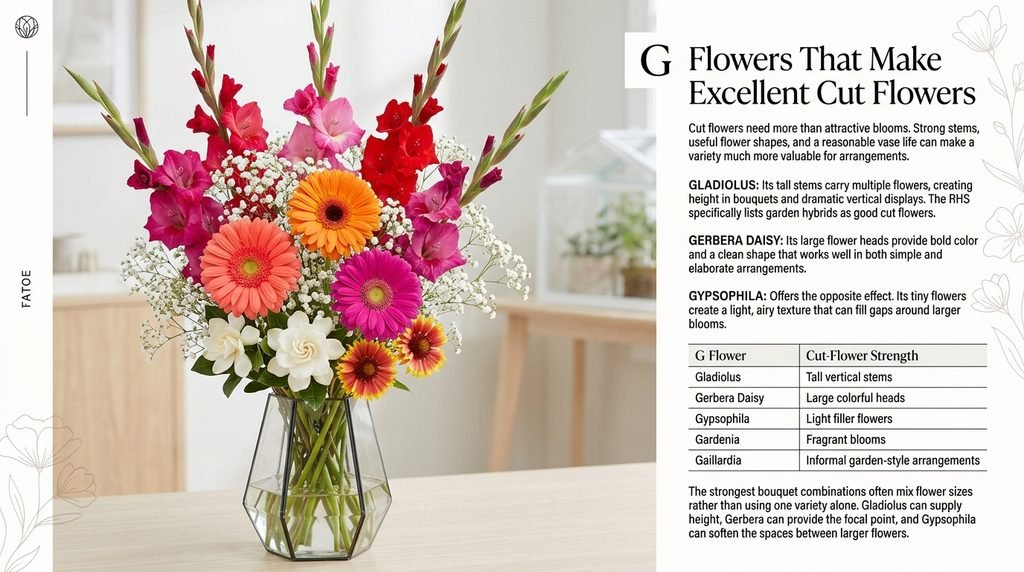
Gladiolus is one of the strongest G choices for this purpose. Its tall stems carry multiple flowers, creating height in bouquets and dramatic vertical displays. The RHS specifically lists garden hybrids as good cut flowers.
Gerbera Daisy is another obvious choice. Its large flower heads provide bold color and a clean shape that works well in both simple and elaborate arrangements.
Gypsophila offers the opposite effect. Its tiny flowers create a light, airy texture that can fill gaps around larger blooms.
| G Flower | Cut-Flower Strength |
| Gladiolus | Tall vertical stems |
| Gerbera Daisy | Large colorful heads |
| Gypsophila | Light filler flowers |
| Gardenia | Fragrant blooms |
| Gaillardia | Informal garden-style arrangements |
The strongest bouquet combinations often mix flower sizes rather than using one variety alone. Gladiolus can supply height, Gerbera can provide the focal point, and Gypsophila can soften the spaces between larger flowers.
G Flowers for Pollinator-Friendly Gardens
A flower garden can provide valuable feeding opportunities for bees and other insects. The best approach is to grow several flower shapes and flowering periods instead of depending on a single plant.
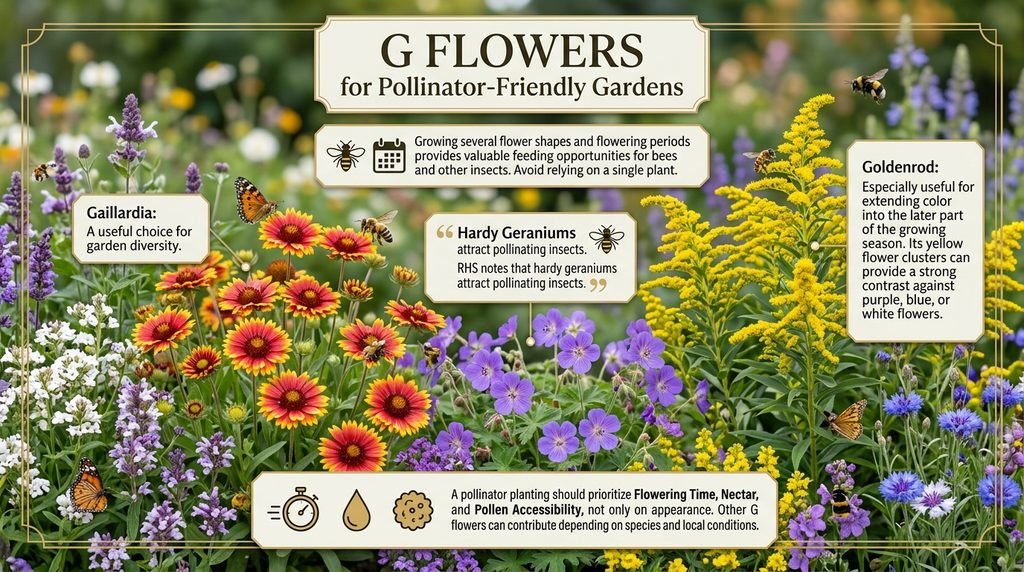
Gaillardia and Goldenrod are useful choices for this type of garden. Hardy Geraniums can also attract pollinating insects, while other G flowers can contribute depending on species and local conditions. The RHS specifically notes that hardy geraniums attract pollinating insects.
Goldenrod is especially useful for extending color into the later part of the growing season. Its yellow flower clusters can also provide a strong contrast against purple, blue, or white flowers.
A pollinator planting should avoid relying only on appearance. Flowering time and accessibility of nectar and pollen are equally important.
G Flowers for Containers and Small Spaces
Containers are useful when garden space is limited. They also allow gardeners to move tender plants indoors or into sheltered areas when temperatures become unsuitable.
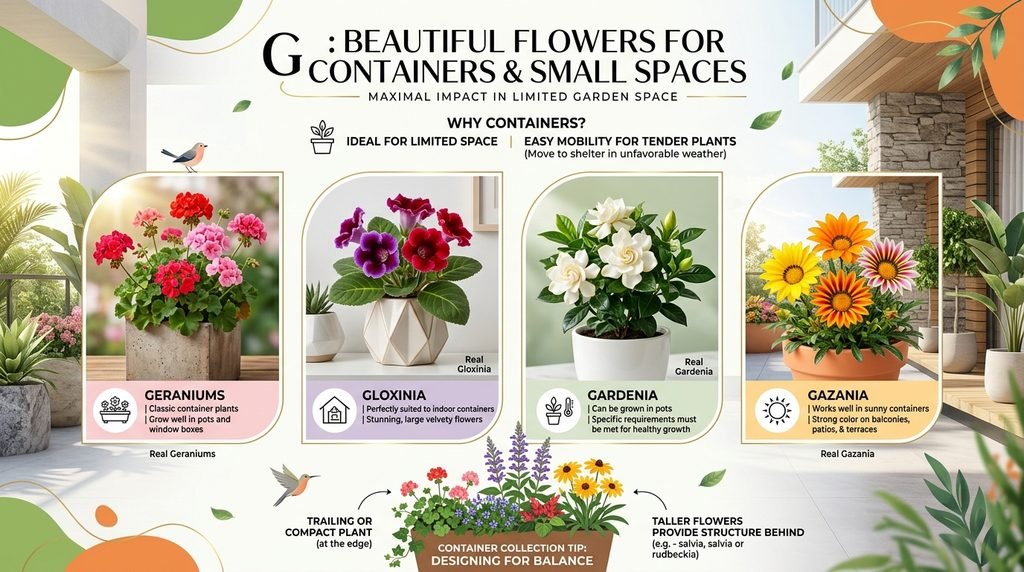
Geraniums are classic container plants because many forms grow well in pots and window boxes. Gloxinia is naturally suited to indoor containers, while Gardenia can also be grown in pots when its specific requirements are met.
Gazania works particularly well in sunny containers. Its compact growth and bright flowers can create strong color on balconies, patios, and small terraces.
For a container collection, different heights can create a more balanced display. A trailing or compact plant can sit near the edge, while taller flowers provide structure behind it.
G Flowers That Bloom Early in the Season
Spring gardens benefit from flowers that appear before summer borders reach their full size. Bulbs are especially useful because they can complete much of their flowering cycle before larger perennials dominate the garden.
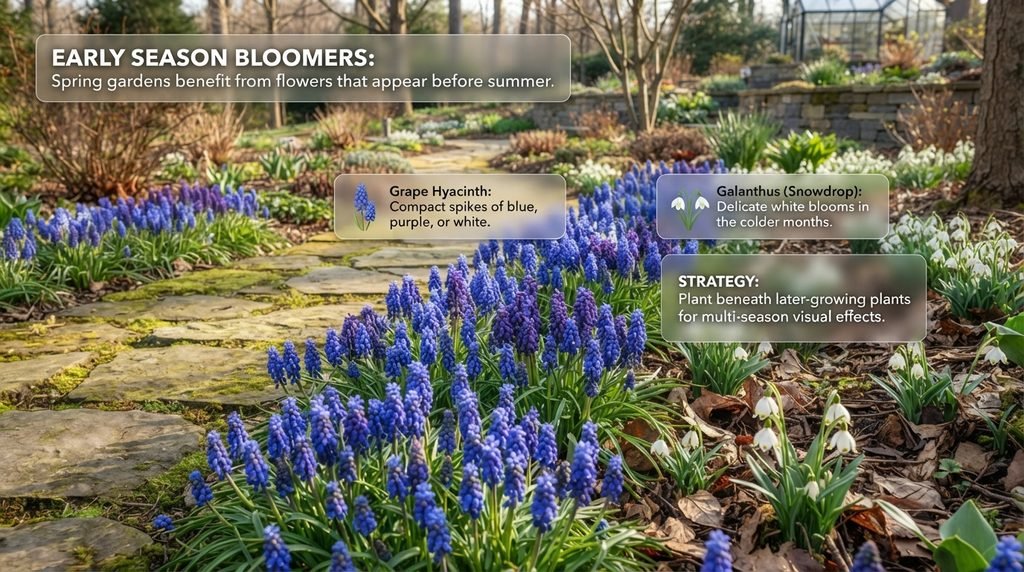
Grape Hyacinth is one of the best-known early G flowers. Its compact spikes of blue, purple, or white flowers work well around paths, borders, and rock gardens.
Galanthus, commonly called Snowdrop, is another early-season choice. It produces small flowers during the colder part of the year and works well in woodland-style settings.
These early flowers can be planted beneath or around later-growing plants. That approach allows the same area of soil to provide different visual effects as the year progresses.
When to Choose a G Flower That Needs More Care
Some G flowers should not be rejected simply because they are demanding. Instead, they should be matched with gardeners who can provide the conditions they require.
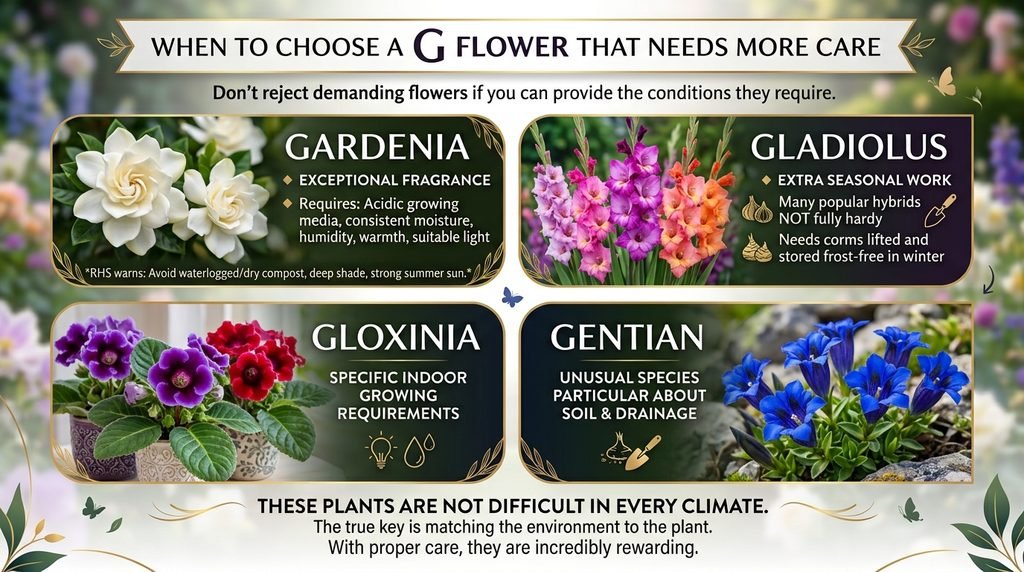
Gardenia is a good example. Its fragrance is exceptional, but it needs acidic growing media, consistent moisture, humidity, warmth, and suitable light. The RHS warns against both waterlogged and overly dry compost, deep shade, and strong summer sun.
Gladiolus can also require extra seasonal work. Many popular hybrids are not fully hardy and may need their corms lifted and stored in a frost-free place during winter.
Gloxinia has its own indoor growing requirements, while unusual Gentian species can be particular about soil and drainage.
These plants are not necessarily difficult in every climate. The real issue is whether the growing environment matches the plant.
A Practical G-Flower Selection Guide
Choosing the right flower becomes easier when the garden’s main goal is identified first. A small sunny balcony needs a different plant from a shaded perennial border or a fragrant patio.
The following guide connects common gardening goals with useful G flowers.
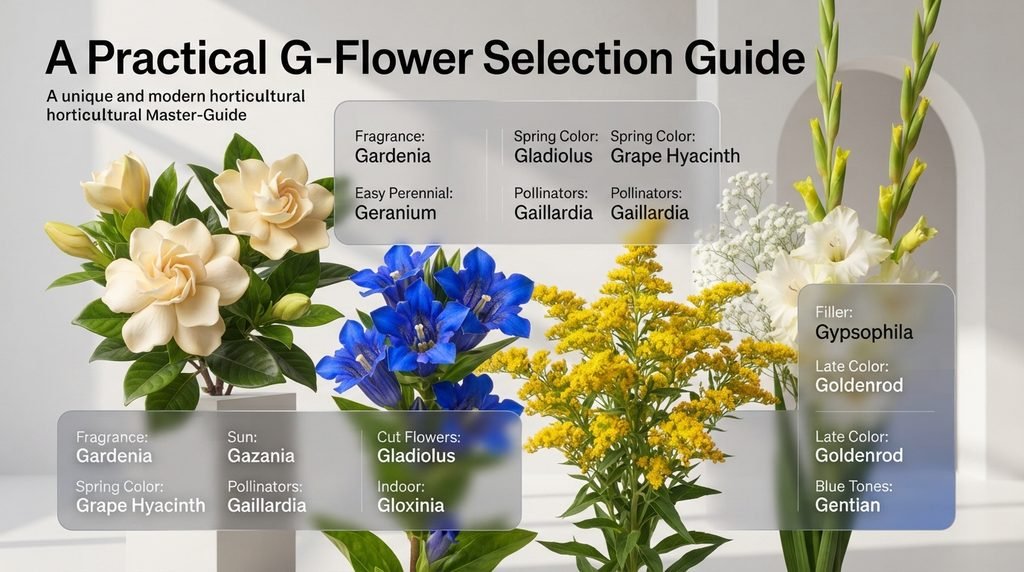
| Garden Goal | Strong G Choice | Why |
| Fragrance | Gardenia | Powerful scented blooms |
| Sunny containers | Gazania | Handles bright conditions |
| Tall cut flowers | Gladiolus | Long flower spikes |
| Easy perennial | Geranium | Adaptable and reliable |
| Spring color | Grape Hyacinth | Early seasonal blooms |
| Pollinator planting | Gaillardia | Useful flowering perennial |
| Indoor flowers | Gloxinia | Attractive potted blooms |
| Bouquet filler | Gypsophila | Fine-textured flowers |
| Late-season color | Goldenrod | Bright yellow clusters |
| Blue flowers | Gentian | Intense blue tones |
The table shows why there is no single “best” G flower. Geranium may be the best choice for an easy perennial, while Gardenia is better for fragrance and Gladiolus for cut flowers.
Selecting by purpose also reduces the chance of placing a plant in conditions it cannot handle.
Companion Planting: G Flowers That Work Well Together
Companion planting should begin with similar growing requirements. A sun-loving plant should not be paired simply because of color with a flower that needs deep shade.
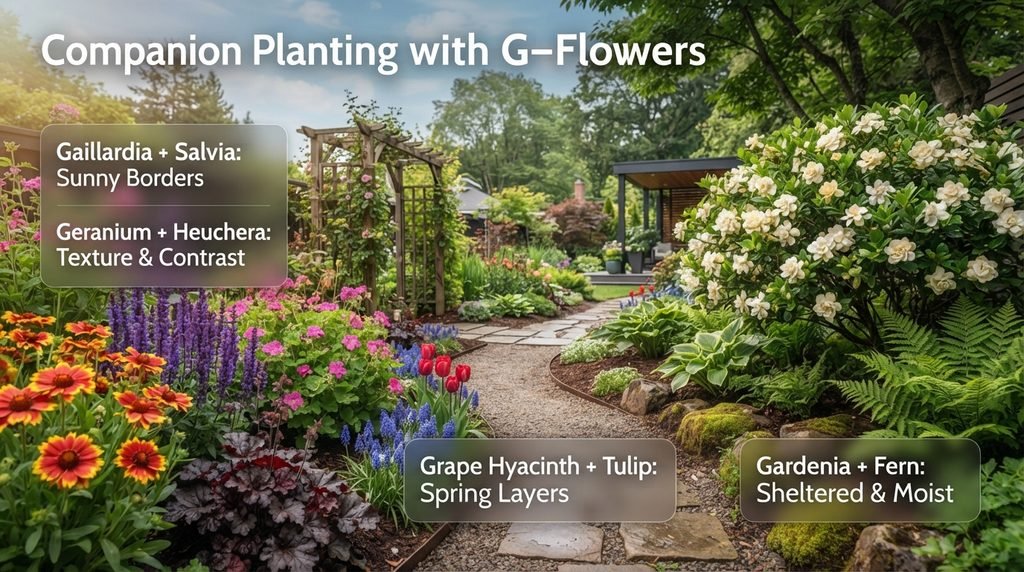
Geranium, Gaillardia, and Goldenrod can create an attractive mixed border when their light and soil requirements are compatible. Grape Hyacinth can provide an earlier layer of color before taller summer plants become dominant.
Gardenia needs more specialized conditions, so it should not automatically be grouped with dry-soil plants such as Gaillardia. Gardenia prefers acidic, consistently moist growing media and high humidity.
| G Flower | Companion | Main Benefit |
| Gaillardia | Salvia | Similar sunny conditions |
| Geranium | Heuchera | Good border contrast |
| Gladiolus | Marigold | Tall and low layers |
| Gazania | Lavender | Sunny, dry-style planting |
| Grape Hyacinth | Tulip | Early spring combination |
| Goldenrod | Aster | Strong late-season display |
| Gypsophila | Rose | Softens larger blooms |
| Gardenia | Fern | Similar preference for sheltered conditions |
The strongest pairings combine plants with compatible needs rather than forcing unrelated species into the same bed. Goldenrod and Aster, for example, can create a strong late-season combination.
Gardenia is the exception that needs more careful planning. Its soil and moisture requirements make it better suited to a dedicated planting area or controlled container.
A Seasonal Care Plan for G Flowers
G flowers do not all follow the same growing calendar. Some begin flowering in early spring, while others reach their peak during summer or continue into autumn. Planning around these differences can keep the garden colorful for much longer.
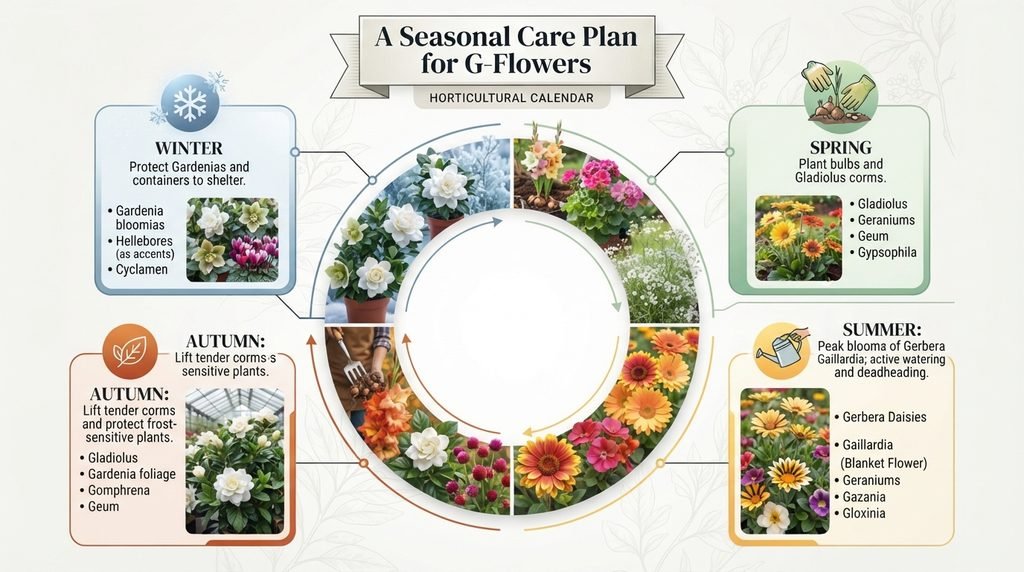
Gladiolus, for example, is generally planted in spring for summer flowering, while Grape Hyacinth provides earlier seasonal color. Hardy Geraniums usually flower from late spring into summer.
The calendar below gives a practical framework. Local temperatures should always take priority over fixed dates.
| Month | Main G-Flower Tasks |
| January | Protect tender Gardenia, Gerbera, and tropical G flowers |
| February | Plan spring bulb planting and check stored Gladiolus corms |
| March | Plant suitable Geraniums and early G bulbs |
| April | Plant Gladiolus corms after severe frost risk |
| May | Add Gazania, Gerbera, and other warm-season plants |
| June | Water actively growing plants and remove faded flowers |
| July | Enjoy peak Gladiolus, Gerbera, Gaillardia, and Geranium blooms |
| August | Continue watering, deadheading, and pest checks |
| September | Collect suitable seeds and reduce care for fading plants |
| October | Lift tender Gladiolus and protect frost-sensitive plants |
| November | Move tender container plants into sheltered areas |
| December | Keep dormant or protected plants cool and avoid excess watering |
The most important seasonal decision concerns frost-sensitive varieties. Many Gladiolus hybrids need lifting and dry winter storage in colder areas, while hardy types can remain outdoors in suitable soil.
Gardenias need a different winter strategy. They prefer warmth, humidity, and bright light, but they should be protected from frost and strong direct sunlight.
USDA Hardiness Zones: Where G Flowers Fit Best
Hardiness zones are useful for understanding winter survival, but they should not be treated as the only factor. Soil, summer heat, humidity, rainfall, and exposure can change how a plant performs.
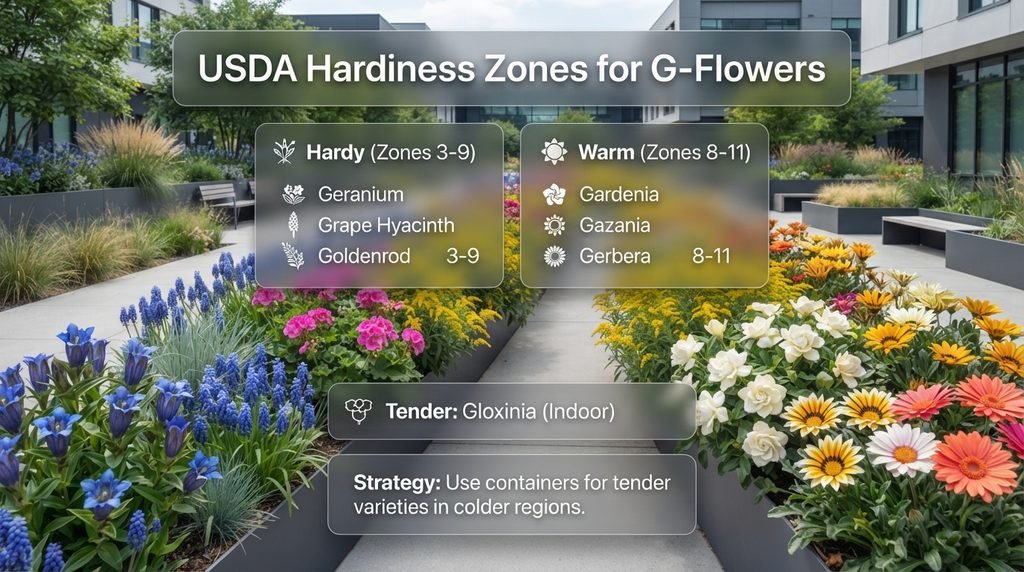
This is especially important with G flowers because the group includes both hardy perennials and tropical plants. Geraniums, for example, include many hardy species, while tender forms require more protection.
| G Flower | General Hardiness Tendency | Climate Preference |
| Hardy Geranium | Zones 3–9, depending on species | Cool to moderate climates |
| Gardenia | Zones 8–11 for suitable outdoor cultivars | Warm, humid conditions |
| Gladiolus | Varies widely by species | Mild to warm summers |
| Gaillardia | Zones 3–10, depending on species | Sunny and relatively dry |
| Gazania | Usually grown as an annual outside warm zones | Warm, sunny climates |
| Gerbera Daisy | Tender in many climates | Warm conditions |
| Grape Hyacinth | Zones 3–9 | Cool to moderate climates |
| Goldenrod | Often hardy across broad regions | Temperate climates |
| Gentian | Varies by species | Cool, well-drained sites |
| Gloxinia | Tender | Warm indoor conditions |
These ranges are intentionally broad because individual species and cultivars can behave differently. Geranium is the clearest example: some species tolerate shade and cold, while tender forms need protected conditions.
Gardeners in colder areas can still grow tender G flowers by using containers. This allows plants such as Gardenia or Gerbera to be moved into protected spaces when temperatures fall.
The Biggest Beginner Mistakes With G Flowers
A good garden does not require perfect technique. It requires the right plant in the right place.
Most problems with G flowers come from a few repeated mistakes. Understanding them before planting can save time and reduce plant loss.
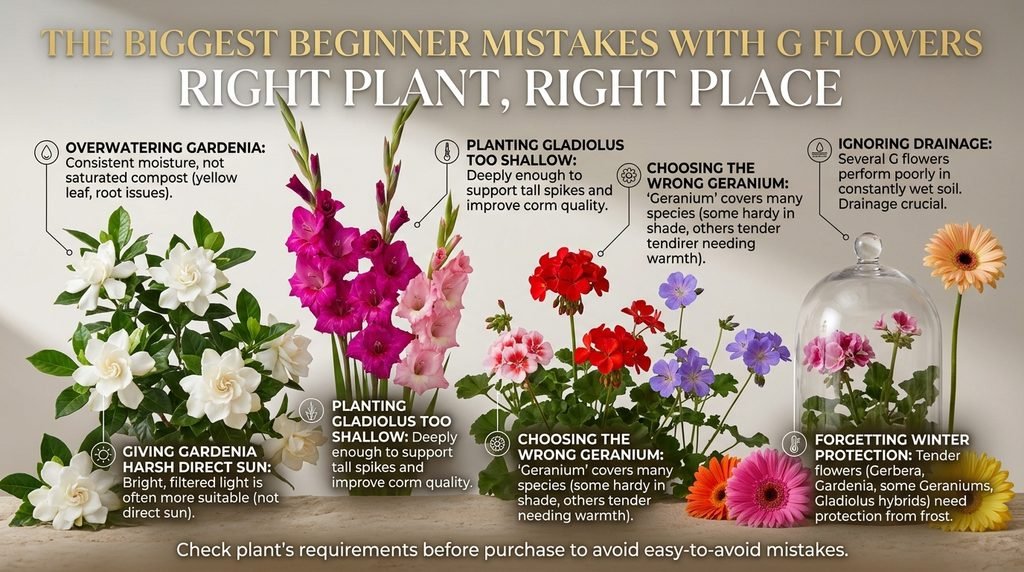
Overwatering Gardenia
Gardenia needs consistent moisture, but its compost should not remain saturated. Poor watering can contribute to yellow leaves, root problems, and weak growth.
Giving Gardenia Harsh Direct Sun
Gardenia needs bright light but can suffer from strong direct sunlight. A sheltered position with bright, filtered light is often more suitable.
Planting Gladiolus Too Shallow
Large Gladiolus corms should be planted deeply enough to support the tall flower spikes. Shallow planting can also reduce the quality of the new corms.
Choosing the Wrong Geranium
“Geranium” covers many different plants. Some hardy species tolerate shade, while tender forms need warmer and more sheltered conditions.
Ignoring Drainage
Several G flowers perform poorly in constantly wet soil. Good drainage is especially important for bulbs, corms, and plants suited to sunny conditions.
Forgetting Winter Protection
Tender G flowers should not be treated like hardy perennials. Gerbera, Gardenia, some Geraniums, and many Gladiolus hybrids may require protection depending on climate.
These mistakes are easy to avoid when the plant’s actual growing requirements are checked before purchase.
Which G Flowers Are Easy to Find and Which Are Specialty Plants?
Availability can influence the final choice just as much as appearance. Common bedding plants are usually easier to find at ordinary garden centers, while unusual species may require specialist nurseries or online suppliers.
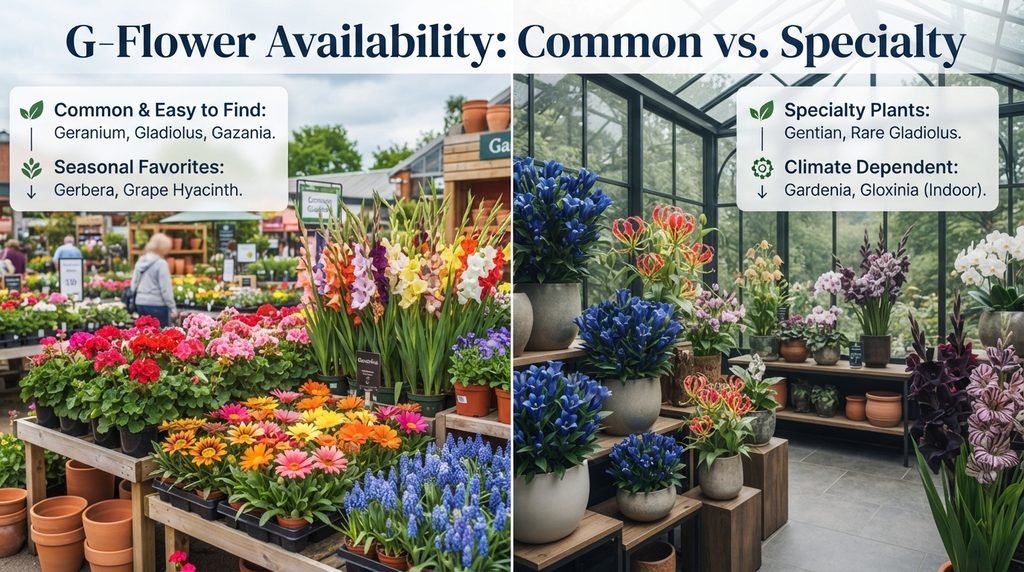
Geraniums are among the easiest G plants to source. Hardy varieties are commonly available as container-grown plants, while specialist nurseries offer a much wider selection.
Gladiolus corms are also widely available during the planting season. Less common species are more likely to appear through specialist suppliers.
| Availability | Examples |
| Common | Geranium, Gladiolus, Gazania |
| Often seasonal | Gerbera, Grape Hyacinth, Gaillardia |
| Usually a specialist for unusual varieties | Gentian, specialty Gladiolus |
| More climate-dependent | Gardenia, tropical G flowers |
| Mostly indoor or protected | Gloxinia |
Common plants are often the better choice for beginners because replacements and basic care information are easier to find.
Specialty plants become more appealing when the garden has a specific climate, soil type, or growing structure that can support them.
If There Is Room for Only Three G Flowers
A small garden does not need a huge plant collection. Three carefully chosen G flowers can provide different heights, flowering periods, and textures.
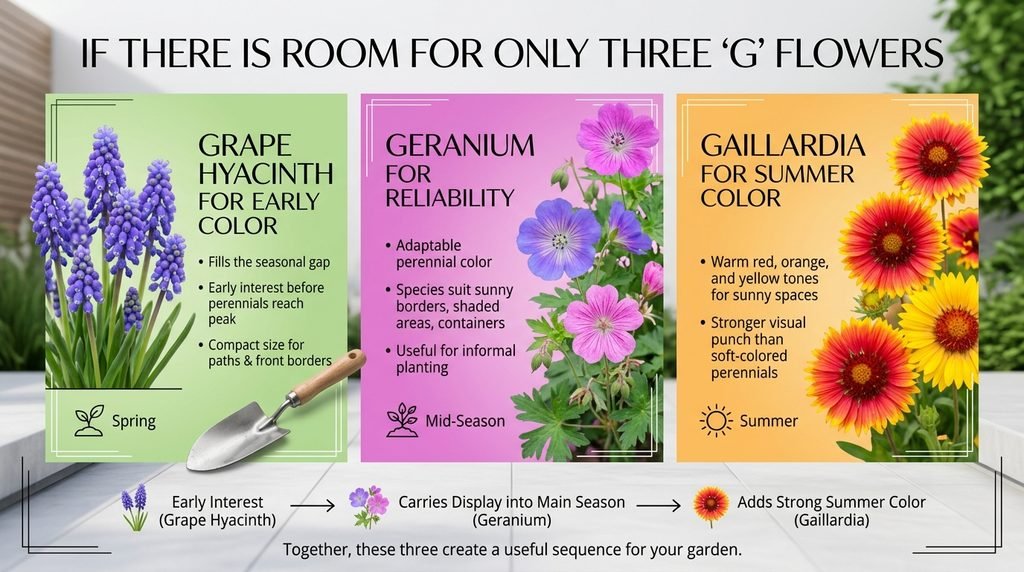
For a general-purpose garden, the strongest combination is Geranium, Gaillardia, and Grape Hyacinth.
Geranium for Reliability
Hardy Geraniums provide adaptable perennial color. Different species can suit sunny borders, shaded areas, containers, or informal planting.
Gaillardia for Summer Color
Gaillardia brings warm red, orange, and yellow tones to sunny spaces. It adds a stronger visual punch than many soft-colored perennials.
Grape Hyacinth for Early Color
Grape Hyacinth fills the seasonal gap before many summer perennials reach their peak. Its compact size also makes it useful around paths and the front of borders.
Together, these three create a useful sequence. Grape Hyacinth provides early interest, Geranium carries the display into the main season, and Gaillardia adds strong summer color.
G Flowers and Garden Safety
Safety deserves attention because “flower” does not automatically mean harmless. Some ornamental plants can cause problems if eaten by pets or people.
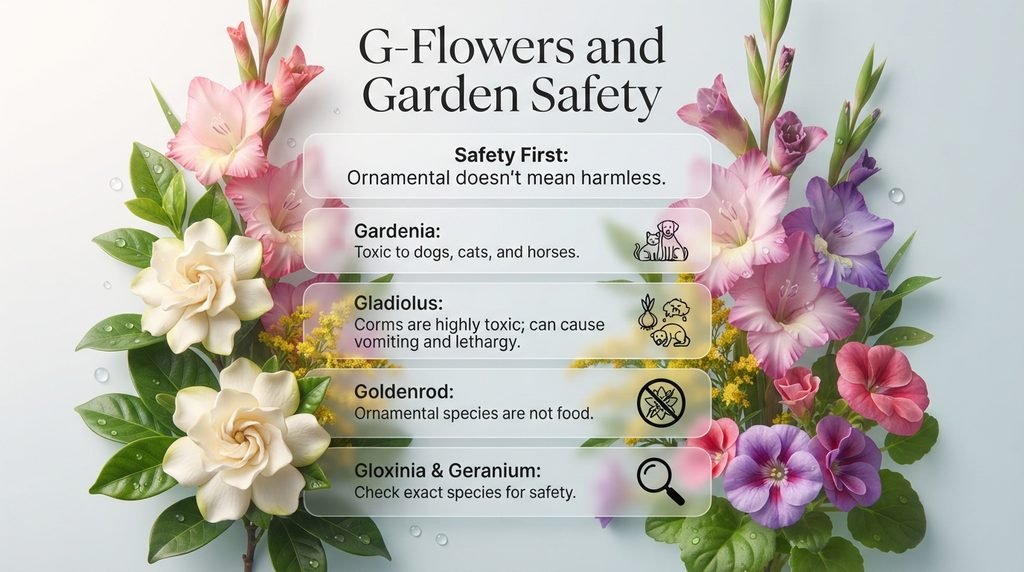
Gardenia, for example, is listed by the ASPCA as toxic to dogs, cats, and horses, with ingestion potentially causing vomiting or diarrhea.
Gladiolus is also listed as toxic to dogs, cats, and horses. The ASPCA identifies the corms as containing the highest concentration of the toxic principle and reports signs such as drooling, vomiting, diarrhea, and lethargy after ingestion.
Because common names can cover multiple species, safety should be checked for the exact plant being grown.
| G Flower | Safety Point |
| Gardenia | Toxic to dogs, cats, and horses if eaten |
| Gladiola | Toxic to dogs, cats, and horses |
| Gloxinia | Species-specific safety should be checked |
| Geranium | Exact species matters |
| Gentian | Check the exact species before consumption |
| Goldenrod | Avoid treating ornamental plants as food |
Children and pets should be discouraged from chewing ornamental plants. Any suspected ingestion should be treated seriously, with professional veterinary or medical advice sought when appropriate.
G Flowers by Color
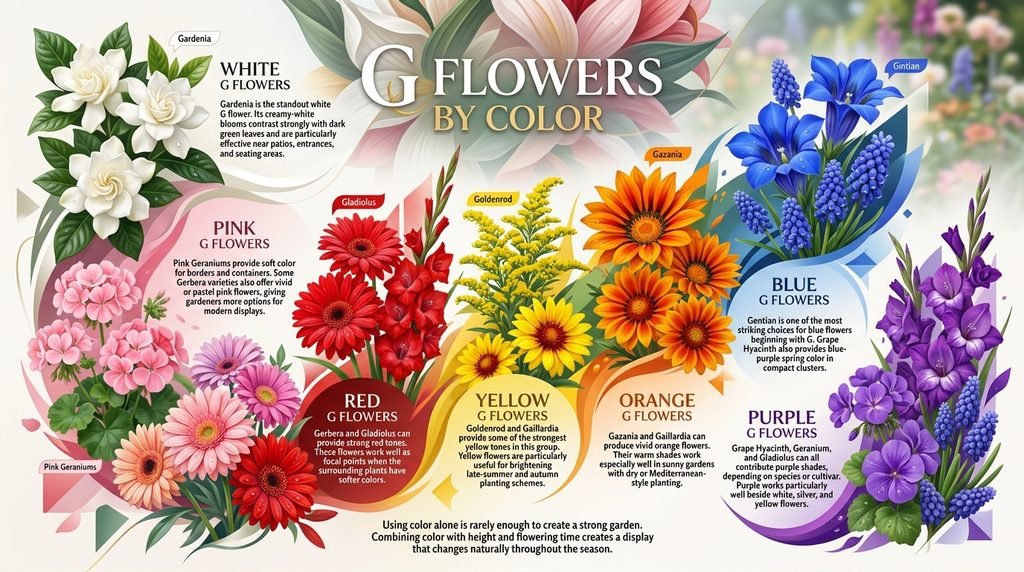
White G Flowers
Gardenia is the standout white G flower. Its creamy-white blooms contrast strongly with dark green leaves and are particularly effective near patios, entrances, and seating areas.
Pink G Flowers
Pink Geraniums provide soft color for borders and containers. Some Gerbera varieties also offer vivid or pastel pink flowers, giving gardeners more options for modern displays.
Red G Flowers
Gerbera and Gladiolus can provide strong red tones. These flowers work well as focal points when the surrounding plants have softer colors.
Yellow G Flowers
Goldenrod and Gaillardia provide some of the strongest yellow tones in this group. Yellow flowers are particularly useful for brightening late-summer and autumn planting schemes.
Orange G Flowers
Gazania and Gaillardia can produce vivid orange flowers. Their warm shades work especially well in sunny gardens with dry or Mediterranean-style planting.
Blue G Flowers
Gentian is one of the most striking choices for blue flowers beginning with G. Grape Hyacinth also provides blue-purple spring color in compact clusters.
Purple G Flowers
Grape Hyacinth, Geranium, and Gladiolus can all contribute purple shades, depending on species or cultivar. Purple works particularly well beside white, silver, and yellow flowers.
Using color alone is rarely enough to create a strong garden. Combining color with height and flowering time creates a display that changes naturally throughout the season.
What Makes G Flowers So Useful in Garden Design?
The biggest advantage of this group is variety. G flowers can provide almost every major garden role, from low spring bulbs to tall summer cut flowers.
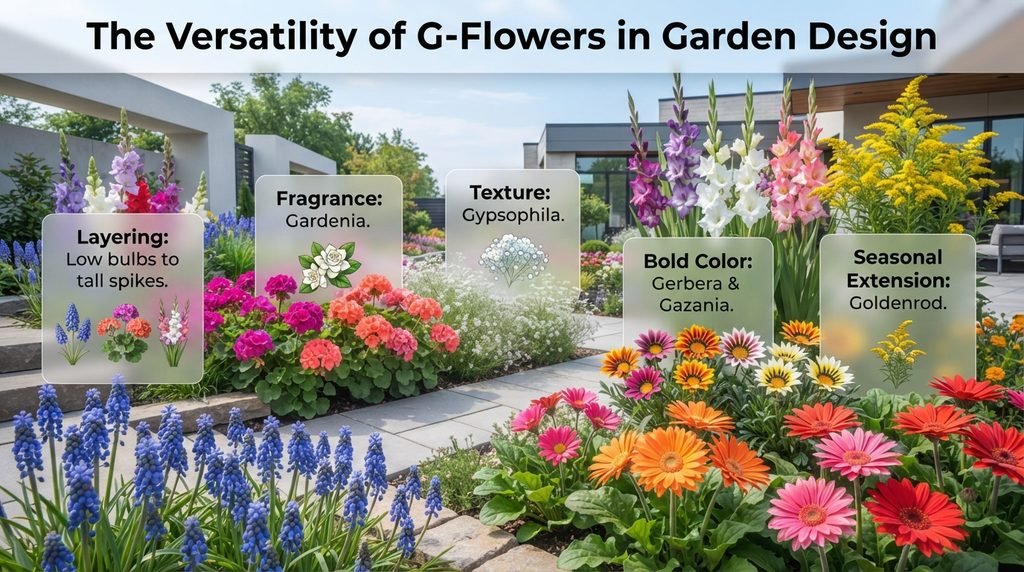
A single border can use Grape Hyacinth near the front, Geranium in the middle, and Gladiolus farther back. A sunny container can instead combine Gazania with compact foliage.
Gardenia offers fragrance rather than mass color. Goldenrod extends seasonal interest. Gypsophila provides a delicate texture. Gerbera supplies bold flower heads.
This range makes the letter G particularly useful for themed gardens. The flowers do not have to look alike to work together.
Conclusion
Flowers that start with G offer far more variety than a simple alphabetical list suggests. The group includes fragrant shrubs, hardy perennials, spring bulbs, colorful annuals, tender houseplants, and striking cut flowers.
For sunny gardens, Gaillardia, Gazania, Gladiolus, and Goldenrod can provide strong color. For earlier seasonal interest, Grape Hyacinth is a useful choice. Gardeners looking for adaptable plants can turn to geraniums, while Gardenia suits warm conditions where fragrance is a priority.
The best choice depends on growing space, sunlight, soil, climate, and the level of care available. Matching those conditions with the right plant usually matters more than choosing a flower simply because its name begins with G.
With thoughtful selection, flowers that start with G can add color, fragrance, height, texture, and seasonal interest to almost any suitable garden.
Frequently Asked Questions About Flowers That Start With G
1. What are some popular flowers that start with G?
Popular choices include Geranium, Gardenia, Gladiolus, Gaillardia, Gazania, Gerbera, Grape Hyacinth, Goldenrod, Gentian, and Gypsophila. These plants cover many different growing styles, from hardy garden perennials to tender container plants.
The best option depends on the available sunlight, climate, soil, and desired flowering season.
2. Which G flower is easiest for beginners?
Hardy Geraniums are among the most beginner-friendly choices. Wide varieties tolerate a range of conditions and can return year after year when planted in a suitable location.
Gaillardia is another good option for sunny gardens because it generally handles heat and relatively dry conditions well.
3. Which flowers that start with G grow well in full sun?
Several G flowers prefer strong sunlight. Gaillardia, Gazania, Gladiolus, Goldenrod, and many Gerbera varieties can perform well in sunny locations when their soil and moisture needs are also met.
Full sun usually means at least several hours of direct light each day, although exact requirements vary by plant.
4. Which G flowers can grow in shade?
Hardy Geraniums provide some of the better options for partially shaded areas. Certain species can handle woodland-style conditions better than sun-loving flowers such as Gazania.
Shade tolerance varies considerably, so the requirements of the exact species or cultivar should be checked before planting.
5. What is the most fragrant flower that starts with G?
Gardenia is one of the strongest fragrance choices in this group. Its white flowers produce a rich scent that makes the plant especially attractive near patios, windows, and outdoor seating areas.
Gardenia does require more careful growing conditions than many hardy perennials.
6. Which G flower blooms in spring?
Grape Hyacinth is a notable spring-flowering choice. Its small, rounded flower clusters provide early color and work especially well along borders, paths, rock gardens, and beneath larger plants.
Some other G flowers may also bloom in spring, depending on species and climate.
7. Which flowers that start with G are good for bouquets?
Gladiolus and Gerbera are especially useful for cut-flower arrangements. Gladiolus produces tall flower spikes, while Gerbera offers large, daisy-like flower heads in many strong colors.
Gypsophila can also add a light, airy texture around larger flowers.
8. Are Gardenias difficult to grow?
Gardenias can be more demanding than many common garden flowers. They prefer suitable warmth, bright conditions, adequate humidity, acidic growing conditions, and consistent moisture without waterlogged soil.
When those needs are met, Gardenia can reward the gardener with glossy foliage and highly fragrant flowers.
9. Are Gladiolus flowers annuals or perennials?
Gladiolus can behave as perennials in climates where their underground structures survive winter. In colder areas, many gardeners lift the corms before freezing temperatures and store them for the following season.
This makes Gladiolus a flexible choice, but winter care depends strongly on local conditions.
10. Are flowers that start with G safe for pets?
Not all of them are safe. The ASPCA lists Gardenia and Gladiolus as toxic to dogs, cats, and horses when ingested.
Because plant toxicity can vary by species, pets should be prevented from chewing unfamiliar ornamental plants.
11. Which G flowers attract pollinators?
Many flowering plants beginning with G can provide resources for pollinators. Gaillardia, Goldenrod, Geranium, and other nectar-producing flowers can be useful additions to wildlife-friendly gardens.
Flower shape, bloom period, local insect populations, and pesticide use all influence their value to pollinators.
12. Which G flower is best for a small garden?
Grape Hyacinth is particularly useful where space is limited because it remains relatively compact. Compact Geranium cultivars can also work well in containers and small borders.
For small spaces, plant height and spread should be considered as carefully as flower color.
13. Can G flowers grow in containers?
Yes. Several can adapt well to containers when the pot, soil, drainage, light, and watering routine match their needs.
Gerbera, Geranium, Gazania, Gardenia, and Gladiolus can all be grown in containers under suitable conditions, although their care requirements differ.
14. Which G flower has blue blooms?
Gentian and Grape Hyacinth are two notable choices. Gentian can produce intense blue flowers, while Grape Hyacinth creates clusters of blue to blue-purple blooms.
Their growing requirements are quite different, so they should not be treated as interchangeable plants.
15. What are the best flowers that start with G for a colorful garden?
A mixed planting can include Gaillardia for warm tones, Geranium for long-lasting border color, Gladiolus for height, Grape Hyacinth for spring interest, and Gerbera for bold flower heads.
Combining different bloom periods creates a more continuous display than planting wide varieties that flower at the same time.